Early lifeFranz Joseph was born in the Schönbrunn Palace in Vienna, the oldest son of Archduke Franz Karl (the younger son of Holy Roman Emperor Francis II), and his wife Princess Sophie of Bavaria.
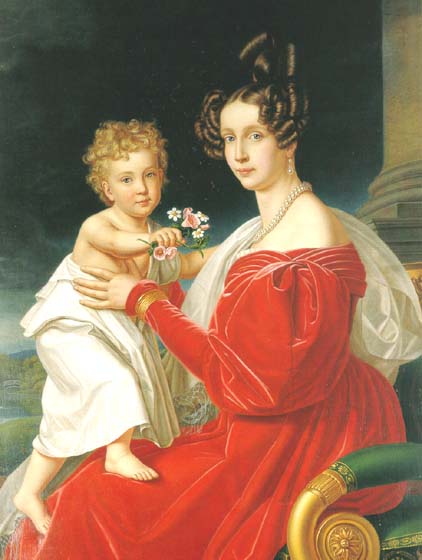
Because his uncle, from 1835 the Emperor Ferdinand, was weak-minded, and his father unambitious and retiring, the young Archduke "Franzl" was brought up by his mother as a future Emperor with emphasis on devotion, responsibility and diligence. Franzl came to idolize his grandfather, der Gute Kaiser Franz, who had died shortly before his fifth birthday, as the ideal monarch. At the age of 13 young Archduke Franz started a career as a colonel in the Austrian army. From that point onward, his fashion was dictated by army style and for the rest of his life he normally wore the uniform of a junior officer.

Franz Joseph was soon joined by three younger brothers - Archduke Ferdinand Maximilian (born 1832, the future Emperor Maximilian of Mexico); Archduke Karl Ludwig (born 1833), and Archduke Ludwig Viktor (born 1842), but a sister, Maria Anna (born 1835), died at the age of four.
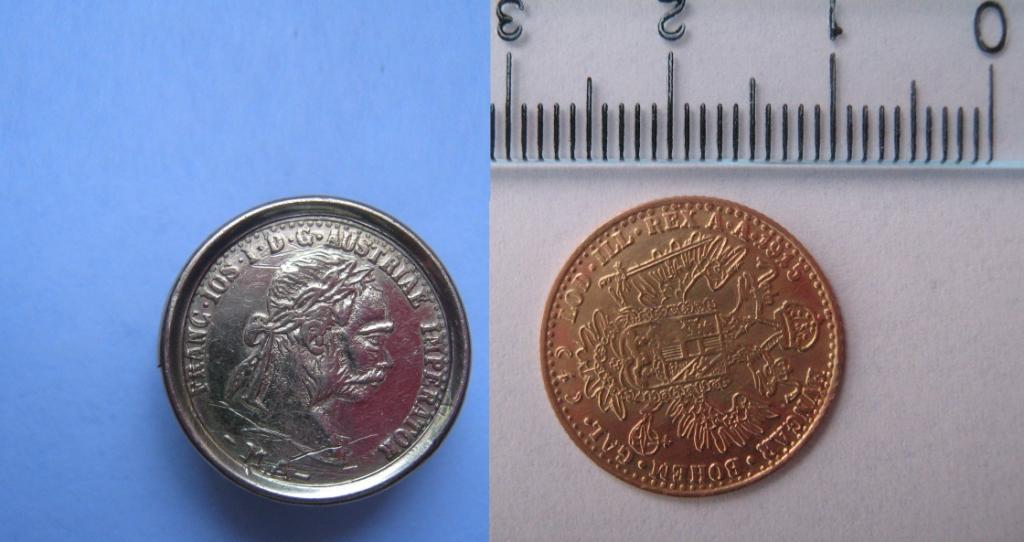
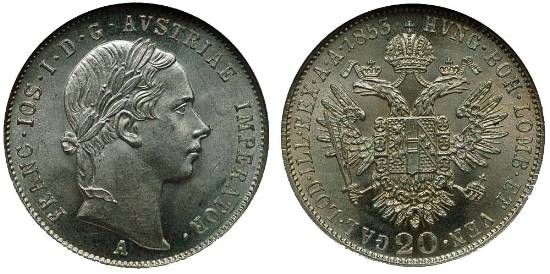
Franz Joseph Bust 20 Kreuzer Coin I own:
Following the resignation of the Chancellor Prince Metternich during the Revolutions of 1848, the young Archduke, who it was widely expected would soon succeed his uncle on the throne, was appointed Governor of Bohemia on 6 April, but never took up the post. Instead, Franz was sent to the front in Italy, joining Field Marshal Radetzky on campaign on 29 April, receiving his baptism of fire on 5 May at Santa Lucia. By all accounts he handled his first military experience calmly and with dignity. Around the same time, the Imperial Family was fleeing revolutionary Vienna for the calmer setting of Innsbruck, in the Tyrol. Soon, the Archduke was called back from Italy, joining the rest of his family at Innsbruck by mid-June. It was at Innsbruck at this time that Franz Joseph first met his cousin Elisabeth, Duchess in Bavaria, his future bride, then a girl of ten, but apparently the meeting made little impact.
Following victory over the Italians at Custoza in late July, the court felt safe to return to Vienna, and Franz Joseph travelled with them. But within a few months Vienna again appeared unsafe, and in September the court left again, this time for Olmütz in Moravia. By now, Prince Windischgrätz, the influential military commander in Bohemia, was determined to see the young Archduke soon put onto the throne. It was thought that a new ruler would not be bound by the oaths to respect constitutional government to which Ferdinand had been forced to agree, and that it was necessary to find a young, energetic emperor to replace the kindly, but mentally unfit Emperor.
It was thus at Olmütz on 2 December that, by the abdication of his uncle Ferdinand and the renunciation of his father, the mild-mannered Franz Karl, Franz Joseph succeeded as Emperor of Austria. It was at this time that he first became known by his second as well as his first given name. The name "Franz Joseph" was chosen deliberately to bring back memories of the new Emperor's great-grand-uncle, Emperor Joseph II, remembered as a modernizing reformer.
Imperial absolutism, 1848-1860Under the guidance of the new prime minister Prince Schwarzenberg, the new emperor at first pursued a cautious course, granting a constitution in early 1849. At the same time, military campaigns were necessary against the Hungarians, who had rebelled against Habsburg central authority under the name of their ancient liberties. Franz Joseph was also almost immediately faced with a renewal of the fighting in Italy, with King Charles Albert of Sardinia taking advantage of setbacks in Hungary to resume the war in March 1849. Soon, though, the military tide began to turn in favor of Franz Joseph and the Austrian whitecoats. Almost immediately, Charles Albert was decisively beaten by Radetzky at Novara, and forced both to sue for peace and to abdicate his throne. In Hungary, the situation was more grave and Austrian defeat was quite possible. Franz Joseph, sensing a need to secure his right to rule sought help from a reactionary Russia. With this Russian aid the Hungarian revolution was crushed by late summer of 1849. With order now restored throughout the Empire, Franz Joseph felt free to go back on the constitutional concessions he had made, especially as the Austrian parliament, meeting at Kremsier, had behaved, in the young Emperor's view, abominably. The 1849 constitution was suspended, and a policy of absolutist centralism was established, guided by the Minister of the Interior, Alexander Bach.
The next few years saw the seeming recovery of Austria's position on the international scene following the near disasters of 1848-1849. Under Schwarzenberg's guidance, Austria was able to stymie Prussian scheming to create a new German Federation under Prussian leadership, excluding Austria. After Schwarzenberg's premature death in 1852, he could not be replaced by statesmen of equal stature, and the Emperor effectively took over himself as prime minister.
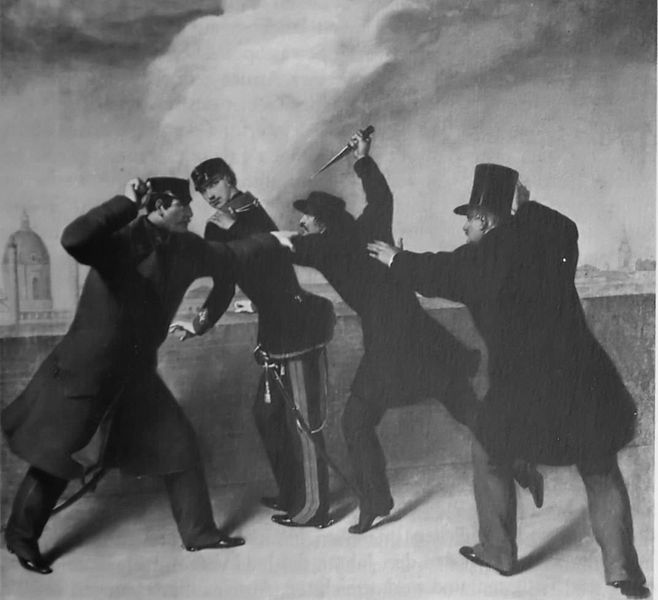
Assassination attempt in 1853On 18 February, 1853, the Emperor survived an assassination attempt by Hungarian nationalist János Libenyi. The emperor was taking a stroll with one of his officers, Maximilian Karl Lamoral Graf O'Donnell von Tyrconnell, on a city-bastion, when Libenyi approached him. He immediately struck the emperor from behind with a knife straight at the neck. Franz Joseph almost always wore a uniform, which had a high collar that almost completely enclosed the neck. It so happened that the collar of his uniform was made out of very sturdy material. Even though the Emperor was wounded and bleeding, the collar saved his life. Count O'Donnell (descendant of the Irish noble dynasty O'Donnell of Tyrconnell) struck Libenyi down with his sabre. O'Donnell, hitherto only a Count by virtue of his Irish nobility, was thereafter made a Count of the Habsburg Empire, conferred with the Commander's Cross of the Royal Order of Leopold, and his customary O'Donnell arms were augmented by the initials and shield of the ducal House of Austria, with additionally the double-headed eagle of the Empire. These arms are emblazoned on the portico of no. 2 Mirabel Platz in Salzburg, where O'Donnell built his residence thereafter. Another witness who happened to be nearby, the butcher Joseph Ettenreich, quickly overwhelmed Libenyi. For his deed he was later elevated to nobility by the Emperor and became Joseph von Ettenreich. Libenyi was subsequently put on trial and condemned to death for attempted regicide. He was executed on the Simmeringer Haide. After the unsuccessful attack the Emperor's brother Ferdinand Maximilian Joseph, the later Emperor of Mexico, called upon Europe's Royal families for donations to a new church on the site of the attack. The church was to be a votive offering for the rescue of the Emperor. It is located on Ringstraße in the district of Alsergrund close to the University of Vienna, and is known as the Votivkirche.
 Later years
Believing it necessary that the Emperor should soon marry and produce heirs, various potential brides were speculated including Princess Elisabeth of Modena, Princess Anna of Prussia and Princess Sidonia of Saxony. Although in public life the Emperor was the unquestioned director of affairs, in his private life his formidable mother still had a crucial influence and she desired to strengthen the relationships between the Houses of Habsburg and Wittelsbach and hoped to match Franz Joseph with her sister Ludovika's eldest daughter, Helene ("Nene"), four years the Emperor's junior. However, the Emperor became besotted with Nene's younger sister, Elisabeth ("Sissi"), a girl of sixteen, and insisted on marrying her instead. Sophie, despite some misgivings about her niece's appropriateness as an imperial consort, acquiesced, and the young couple were married on 24 April, 1854 in St. Augustine's Church, Vienna. Their married life was not happy: not only could Sissi never really adapt herself to the court and always had disagreements with the Royal Family, but their first daughter Sophie died as an infant, while the only son, Crown Prince Rudolf, died, allegedly by suicide in 1889, in the infamous Mayerling episode with his young mistress Baroness Mary Vetsera. The Empress herself was stabbed to death by an Italian anarchist in 1898; Franz Joseph never fully recovered from the loss. According to the future Empress-Consort Zita of Bourbon-Parma, he usually told his relatives "You'll never know how important she was for me" or, according to some sources, "She will never know how much I loved her" (although there is no definite proof he actually said this).
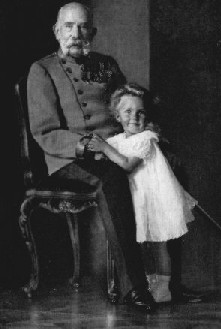
The 1850s witnessed several failures of Austrian external policy - the Crimean War and break-up with Russia, Austro-Sardinian War of 1859 against armies of the House of Savoy, and Napoleon III. The setbacks continued in the 1860s with Austro-Prussian War of 1866. It resulted in the Austro-Hungarian Compromise of 1867.
Franz Joseph built a villa named Villa Schratt in Bad Ischl for his mistress, Katharina Schratt, an actress with whom he had a long-standing relationship which was, to a certain degree, tolerated by Sissi.
In 1914 the heir to the throne, Archduke Franz Ferdinand, was assassinated in Sarajevo, leading to World War I. After he heard the news of the assassination of the Archduke he said that "in this manner a superior power has restored that order which I unfortunately was unable to maintain".
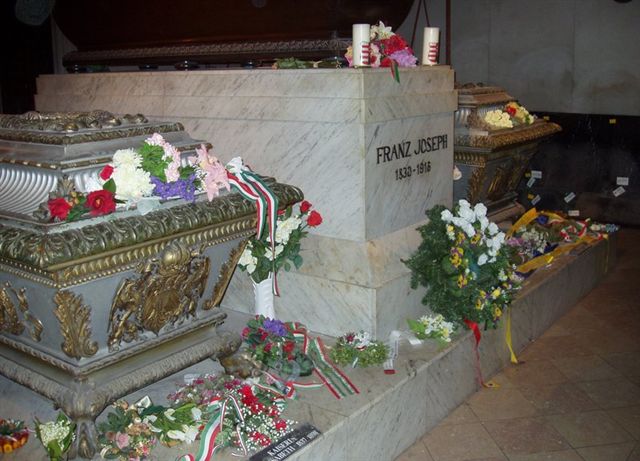
Emperor Franz Joseph died in the Schönbrunn Palace in 1916, aged 86, in the middle of the war. After the defeat in World War I, the Austro-Hungarian Monarchy dissolved. He is said to have died singing "God Save the Emperor".
His 68-year reign is the third-longest in the recorded history of Europe (after those of Louis XIV of France and Johannes II, Prince of Liechtenstein).






 Wonderful coin Zohar444, really wonderful


 Posted 11/16/2008 02:33 am