PCGS - Prior to being admitted to the union as the 28th state, Texas existed as a republic from 1836 to 1846. Famous Texan Sam Houston would be elected as president of the Republic of Texas twice, the second time rigorously overseeing the final issue of Texas paper money before statehood. It was his tight-fisted fiscal conservatism that resulted in this "Exchequer Series" of notes being so sought after today as to be considered the "holy grail" of Texas obsoletes.
Before these notes were authorized by the Congress of the Republic of Texas, there had already been multiple issues of notes that had become worth pennies on the dollar, if even accepted in commerce at all, as the country wasn't accepting its own currency for taxes.
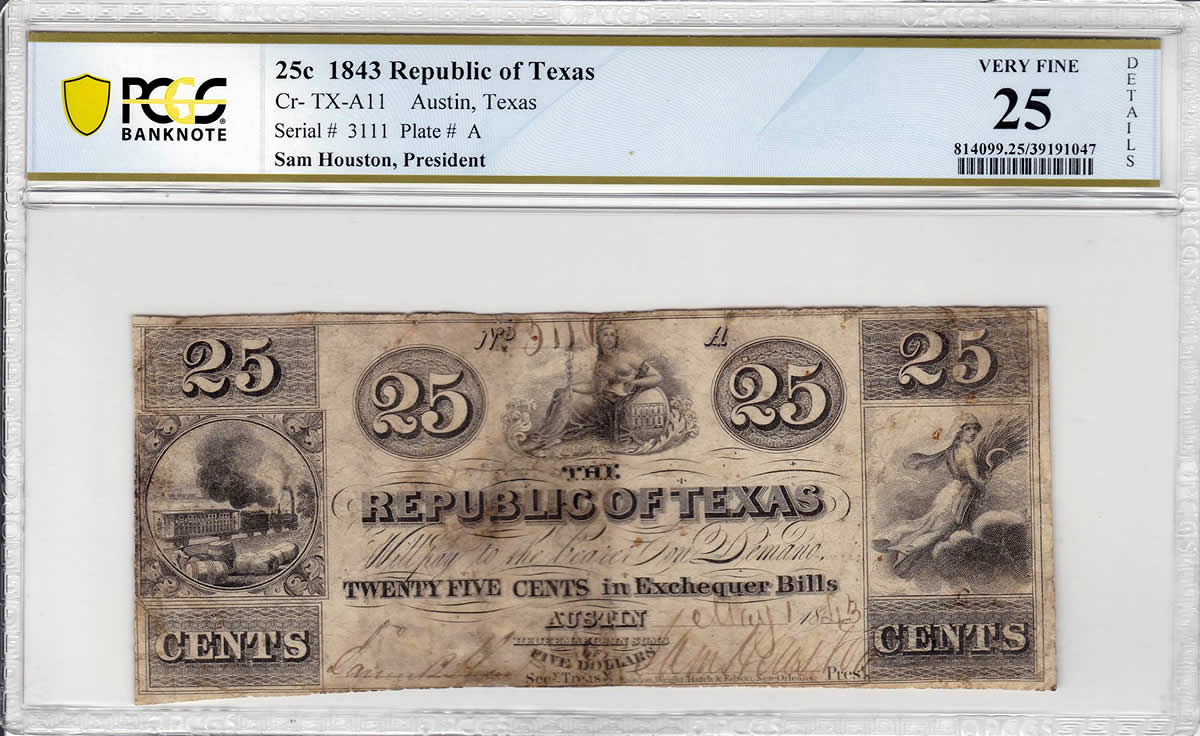
Because of this, it's quite understandable why there was great controversy over the issuance of yet another series of notes. Houston had a plan, and the fledgling country needed a circulating medium that could be trusted. A deep depression had set in after the Panic of 1837, and the situation was dire.
The act authorizing these Exchequer Bills would effectively deem all previous issues of paper notes worthless and allow taxes and government debts to be paid only in gold, silver, or Exchequer Bills at face value. Despite heated debate, the act passed on January 19, 1842.
While the total issue ended up being $150,490 (of the initial $200,000 authorization), Congress mandated that no more than $50,000 be outstanding at one time, which was further reduced to under $30,000. Initially, larger denominations were issued, which were used for payment of customs and taxes, canceled, burnt (some said Sam Houston enjoyed seeing the notes destroyed after redemption), and replaced with smaller denominations, eventually ending up in majority fractional denominations that were issued due to the lack of small change in circulation during the Hard Times era. The notes were issued from 1842 through 1845 and were very tightly controlled.
Read the Entire Article








 Posted 08/24/2020 8:12 pm


