PCGS - Perhaps the most popular of all pre-1933 United States gold denominations is the Double Eagle, a hefty gold coin carrying nearly a full troy ounce of the precious yellow metal and with a face value of $20. Surely, it's hard for many to imagine today a coin being worth "only" $20, but then again that much money in the mid-19th century represented nearly a month's wages for the common laborer. So, why was a denomination so lofty minted at the time?
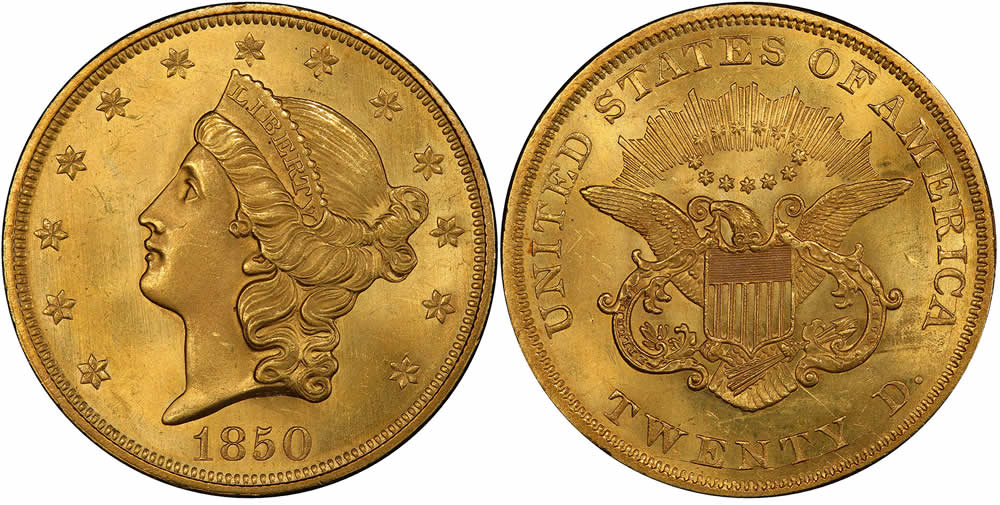
The $10 Eagle had been the nation's highest coined denomination, authorized under the Coinage Act of 1792; the first Eagles were minted in 1795 and were available in plentiful supply by the mid-19th century. But the California Gold Rush of 1848 provided the nation with copious amounts of new gold. Interestingly, the United States Mint's $20 gold coin wasn't an entirely foreign concept. The Mormons privately minted a $20 gold denomination in 1849, the first Pioneer coins minted with gold mined in California and distributed into circulation a year before the first federally minted $20 gold coins.
And, with the fresh new bullion supplies on hand from California, the decision was made to strike a higher-value government-issued gold coin that could be used for facilitating larger-value transactions both domestically and abroad. Hence, the Double Eagle was born. The Double Eagle was authorized by Congress under the Coinage Act of March 3, 1849, spawning the production of an 1849-dated pattern on December 22, 1849. Records suggest two were made, but only one is known and it's located in the National Numismatic Collection at the Smithsonian Institution in Washington, D.C.
Read the Entire Article 









 Posted 09/03/2020 3:38 pm


