








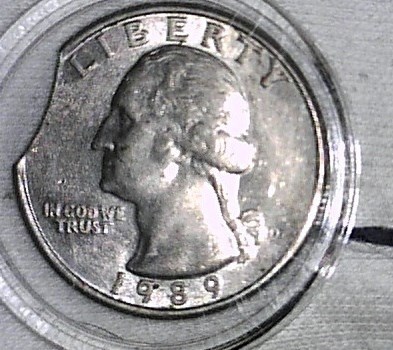


 Posted 09/23/2020 09:58 am


What you want to know is two times the circular segment bounded by the chord connecting the end points of the clip on the perimeter of the coin. The formula for a segment is (theta - sin(theta))/2 *r^2, where r is the radius and theta is the angle formed by the end points of the clip measured at the center of the coin, so multiplying by 2, we get just (theta - sin(theta))*r^2. Since the theta might be hard to compute compared to the length of the chord, c, we also know that the chord length is given by c = 2r*sin(theta/2), so solving for theta, we get theta = 2*sin^{-1}(c/2r). We can then plug that into our theta from the first equation to find the missing area, and then divide the missing area by pi*r^2 to get the ratio of missing material to the whole coin.
Edit: lol, or do what Yokozuna says. I feel like there's a "mathematician, a physicist, and an engineer are all going to the same conference" joke in here somewhere...
Edit: lol, or do what Yokozuna says. I feel like there's a "mathematician, a physicist, and an engineer are all going to the same conference" joke in here somewhere...
Edited by SamCoin
09/23/2020 10:02 am
09/23/2020 10:02 am


