This little bronze from the Pergamene Kingdom looked to be in good condition and was inexpensive. It caught my interest, as the Attalids had a fairly short dynasty, had an interesting history, and there was also a Seleucid connection.
I was intrigued with the name ΦΙΛΕΤΑΙΡΟΥ and the date range of 282-133 BC, which actually covered the reigns of Philetaerus, 282-263 BC; Eumenes I, 263-241 BC; Attalus I, 241-197 BC; Eumenes II, 197-159 BC; Attalus II, 160-138 BC and Attalus III, 138-133 BC. When Attalus III died without an heir in 133 BC, to prevent a civil war he had bequeathed the kingdom to the Roman Republic.
Philetaerus was born c 340 BC to Attalus, a Macedonian, and his wife Boa, a Paphlagonian. The later Attalids were descended from Philetaerus' father and expanded the city into a kingdom.
During the Wars of the Diadochi, Philetaerus served first under Antigonus. He then shifted his allegiance to Lysimachus (ruler of Thrace from 323 BC to 281 BC), who, after Antigonus was killed at the Battle of Ipsus in 301 BC, made Philetaerus commander of Pergamon, where he kept a treasury of nine thousand talents of silver. After 302 BC and the battle of Ipsus in 301 BC, he was loyal to Lysimachus. However in the court intrigue that plagued Lysimachus in 283 BC, Philetaerus sided with Lysandra, wife of Lysimachus' executed son Agathocles, and they fled to Seleucus in Babylon.
In 282 BC Seleucus invaded Lysimachus' Asian possessions, and early in 281 BC defeated him at Corupedium. Philetaerus was restored by Seleucus, but in the summer of 281 BC Seleucus was assassinated by Ptolemy Keraunos in Thrace. Philetaerus paid for the dead body and sent the remains to Seleucia, where Seleucus' son Antiochus had them interred. He also gained a lot of influence in the Greek world.
Philetaerus never married, and since he was a eunuch, had no children. He adopted his nephew Eumenes I (the son of Philetaerus' brother also named Eumenes), who succeeded him as ruler of Pergamon. After the death of Philetaerus in 263 BC, with the exception of Eumenes II, all future Attalid rulers would depict Philetaerus on their coins, paying tribute to the founder of their dynasty.
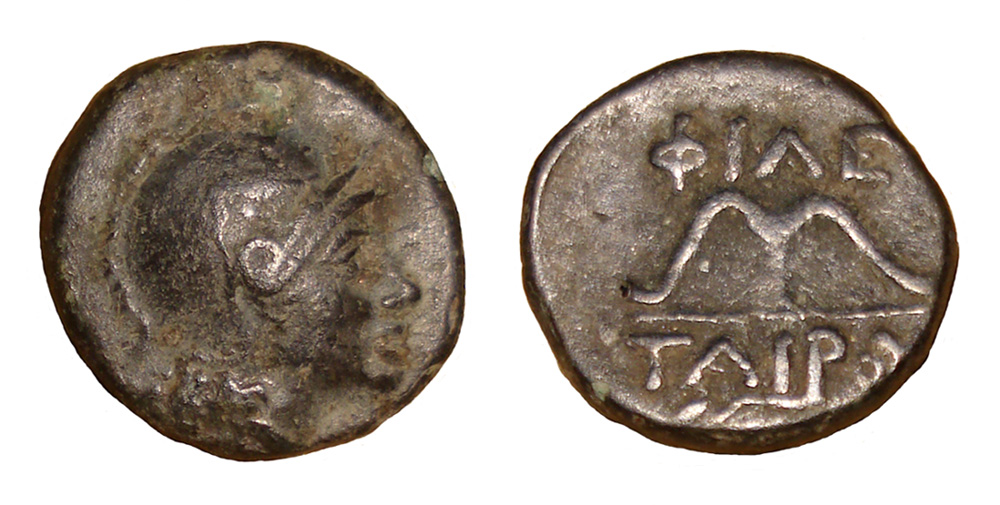
Pergamene Kingdom, 282 - 133 BC.
Obverse: Head of Athena right, in crested helmet ornamented with griffin. Reverse: ΦΙΛΕ / ΤΑΙΡΟΥ above and beneath bow. Bronze. Diameter: 13 mm. Weight; 2.0 gr.
Sear 7233.







 Posted 11/13/2020 4:21 pm


 ....
....



