Buzzard - Is probably correct. For now, I believe this is a REAL 1863 Oaxaca. I have a few concerns that will be outlined below, but overall I am leaning to it being real. Buzzard is also correct that in large measure this die pair was hand engraved. But this mint facility was not under Imperial control until 1865. During this early period, Oaxaca was a State run facility that made notoriously awful looking coins.
KurtS - The chop marks (large ones) are in fact not commonly seen on 1863 Oaxaca coins, but by itself that is not enough to say the coin is fake. I have not examined the coin in person so I can not comment on whether the chops are real or not.
trdhrdr007 - The design and feathering of this particular eagle is very close to correct. The head and beak are CORRECT. The 1863 Oaxaca eagles are among the worst looking birds to appear on real 8Rs. However, that said the Eagle's chest feathers are in nearly horizontal rows - every real 1863 I have examined has diagonal rows of feathers running downward from left to right or irregularly arranged feathers. The conclusion is that the feathers were actually cut into the die individually by hand - so orientation is a die by die feature. The feathering proves to be inconclusive.
LlacerSBD - the letter font is actually close to correct. There was a punch set used in 1863 that was not used either before or after that date. The fact that the letters are irregular in spacing and orientation is in this case, proof that they were punched into the die ONE AT A TIME. This is correct for Oaxaca in 1863. There are MANY other dates where similar irregular letters would prove a forgery.
Early Oaxaca issues are all rather crude and many are VERY RARE. There are 4 totally different Oaxaca styles issued in 1863. There are three mint marks and two different assayers. There are also flat top and Round top 3's on the date. At least 4 different eagles were used in this one year. Dunigan theorizes that there were TWO different Oaxaca mints operating in 1863. So it is a complex year that has never been fully explained. New hoards of coins from the period are always introducing new wrinkles into the puzzle because the individual dies vary so widely.
This particular coin has the O mint mark - the other two are A within the O and A over the O. This is the most common type of Oaxaca coin issued in the 1860s along side the 1864. So for anyone who is a type collector this should be a target coin for the Oaxaca mint. In VF or so - the coin catalogs about $100, so it is not prohibitively expensive or hard to locate.
One item not raised is the NON-RADIAL arrangement of rays on the cap. The arrangement here is clearly not Radial. If you project the rays backward to the center you do not get a single center point as you "should". I noticed this fact, but the Dunigan plate coin in "Resplandores" has a similar arrangement. There is one oddity that strikes me as different - the top center ray has an angle (bend) just before it joins the cap. That short section has to have been engraved by hand. The die sinker used the ray punch but left a gap between the end of the punch and the cap which he then filled in somehow.
Here are the odd ray features.
Image Insert: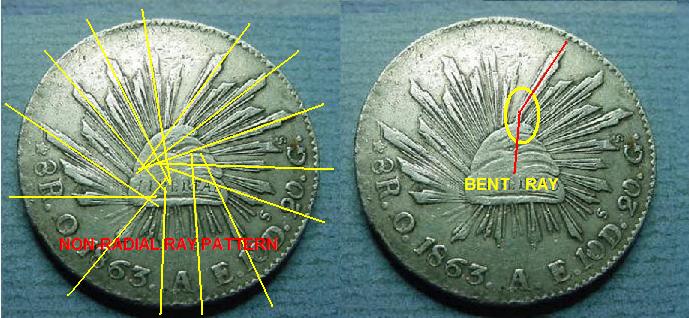
My interest in this coin lies in the possibility that it still might be a counterfeit. You see, contemporary circulating counterfeits of scarce mints are hard to find - some types are not yet known to exist. My earliest Oaxaca forgery up to this point in time is an 1869. This is the first 1863 I have encountered that might be a period counterfeit. There are Modern Numismatic counterfeits of these dates made for coin collectors, but counterfeits made to circulate at face value are not known to me.
My gamble is to buy the coin at a reasonable price (retail for a real coin) and then hope it is NOT a modern counterfeit. A modern numismatic forgery of this coin is worth only a nominal amount above melt value.
I am negotiating to buy this coin so I am hopeful to have a definitive answer within a couple weeks. But for now I believe it is likely REAL but I am hoping that it may in fact be a contemporary forgery.
Does that sound TOTALLY stupid?












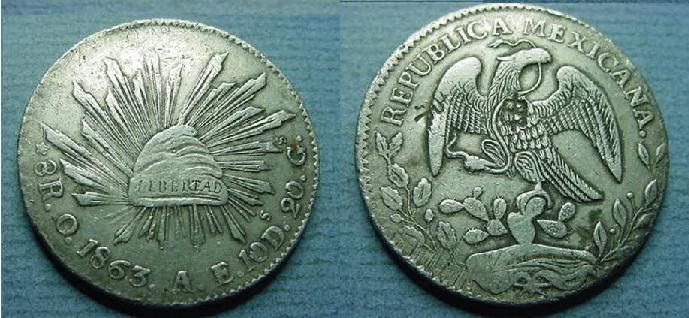


 Posted 12/14/2008 4:10 pm


