| Author |
 Replies: 7 / Views: 1,568 Replies: 7 / Views: 1,568 |
|
|
Valued Member
United States
143 Posts |
Hello, and thanks for coming to the peep show ;) As with my previous post re: JFK halves, I'll try to include my better photographs and descriptions; any information or tips on photography welcomed! Here are the goods (or bads?) 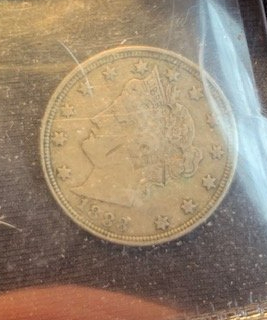 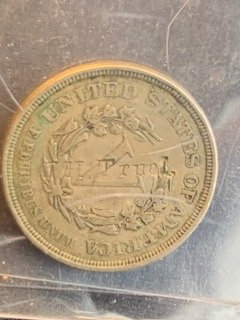 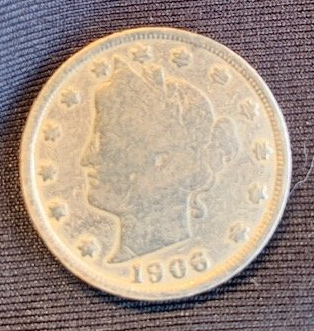 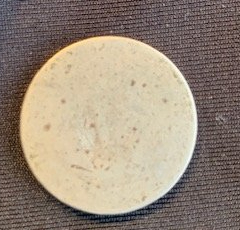 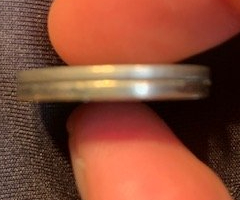 Pictured in the first two photos is an 1883 no cents liberty head nickel. The obverse has an odd sort of puzzle piece stamped into the head, with the liberty headband being a bit cutoff as a result. On the reverse, stamped through the center of the coin and ending near the end of "states" and beginning of "of" is TH TrueL. Looking for authenticity verification, potential sources of the damage, if these damages were created over an extended period, and anything else you wanna throw in :) Pictures 3-5 feature a 1906 liberty head nickel with a scuffed obverse and a nearly-blank reverse. Besides the obvious spots, I believe I see the faintest hint of an actual V nickel back. However, the two pieces are obviously adhered together (adhesive method?) with the fifth picture showing the blank side above the coin side; i.e. the part which shows blankness on the reverse is much thinner than the part which shows 1906 liberty head on the obverse. I hope this description is helpful - I can use other words or pictures to further elucidate my point. Thanks for checking out these coins! Always glad to hear from other enthusiasts  |
|
|
|
Bedrock of the Community
United States
12477 Posts |
The first one is some sort of private counterstamp. It could have been done way back when, but the only way to know, I think, is to find out who the name/initials belong to. It may be impossible to find another like it to compare.
The second looks like it has maybe a piece of aluminum(?) stuck to the reverse. If it is glued, soaking it in acetone may help to separate the two pieces.
In Memory of Crazyb0 12-26-1951 to 7-27-2020
In Memory of Tootallious 3-31-1964 to 4-15-2020
In Memory of T-BOP 10-12-1949 to 1-19-2024
|
|
Valued Member
 United States
143 Posts |
Thanks for the answers, Spruett :) I'll dig a bit and see if I can find anything for the counterstamping. Any potential damage from acetone to the liberty head? I'd love to see the back, but also kind of delighted to ponder what may have been the reasoning behind such an adherence. I am either convincing myself or seeing the faintest hint of the back of a Liberty nickel in the spotted mess. Is there any way other coins of the same type become so varied in width? i.e. someone ground down another nickel of the same type to that width then stuck them together? I appreciate it! |
|
Bedrock of the Community
United States
12477 Posts |
Pure acetone will not hurt the coin, but it can dissolve/loosen adhesives and may allow you to separate the pieces. Getting them apart may answer your question about what is on the reverse.  In Memory of Crazyb0 12-26-1951 to 7-27-2020
In Memory of Tootallious 3-31-1964 to 4-15-2020
In Memory of T-BOP 10-12-1949 to 1-19-2024
|
|
Pillar of the Community
United States
1613 Posts |
The obverse of the 1888 has the distinctive square and compass of the masonic lodge. Assuming the reverse below is the same coin, the counter-stamping plays into this. As to the adhered coins, Spruett001's advice on acetone may work as there is no real harm in finding out.
ANA member - PAN Member - BCCS Member There are no problems only solutions - the late, great John Lennon
|
|
Pillar of the Community
United States
4233 Posts |
In your last image it looks like three coins sandwiched together, not two. Are you sure you can't just pry it open? It looks like a magicians or spy coin.
|
|
Valued Member
United States
143 Posts |
Woah, ballyhoo, you absolutely nailed it based on the poorest of pictures: the symbol stamped upon the obverse is the masonic icon, with the back having JH TrueL stamped in the center. I just learned about the 1883 counterfeiting of these coins; although the pictures don't indicate it, this is an 1883 no cents V nickel. I'll be scouring some internet locations for what the stamp means; I'll report back if this yields anything. Let me know if you all can think of any direction to investigate this stamp a bit :) P.S. acetone soak in progress; will update with results! |
|
Valued Member
United States
143 Posts |
Acetone success! It looks like the pieces had some seriously strong glue holding together the 1906 (back looks fine besides some residual adhesive) and other piece, which is the very definition of a cull V nickel. Glad to get the mystery unstuck :) |
| |
Replies: 7 / Views: 1,568 |
|










 Posted 02/04/2021 11:06 pm


