










 Posted 02/17/2021 6:19 pm


I do not think they are "tokens". The whole point of tokens is that they are a substitute for money; no-one would take an actual piece of money and make a token out of it, especially in a country like Britain where doing so would be illegal.
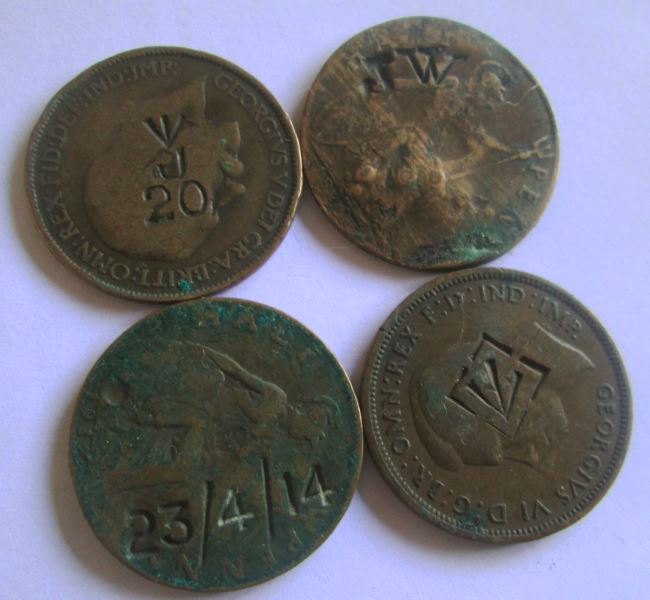
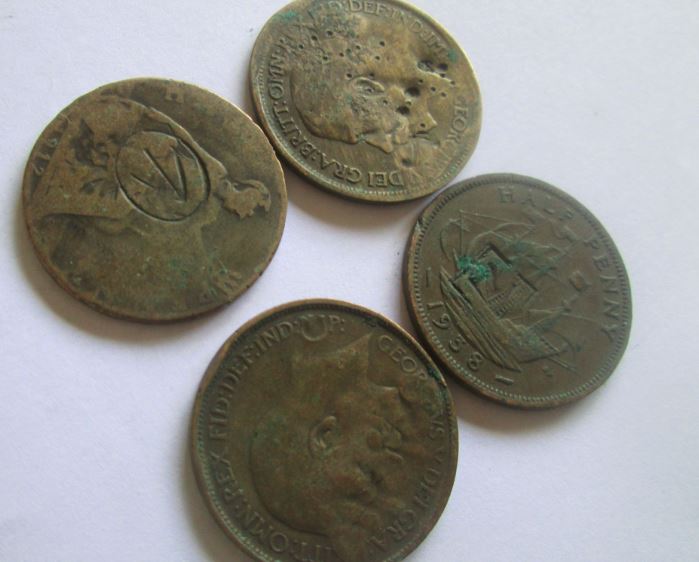
If I had to guess, the two with broad-arrow stamps were done within a government military workshop during WWI (or WWII in the case of the 1938 penny). The one with the date might simply be the date that whoever made the stamping, made the stamping, though a "memory piece" to (for example) help a guy remember his wedding anniversary cannot be ruled out. for the others, I would postulate the reason for their manufacture might simply be to test the stamps and punches on a convenient piece of metal - a coin - before they go on to use them on whatever it is they were actually stamping in the workshop that day. I would note on the "J20" piece that the broad arrow is actually upside-down, compared to the "J20".
The one stamped "JW" could have been made anywhere, at any time after the coin's manufacture, by anyone, for any reason. Perhaps similarly to the above possibility, someone was simply testing their letter-punch kit on a convenient piece of metal (the splattering of other punch-marks testifies to this possibility), though the alignment of the "JW" does not look random and suggests someone's initials.
If I had to guess, the two with broad-arrow stamps were done within a government military workshop during WWI (or WWII in the case of the 1938 penny). The one with the date might simply be the date that whoever made the stamping, made the stamping, though a "memory piece" to (for example) help a guy remember his wedding anniversary cannot be ruled out. for the others, I would postulate the reason for their manufacture might simply be to test the stamps and punches on a convenient piece of metal - a coin - before they go on to use them on whatever it is they were actually stamping in the workshop that day. I would note on the "J20" piece that the broad arrow is actually upside-down, compared to the "J20".
The one stamped "JW" could have been made anywhere, at any time after the coin's manufacture, by anyone, for any reason. Perhaps similarly to the above possibility, someone was simply testing their letter-punch kit on a convenient piece of metal (the splattering of other punch-marks testifies to this possibility), though the alignment of the "JW" does not look random and suggests someone's initials.
Don't say "infinitely" when you mean "very"; otherwise, you'll have no word left when you want to talk about something really infinite. - C. S. Lewis


