



Coin Community Family of Web Sites Join Thousands of Coin, Bullion, & Money Collectors
Join Thousands of Coin, Bullion, & Money Collectors Royal Canadian Mint products, Canadian, Polish, American, and world coins and banknotes. Coin, Banknote and Medal Collectors's Online Mall 300,000 items to help build your collection! Specializing in Modern Numismatics Vancouvers #1 Coin and Paper Money Dealer Royal Estate Auctions - $1 Coin Auctions


Username:
Password:
Save Password
Forgot your Password?


This page may contain links that result in small commissions to keep this free site up and running.

Welcome Guest! Registering and/or logging in will remove the anchor (bottom) ads. It's Free!

Spanish Netherlands 1689 Patagon Contemporary Counterfeit?

To participate in the forum you must log in or register.
Author Previous TopicReplies: 5 / Views: 3,218Next Topic  
Pillar of the Community
Learn More...
tdziemia's Avatar
United States
7958 Posts
 Posted 04/24/2021  5:06 pm Show Profile   Bookmark this topic Add tdziemia to your friends list Get a Link to this Message Number of Subscribers
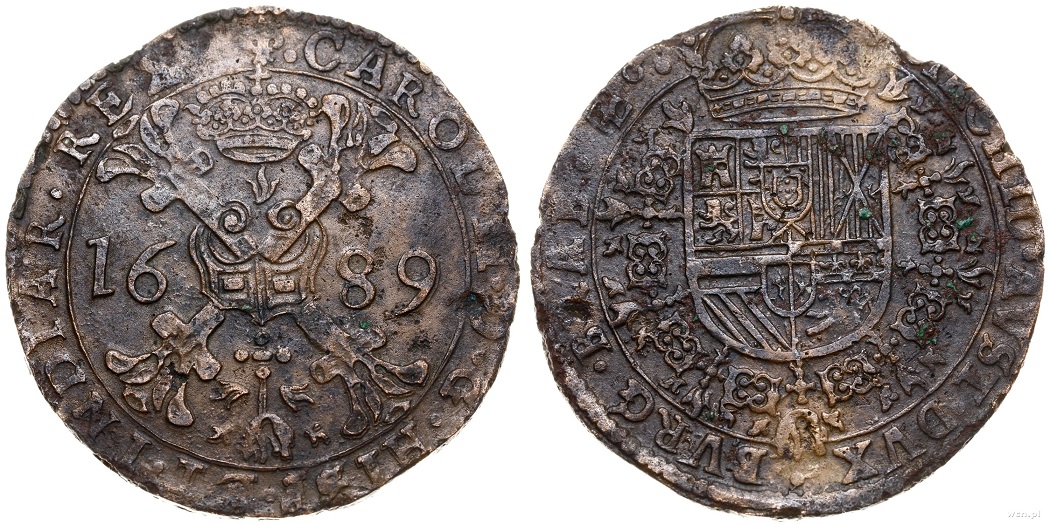
I just won this coin in an auction, and have to admit there were a lot of bad things about my going after it, (not least that I couldn't find another example of such a coin). But now that I've won it (though it is not yet in hand), I'd like to get input from others who are knowledgeable in this area.

The patagon was a crown sized coin issued in Spanish Netherlands between 1612 and 1710 under three reigns (Albert & Isabelle, Philip IV and Charles II). The obverse has the Burgundian (St. Andrew) cross fashioned of tree limbs dividing the date, and a legend containing the monarch's name, and ending with the mint mark at 12:00. The reverse has the crowned Spanish-Hapsburg arms encircled by the collar of the Golden Fleece, and a legend specifying the issuing entity at the end (BRAB for Brabant, FLAN for Flanders, TOR for Tournai).
The screwpress was introduced along with a modified design in Brabant 1686 (KM#107 replacing KM#81), and in Flanders in 1694 (KM#91 replacing KM#63), upgrading earlier hammered technology.

Here is the coin:
Spanish-Netherlands-1689-Patagon-Contemporary-Counterfeit?
First, there is no doubt that it is counterfeit for these reasons:
1. it is copper, not silver, with a mass of 23.1 g (28.1 for a real patagon).
2. it combines an obverse design with a Bruges mint mark (Flanders), with a Brabant reverse. Brabant was using the new screwpress design by 1689, which looks different from this reverse.

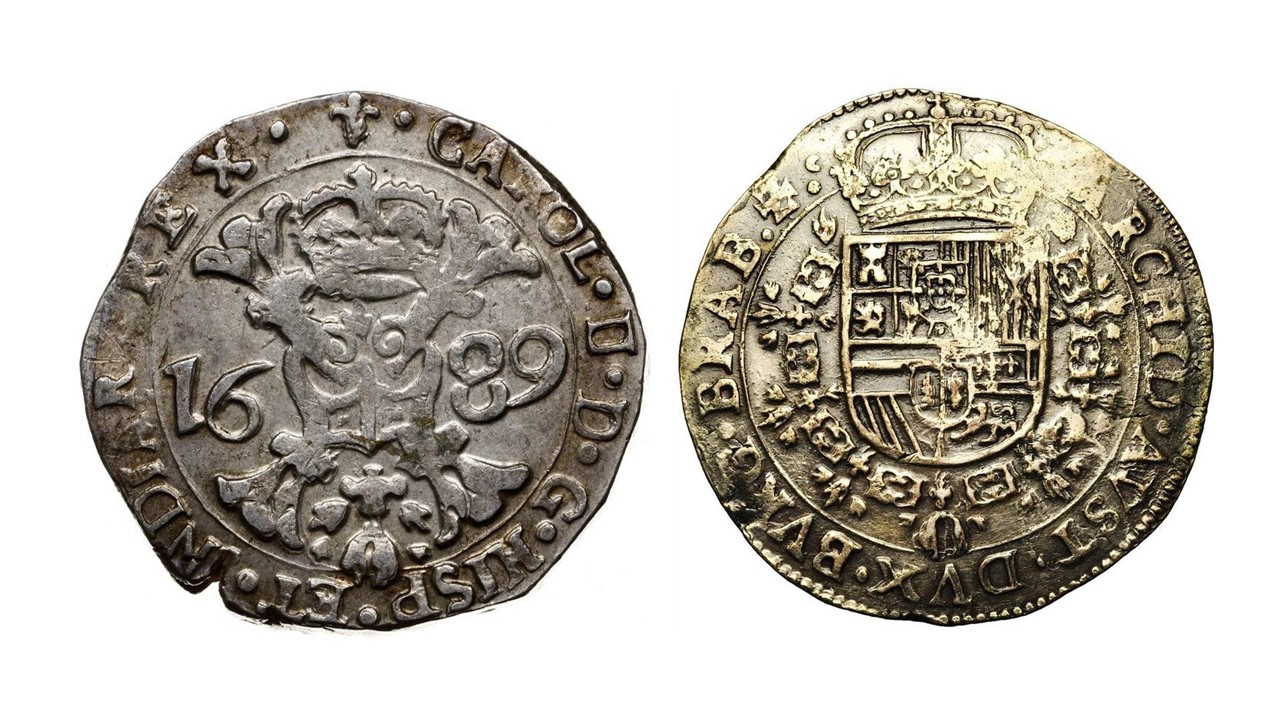
Here is what a real 1689 Bruges obverse would look like, combined with a real Brabant reverse from Charles II but before the changeover to the screwpress:
Spanish-Netherlands-1689-Patagon-Contemporary-Counterfeit?

The auction house called this a contemporary counterfeit in copper, but added the comment "probably struck in Bruges."
Curious if this indeed looks like a contemporary counterfiet, and what I should look for when I have it in hand.

Edited by tdziemia
04/24/2021 7:00 pm
Pillar of the Community
United States
1915 Posts
 Posted 04/24/2021  5:16 pm  Show Profile   Bookmark this reply Add Albert to your friends list Get a Link to this Reply
I have a number of contemporary counterfeits from those years, and they tend to be composed of silver over copper, brass or bronze.
Pillar of the Community
Learn More...
tdziemia's Avatar
United States
7958 Posts
 Posted 04/24/2021  6:54 pm  Show Profile   Bookmark this reply Add tdziemia to your friends list Get a Link to this Reply
Thanks for the response. I am guessing these are not so common as Spanish colonials from the same era, and was hoping to hear from collectors who might have one, since I hadnt seen before.

I guessed that maybe this coin was originally silvered, but it looks like there is no longer any evidence of it.

One of the things that struck me (and attracted me) is that the details are much sharper than most authentic coins from that era that show up at auction. Which made me think a bit about whether it is contemporary.
Edited by tdziemia
04/24/2021 7:01 pm
Pillar of the Community
United States
1915 Posts
 Posted 04/24/2021  7:43 pm  Show Profile   Bookmark this reply Add Albert to your friends list Get a Link to this Reply
Is your definition of contemporary meaning in present or modern times?
Or is it "back in the day"? Meaning made during the times when the authentic coins circulated.
Some difficulty can be attributed to the fact that some counterfeits were actually made better than the genuine.
That is the case with my contemporary circulating counterfeit Cayenne coins made in Birmingham. They are much sharper than the genuine pieces.
I see in a number of cases some of my known fakes are much better looking than the genuine.
Edited by Albert
04/25/2021 04:20 am
Pillar of the Community
swamperbob's Avatar
United States
5362 Posts
 Posted 04/25/2021  12:40 am  Show Profile   Bookmark this reply Add swamperbob to your friends list Get a Link to this Reply

tdziemia
I believe I also saw this coin and nearly bid on it. I didn't because I feared that I would be overextended financially due to a couple large collections I was negotiating for.

To me it certainly looked like a "contemporaneous circulating counterfeit". At this time period (pre-Sheffield) it is most likely to be an unsilvered core (and hence uncirculated). Silvering would have been added to a struck copper fake using a paint (any number of pigments) or a silver amalgam application similar to gilding only using silver not gold. In silver amalgam the struck core is coated with a mercury-silver amalgam (a past like stuff) which is brushed on to form a uniform layer (artistically) and then it is heated in a furnace to several hundred degrees to cause the mercury to boil away leaving behind the silver residue. The process was not without problems and silver gilding was far less successful than gold gilding. It often cracked or flaked off.

The only other process of striking a coin with a core of copper and a surface of silver is the ancient fouree process. In that case a copper blank planchet is covered with a silver foil layer on both sides and it is then struck as a unit. The striking pressure, if adequate, bonds the three layers together. This process also had drawbacks - namely the edge was not covered (treated variously - sometimes with solder). Additionally the mechanical bond between the silver foil and the core was easily broken and the silver could peel away or expose the core to corrosion very quickly. These were usually single pass counterfeits.


Quote:
To be successful a counterfeit coin has to pass only once.


That adage often attributed to counterfeiters seems to have originated outside the trade because following that advice makes for an unsuccessful counterfeiter. Once the first person notices the fraud - the counterfeiter would need to flee the area or stop passing that type.

A better adage would be the one I heard directly from an old forger who was never caught. He said it was better to make something so common that no one ever looks at it closely or immediately. That way by the time the fraud is finally noticed the forger's profit is secured and the mark no longer remembers the passer. He also advised making low value things so that the mark does not bother reporting the fraud.
Pillar of the Community
Learn More...
tdziemia's Avatar
United States
7958 Posts
 Posted 04/25/2021  07:39 am  Show Profile   Bookmark this reply Add tdziemia to your friends list Get a Link to this Reply

Quote:
Is your definition of contemporary meaning in present or modern times?
Or is it "back in the day"?

I meant "back in the day" which I think is the same way that you and @swamperbob use it.

Quote:
Some difficulty can be attributed to the fact that some counterfeits were actually made better than the genuine.

Yes, I was questioning whether such a well-struck and/or well-preserved coin was likely to have been that old. There are very few authentic pre-screwpress patagons around in this condition. Even coins that show up in near mint state tend to show more significant imperfections from the minting process.
Your and @swamperbob's comments make me feel more confident.


Quote:
I believe I also saw this coin and nearly bid on it
Well I'm glad to have not had such a formidable competitor. As it was, there were 7 bidders, but it started very low, and the increments were small.

I made an obtuse comment in the beginning of the thread about my motivation. In my small collection of Brabant/Flanders, I have a hole for a patagon of Charles II. I had been outbid on a few authentic ones, and when I saw this coin in such nice shape, I was curious enough to bid, and lucky enough to win (at a far lower price than an authentic one would have commanded).

Edited by tdziemia
04/25/2021 07:41 am
  Previous TopicReplies: 5 / Views: 3,218Next Topic  

To participate in the forum you must log in or register.


Disclaimer: While a tremendous amount of effort goes into ensuring the accuracy of the information contained in this site, Coin Community assumes no liability for errors. Copyright 2005 - 2026 Coin Community Family- all rights reserved worldwide. Use of any images or content on this website without prior written permission of Coin Community or the original lender is strictly prohibited.
Contact Us  |  Advertise Here  |  Privacy Policy / Terms of Use

Coin Community Forum © 2005 - 2026 Coin Community Forums
It took 0.25 seconds to rattle this change. Forums