PCGS - The United States Mint has been striking many coins at the West Point Mint with the "W" mint mark in recent years. Among these W mint mark coins are the circulating 2019-W and 2020-W Quarters, which garnered a lot of attention in the press and even inspired the popular PCGS Quarter Quest. But as the catalog of W mint mark coinage grows larger and larger, many collectors are left to wonder what that first W mint mark coin was.
Collectors must look back to the 1980s to zero in on that first W mint mark coin, which was the 1984-W $10 Olympic gold coin. The 1984 $10 gold commemorative became the first legal tender gold coin produced by the United States Mint since 1933 and represented a bold move forward for the young Modern U.S. Commemorative Coin program, which launched in 1982 following the mint's 28-year hiatus on striking commemoratives.
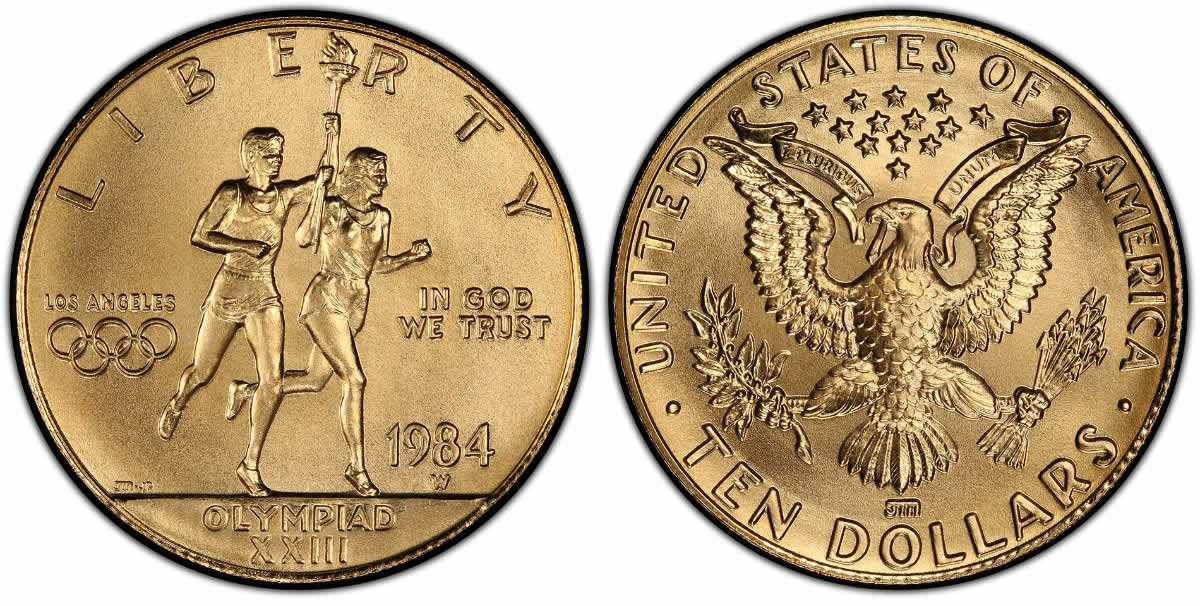 Modern Gold Commemorative, 1984-W $10 Olympic, PCGS MS70.
 The 1984-W $10 Olympic commemorative gold coin saw a mintage of 75,886 business strikes and 381,085 proofs - an outstanding output, especially considering the relatively small productions of gold commemoratives today. But when the first $10 Olympic gold coins were struck at what was then the West Point Bullion Depository on September 13, 1983, the public was especially hungry for new United States gold coinage, long absent from the mint's production lineup.
There was a total of five purchase options for the 1984 $10 Olympic gold, with the Philadelphia, Denver, San Francisco, and West Point Mints all issuing proof versions and the West Point kicking in an additional fifth variant with its uncirculated finish offering. Regular-issue prices were $339 for the business strikes, while proofs sold for $352.
While the 1984 $10 Olympic commemorative was the first United States coin to bear the "W" mint mark, it was not the first to be struck at West Point. For that, we must turn the clocks back yet another decade further to 1974, when the West Point Mint began striking Lincoln Cents without a mintmark to supplement production of the one-cent coin for the Philadelphia Mint.
Read the Entire Article 






 Posted 07/01/2021 4:48 pm


