Quote:
Could it be that who had classified this piece as counterfeit be wrong? is that possible?
Coins are generally condemned on three bases:
- They are sold by a known counterfeiter.
- They have exact die-matching with coins sold by a known counterfeiter.
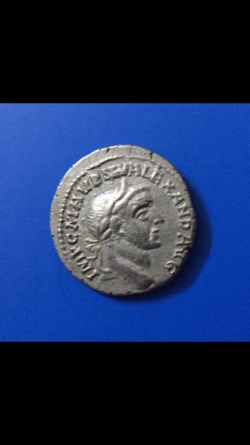
- Multiple examples of identical-looking coins are found.
This coin fails that third test.
Ancient coins are unique works of art - each one is "hand-made", and thus each one has a unique appearance. When you see multiple coins that all "look the same", in terms of the flaws and imperfections that normally help make a coin unique, it is a surefire sign that the coin is not a unique ancient coin, but something mass-produced.
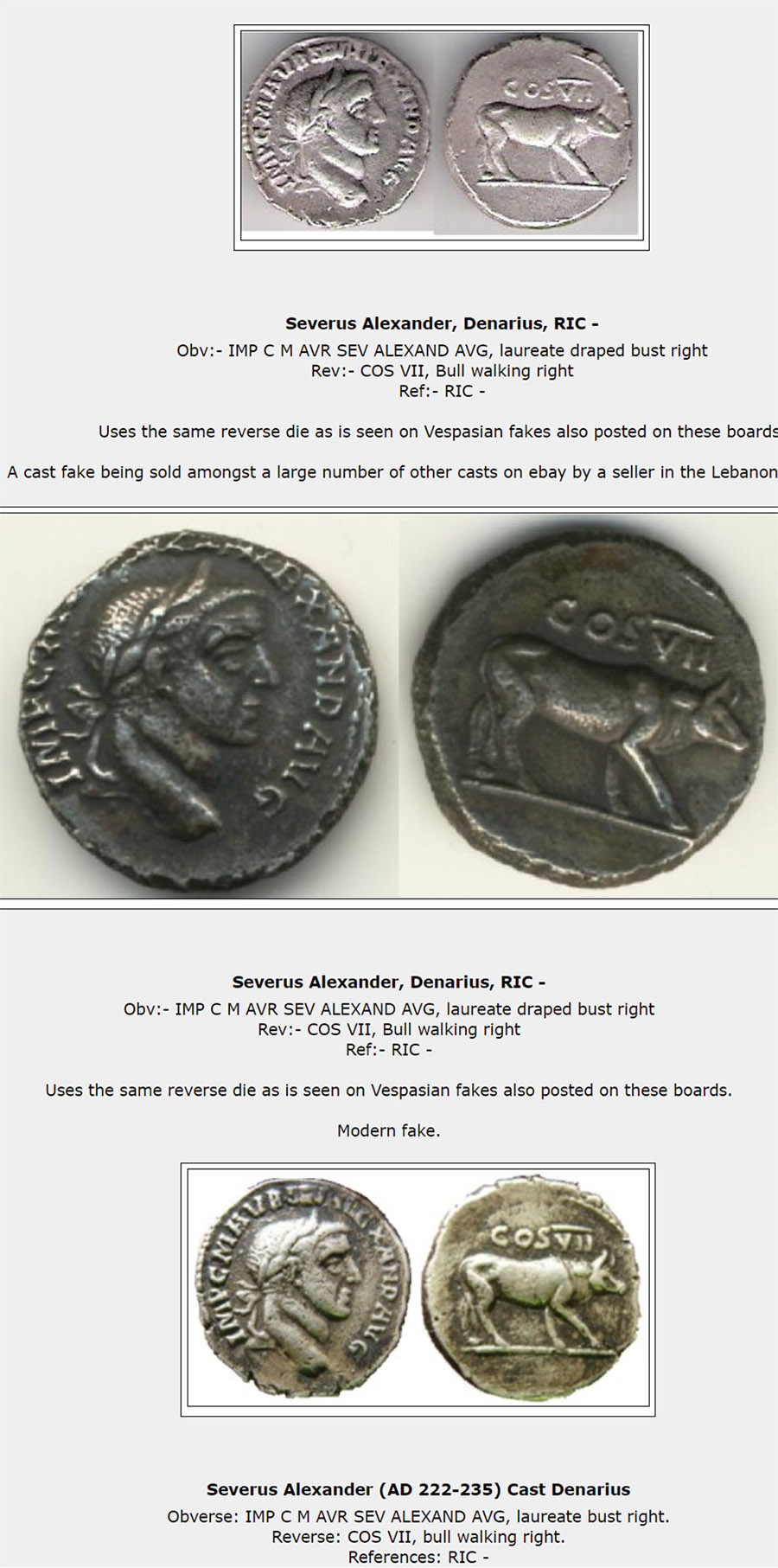
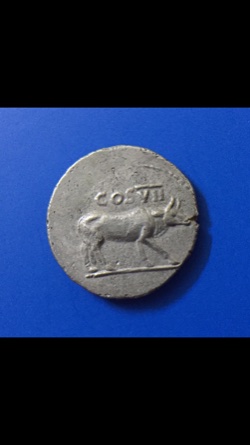
In the case of this coin, I'm looking at the reverse, with the cow. See the line of dots stretching in an arc, from right to centre above the cow, and fading away there in the middle of the coin above the "V"? That arc is supposed to be a complete circle of dots, going all the way around the coin. You can see this on
this genuine example I might expect to find some coins with "incomplete arcs" of dots, especially if they are struck off-centre. But I would not expect to find multiple examples of identically imcomplete arcs, where the arc stops at exactly the same place on each coin.
For this particular coin, however, we can find additional evidence of fakery: it''s an "impossible mule". Severus Alexander did not issue a coin with this reverse design. Emperor Vespasian did, 150 years before Severus ruled. And it's not some kind of "revival" of an old design. "COS VII" is a date; the seventh year of Consulship of the emperor. Severus Alexander did not reign for long enough to make it to Year 7. Vespasian did.
Don't say "infinitely" when you mean "very"; otherwise, you'll have no word left when you want to talk about something really infinite. - C. S. Lewis









 Posted 05/09/2021 6:19 pm