PCGS - On October 19, 1453, Bordeaux surrendered to the French, leaving Calais as the only English possession in France and ending the conflict known as the Hundred Years War. The Hundred Years War was not a continuous battle but a series of battles that would establish France as a nationality as well as a territory. The conflict began with the death of Charles IV of France on February 1, 1328. Charles IV as the last Capetian King had his closest-living male relative in succession as Edward III of England, who was a nephew, as his mother was the sister of Charles IV. The nobility of France rejected Edward III's claim to the throne and instead accepted Philip of Valois as King Philip VI.
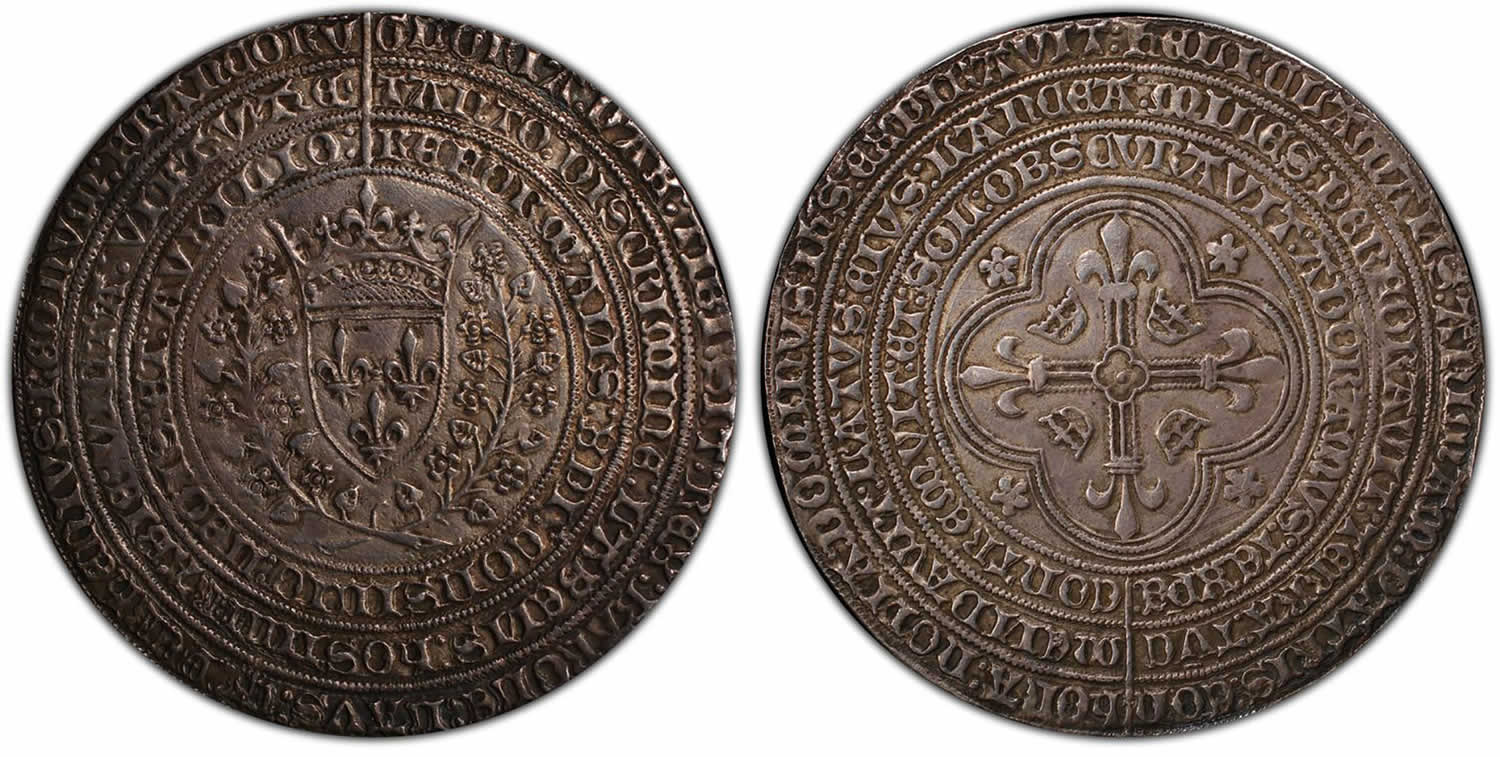 France (1454) Medal "End of the Hundred Years War" PCGS SP53
The Hundred Years War began in 1337, when Philip confiscated Aquitaine and Ponthieu as punishment for harboring Robert of Artois, a cousin of Philip and an enemy. The English retaliated and won significant victories in Crecy in 1346, Poitiers in 1356, and Agincourt in 1415. The victory in Agincourt left Henry V of England in control of Paris, Normandy, and most of Northern France. On June 2, 1420, Henry V of England married Catherine of Valois, the daughter of Charles VI, and become regent of France.
In 1422, both King Henry and Charles died. The French Dauphin, the eleventh child, and fifth son of Charles VI, claimed the title of King Charles VII of France. Henry VI of England also took the title of King of France in 1422 and had his coronation at Notre Dame in Paris on December 16, 1431, at the age of 10. Joan of Arc played an important role in the events that followed with claims of visions from archangel Michael and saints who instructed her to support Charles VII and recover France from the English. After the siege of Orleans was victorious for Charles VII with Joan of Arc, the French morale improved, and other victories followed. Joan of Arc were captured and executed in 1431.
The English lost Paris in 1436, Normandy in 1450, and Aquitaine and Bordeaux in 1451. In 1452 Henry VI sent a force of 3,000 under John Talbot, Earl of Shrewsbury to Gascony, which was mostly recovered. However, the French fought back and by July 1452 the French army defeated Talbot at Castillon. This victory let France recover Gascony and left only Calais as the only English possession in France. The defeat of Talbot is where historians end the Hundred Years War, yet the War of the Roses would soon begin in 1455.
An undated medal to commemorate the end of the conflict and the expulsion of the English was produced in 1454. This extraordinary piece mimics circulation coinage in its design and production. Featuring a crowned arms of three fleur de lis between rose vines, the medal has three rings of texts. The reverse also features three rings of text, with the center imitating coins featuring a Lily cross with four crowns in the angles with a center quatrefoil with flowers. The text on the obverse translates to, "O King Charles! Glory, peace, and praise be to you without end! When the kingdom of France was plunged into great danger, you were able to conquer the anger of your opponents by your worth, and you have the kingdom with the advice of Christ and reformed the law." The text on the revers states, "In the ninth hour our Lord Christ died and cried: I entrust my soul into your hands, O father! A soldier stabbed him in his side with a spear. The earth shook and the sun darkened. O Christ, we adore you."
Today, surviving examples of this contemporary medal are extremely scarce and desirable. This is just one of eight different types struck between 1451 and 1460. This example was offered for sale on January 28, 2021, by Fritz Rudolf Kunker GmbH & Co. KG in their Auction 346, where it was lot 506. The medal sold for 42,000€, or about $51,000 USD plus buyers' premium. The piece was submitted to PCGS for grading and certification through the Paris office and was graded SP53 by PCGS.







 Posted 09/05/2021 5:04 pm


 Absolutely stunning




