| Author |
 Replies: 11 / Views: 1,705 Replies: 11 / Views: 1,705 |
|
|
Valued Member
United States
467 Posts |
First of all, I would like to say hello after a prolonged absence from this forum. For a while I was on an internet detox, having spent countless (way too many) hours online, instead of getting out there in the world. Detox successful! Nice to see that this place is still active. The story continues with my recent retirement, and I was planning to stop collecting and sell off my collection, but I changed my mind. The hobby is too ingrained in my blood to just walk away, as it turns out. So anyhow, I bought the newest version of the Charlton guide, which happens to be the edition that is focusing on fifty cents. When I came to the 1948 coin, the guide lists two varieties, Narrow Date with the 4 low and Wide Date one with the 4 high. My coin is neither, and Charlton's notes (page 194) indicate that, "Only two varieties of business strikes are known, a wide and narrow date." With this in mind, I either have an undiscovered variety, or my coin is a Specimen Proof. Anyone care to chime in as to the possibilities? I've included a reverse photo to help with the discussion. When I posted this coin a few years ago I remember a comment about how well struck it was, which lends some credence to the possibility of a Specimen Proof. Thanks in advance, and I look forward to hearing from some fifty-cents aficionados. 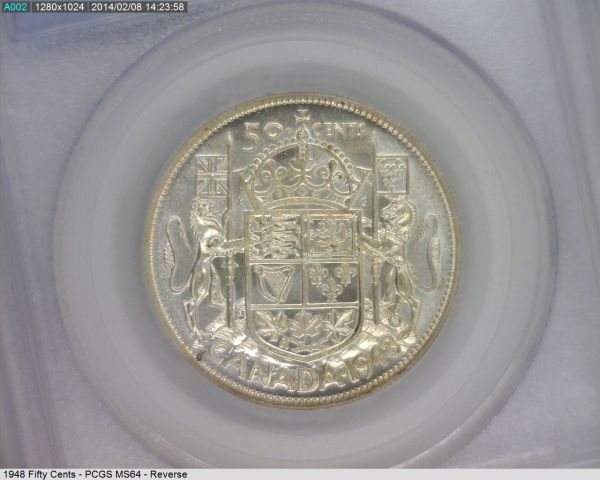 |
|
|
|
Bedrock of the Community
Canada
21855 Posts |
Would to to see a picture of the Obverse as well as a clear close up of the date.
Appears to be well struck but pictures are a little too bright to see detail.
|
|
Valued Member
 United States
467 Posts |
Thanks for the request for the obverse photo. Here it is. I don't have a ready enlargement of the date, but feel free to copy the image to your computer and zoom in on the date with your photo viewer until I can put something together. Note that the 4 in the date is as large as the other numerals, whereas the 4's in both varieties of the business strike are smaller than the other 3 digits. 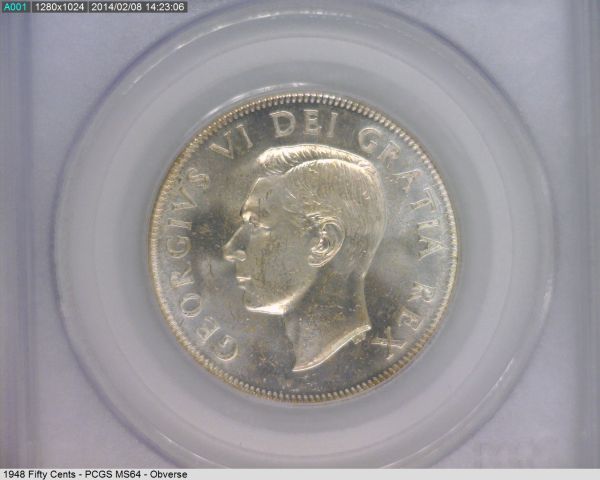 Edited by justanothercoinaddict
06/29/2021 6:31 pm
|
|
Pillar of the Community
 Canada
5644 Posts |
Well, "pginrh" is the 50 cent guru who also wrote the variety section in the back of the Charlton. Paul's REAL list of all the 50 cent varieties would have taken the entire book. ANY of the variety sections in the back of xxxx year's guide only has a small sample of all the known varieties. There is a severe space limitation that says how many pages in the back that can actually be printed. Let's hope that Paul sees this post and goes ahead and offers his sage determination.
|
|
Pillar of the Community
 Canada
5416 Posts |
Looks like a narrow date business strike to me .
Some sharper pix might be of assistance .
There are bucket loads of date spacing variants in the GVI
Fifty Cents series , most of which are of little relevance
to almost all who collect the coins .
|
|
Pillar of the Community
United States
683 Posts |
That looks like a well struck business strike to me. Nice coin.
|
|
Valued Member
United States
467 Posts |
Thanks for the input everyone. The number of varieties, repunches, design characteristics and so forth make collecting George VI fifty centers quite interesting.
|
|
Valued Member
United States
467 Posts |
Here's a closeup of the date. 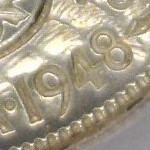 |
|
Bedrock of the Community
Canada
21855 Posts |
In 1948 due to the low mintage (37,784) unlike other years, there were only two reverse dies used.
The Narrow Date, Low 4 and the Wide Date High 4.
Yours is the more common Narrow Date, Low 4.
|
|
Valued Member
Canada
456 Posts |
I was in conversation with Bill Cross of Charltons several years ago and this was his take on Specimen coins of the George VI era. They (the folks at the mint) took a used die and refurbished it (repolished it to refresh the fields to a mirror finish, but this also caused the numbers and digits to appear wider). So if your coin appears to match this refurbishment, then a "low 4' die would look like it was the original die. I cannot tell from your picture but the early die states of that die also had a doubling of the stem of the '4' and a slight doubling on the inside lerft of the bottom loop of the '8' , and the last usage had a die chip in the top of the '4' .... so I hesitate to say that this was the methodology used for your 'Specimen' 1948 50c coin and it appears that your coin may be plain regular coin. .
|
|
Valued Member
United States
467 Posts |
This has been quite educational, and I thank all of you for contributing to the discussion. A plain ole 1948 it is then, not that I am at all disappointed. It was interesting to learn about specimen die preparation, pginrh, and I appreciate you sharing your expertise.
Wishing everyone a Happy 4th of July weekend coming up, and for those of you north of the Border, Happy Canada Day tomorrow.
|
|
Valued Member
United States
302 Posts |
Years ago I actually talked with mint employees close to those who were preparing the dies for the specimen coins. My old friend Bill Cross has got it completely backwards. New dies with an extra polishing prior to plating were used for specimen coins. After the specimen coins were struck these dies were mixed with the regular dies and sent to the presses to produce business strikes. That is why it is possible to find specimens and business strikes from the same die.
|
| |
Replies: 11 / Views: 1,705 |
|










 Posted 06/29/2021 6:26 pm


