|
This page may contain links that result in small commissions to keep this free site up and running.

Welcome Guest! Registering and/or logging in will remove the anchor (bottom) ads and the security checks. It's Free!
To participate in the forum you must log in or register. | Author |
 Replies: 105 / Views: 11,358 Replies: 105 / Views: 11,358 |
|
|
|
Pillar of the Community
 4628 Posts |
Daltonista and others can I ask you respectivefully not to show or say any details of the following tokens and issuers. 1. Hague Smith 2. United Service Hotel 3. Auckland Licenced Victuallers 4. J Hurley I have bought these tokens, but the seller has lockdown fear and is not sending them until lockdown ends, so far its already been 8 days and shows no signs of abating because of a Minority Church gathering that has spread it like crazy. I also brough Coombes and Kirkaldie and Stains, but you have done those. I would really appreciate it  However feel entirely free to show anything else! |
|
Pillar of the Community
United States
1077 Posts |
I happen to have all of those, Princetane, but will defer to your ownership of this thread and hold on to mine for comparisons later. Meanwhile, here's my beat-up Brown and Duthie penny dated 1866. They were New Plymouth ironmongers, so of course we have yet another view of Taranaki, the Maori name for what is now called Mount Egmont. Renniks 61; Andrews 50; KM Tn10. 31mm.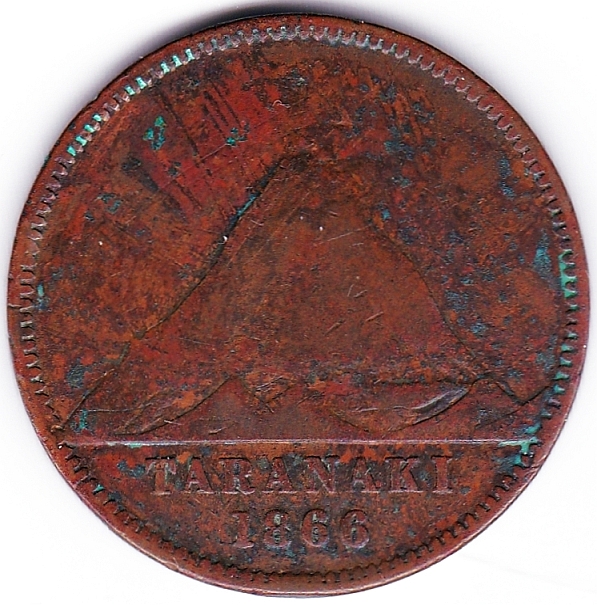 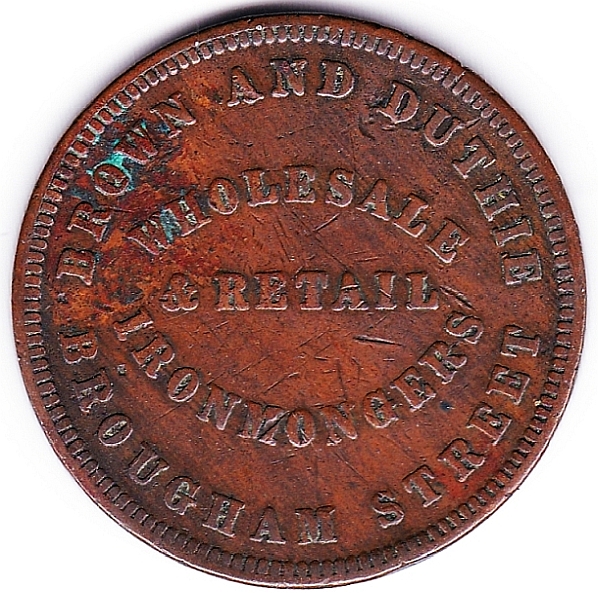 "If everything seems to be under control, you're just not going fast enough."
--- Mario Andretti
|
|
Pillar of the Community
4628 Posts |
Thanks Mate, you are a good man(Woman?), love your Duthie - shame about Verdigris though, but this is expected on copper and bronze coins that old.
Especially in our damp and mild climate, you would expect verdigris and black wear on base silver coins.
If they are not here in a week, you can go ahead. If you have any rare ones, you should show those as your posts are great and you know your stuff.
Edited by Princetane
08/25/2021 01:51 am
|
|
Pillar of the Community
4628 Posts |
The tokens have arrived.
Expect an update in the next few days!
|
|
Pillar of the Community
4628 Posts |
Thanks for your Patience - we are back. The first token is by John Hurley and its different for two reasons, it is one of the few Halfpennies issued by traders in New Zealand (Hall and Lipman Levy were others). Hurley pennies were also issued and are about the same scarcity. 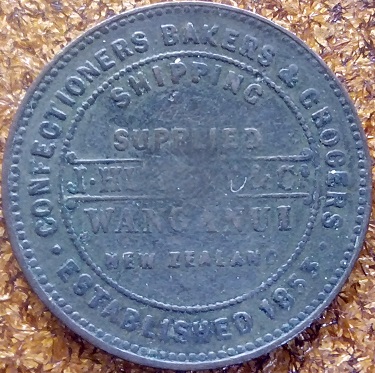 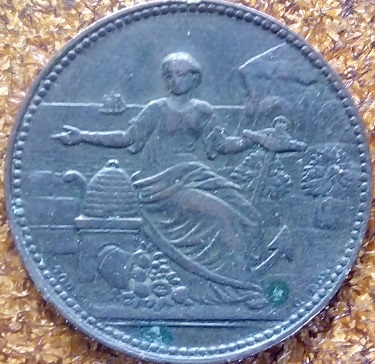 J. Hurley Halfpenny Token, aVF but weak strike. J. Hurley Halfpenny Token, aVF but weak strike.The coin is bronze and some 25mm in size. They were minted by Todman, London and there is words on one side and on the other shows an allegory of plenty surrounded by provisions, holding an anchor with a beehive and cornucopia (Horn of plenty). Behind are cliffs and the sea. The image suggests the issuers role in shipping in provisions and luxuries to a frontier settlement. As this token is bronze and small it is believed it was minted in the early 1870s (1872 is a guess by Roker). Hurley ran his grocery and bakery business between 1853 and 1857 and again after 1864 According to Roker, John Hurley came with his parents and siblings to Wellington in 1842 at the age of 12. Meaning he was born in 1829 or 1830 in England. By 1853 he was in Petre (Whanganui) running a grocery store as well as baking cakes, biscuits and confections. In 1857 he sold his business, but brought it back in 1864. 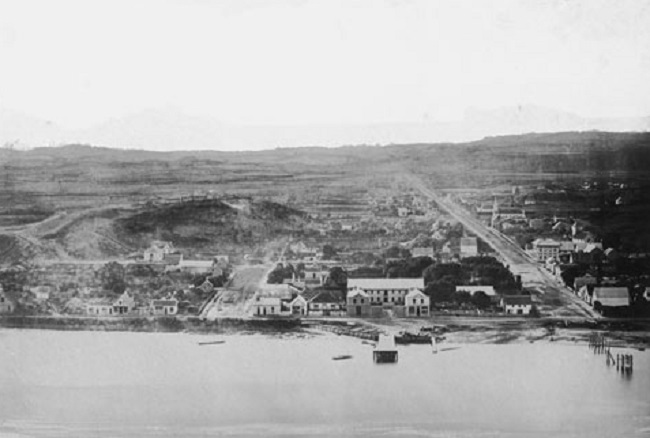 Whanganui in 1858 - Photographer unknown, but possibly Bruno Hamel (One of the few operating then). Source - te Ara, Encyclopaedia of New Zealand. Whanganui in 1858 - Photographer unknown, but possibly Bruno Hamel (One of the few operating then). Source - te Ara, Encyclopaedia of New Zealand.Whanganui was the 4th New Zealand Company settlement set up after Auckland, Wellington and New Plymouth. Started in 1842 it was known as Petre until 1862. Petre sat at the mouth of the Whanganui river, a long river navigable for 100 miles upstream. The town grew quickly reaching 8k by 1860 and affected by the Maori Wars. After 1870 it grew further and by 1891 had 20k people, in 1920 it was the 5th largest town in NZ after the 4 main centres (Akl, Wel, Chch and Dunedin) with 35k people. 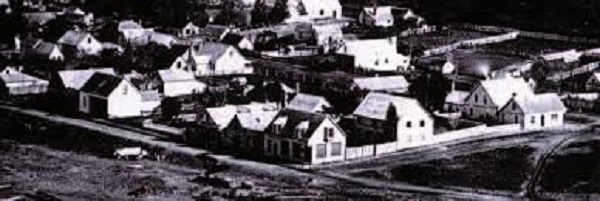 Whanganui CBD c.1865 - Source cfg heritage. Photographer unknown - the era of Hurleys store and bakery. Whanganui CBD c.1865 - Source cfg heritage. Photographer unknown - the era of Hurleys store and bakery.After 1930 Whanganui's prominence declined and today it has 45k people and is about the 10th largest town. Hurley expanded his premises after 1864 and had his brother Henry involved, later he had his sons and by 1878 had a huge 2 storey building with plate glass windows. By the time he issued these coins, he was a made man. At this time Whanganui was very much an oasis of civilisation in a wild frontier area. Pennies and Halfpennies were issued and they are quite common. My example is quite nice (VF or close to VF) but has a weak central strike. The coin is nice too for its image which sums up the nature of Hurley's business well! |
|
Pillar of the Community
4628 Posts |
Just for you all my Coombes token, you can read all about him in Daltonista's post on Page 3. 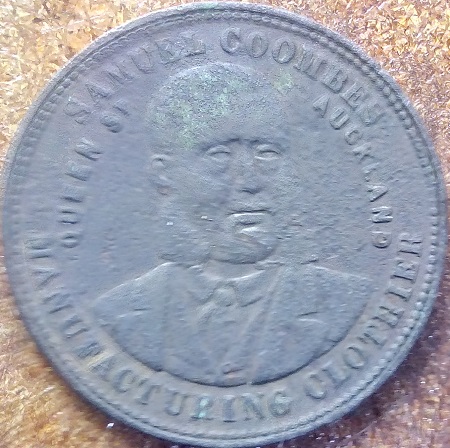 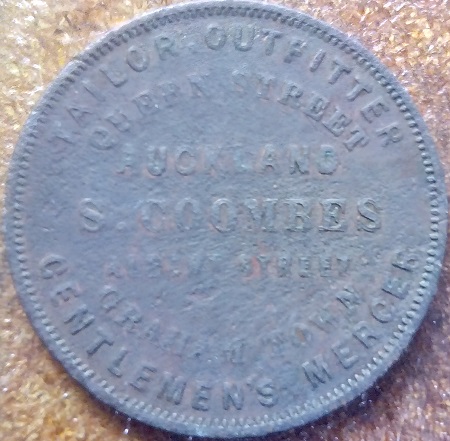 Samuel Coombes Token, 1870 - gFine/VF, some Corrosion Samuel Coombes Token, 1870 - gFine/VF, some CorrosionMy piece is not quite on Daltonista's level!  Some more Info. Coombes had stores at Grahamstown (Thames) and Auckland and he owned a whole arcade of shops in Auckland. The coins state he was also a mercer, which meant he sold fabrics. At this time (The 1870s), nearly all fabrics were imported and it was not just for clothing, you woudl need them for manchester, drapes, curtains, tapestries and blankets. No doubt fine materials along with common tweed and sack were also sold. 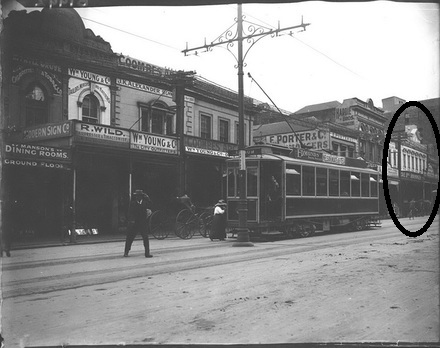 Coombes Arcade in Black circle - Auckland Museum Photo Collection, photo is early 1900s. Coombes Arcade in Black circle - Auckland Museum Photo Collection, photo is early 1900s.The building on the far right is the only survivor of the arcade. Queen Street saw much rebuilding in the Edwardian period where 2 and 3 storey masonry buildings of the 1870s/80s were bulldozed for 5 - 6 story monstrosities of the 1910s and 1920s, which in turn are now being demolished for faceless glass boxes and cheaply built apartments for students and workers. However a building which is now a Starbucks survives. Coombes himself looks the proper mid Victorian dandy with his muttonchop sideburns and silk cravat and tie. yet his stern face says all business and that even though he will make you look good and cover your home in organza, order and neatness along with professionalism will prevail. The coins are copper at 34mm round and were minted by Stokes and Co in Melbourne, a few varieties exist and the coins are quite common. Again most are worn and corroded being copper. Mine is a better than average example. There are 3 major varieties and a possible fourth, these are minor. Coombes was still trading in 1883 and by 1884 had moved to Ponsonby Road, possibly working there or renting his arcade out. I doubt he had retired as he was still only 46. We have no more info after that, a Births, Deaths and Marriages search reveals nothing, only one who died in 1903 aged 54 - being too young to be our Samuel Coombes. General comments on the issuers of these tokensThese tokens show the same pattern so far, most issuers were young men, who were on the make and had made enough money, connections and success to commemorate this in metal. Having your own tokens was the pinnacle of achievement of this era. In many ways this was the pioneer ideal, colonies like New Zealand in the early and mid Victorian era, wanted young men and women who were healthy, intelligent and strong with ambitions, hopes and dreams to build a new utopia on the other side of the world. The poor and needy, along with the rich decadent were not required as they could not thrive in a frontier. The men on these coins were those ideals. Coombes looks like a GQ foldout for 1871 or Fortune's self made set up for 1863, but I can bet you when he arrived he probably looked very different, dressed in rough sackcloth, with a few bob to his name and waiting for his first opportunity to make his mark. None went as far as Coombes by having their face on the coins though! Some criticise him for not being in profile as his nose was considered very prominent (According to Roker). Other tokens had generic scenes of Zelandia, Maoris, nature scenes and as you will see Royal Themes. Still this is an iconic token, and it makes any Kiwi token collection! Edited by Princetane
08/30/2021 06:47 am
|
|
Moderator
 United States
196100 Posts |
Outstanding!  |
|
Pillar of the Community
United States
1077 Posts |
Here are my Hurleys, almost a matched set. Renniks lists the penny and halfpenny tokens as #280 and 281, and in Andrews they're #276 and 277, with sizes at 31mm and 25mm, respectively. Although the practice wasn't universal across all the mid-19th-century token issues, these are pretty typical in that neither date nor denomination are shown. My guess is that by the 1850's any folks using coppers in the colonies would have been fully acclimated by the regal issues and any other coins that were circulating at that time. 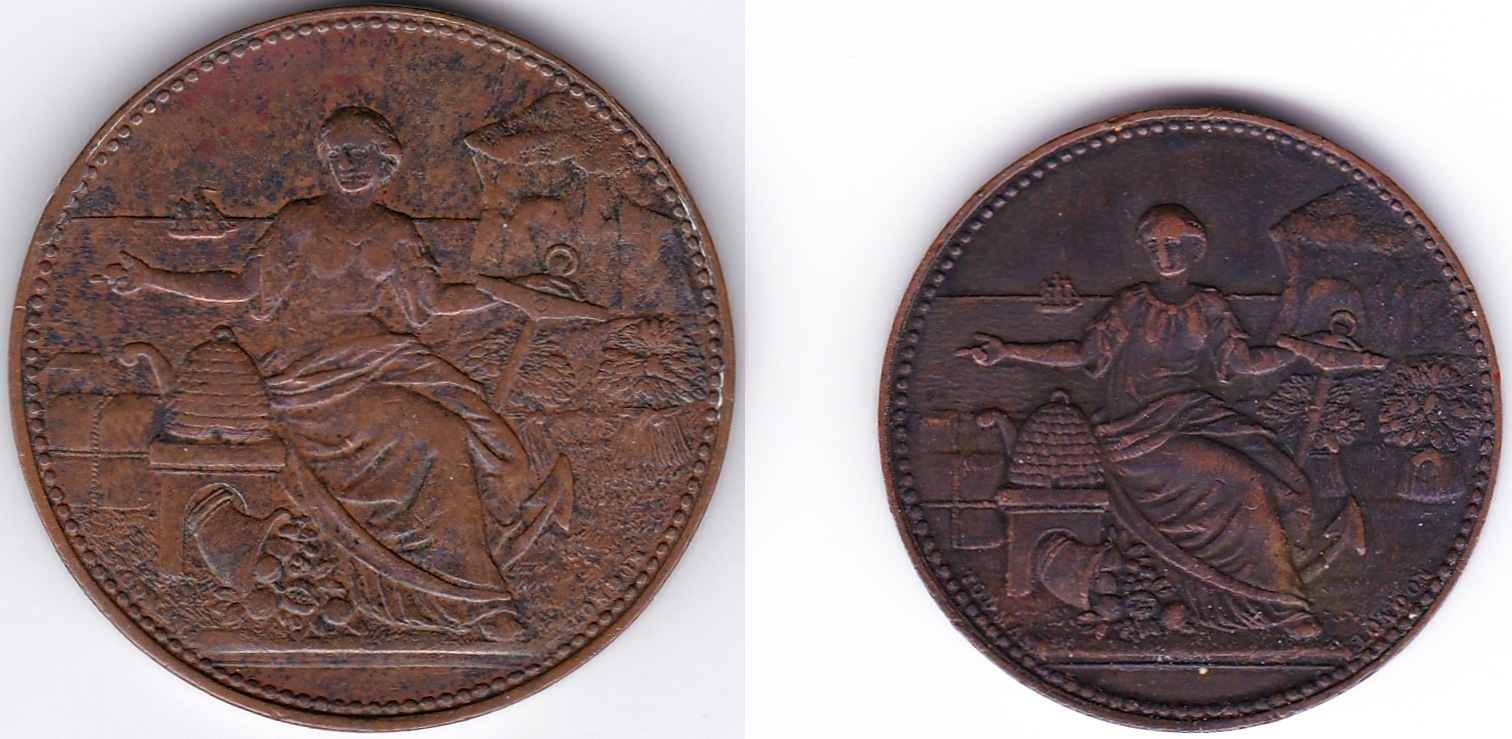 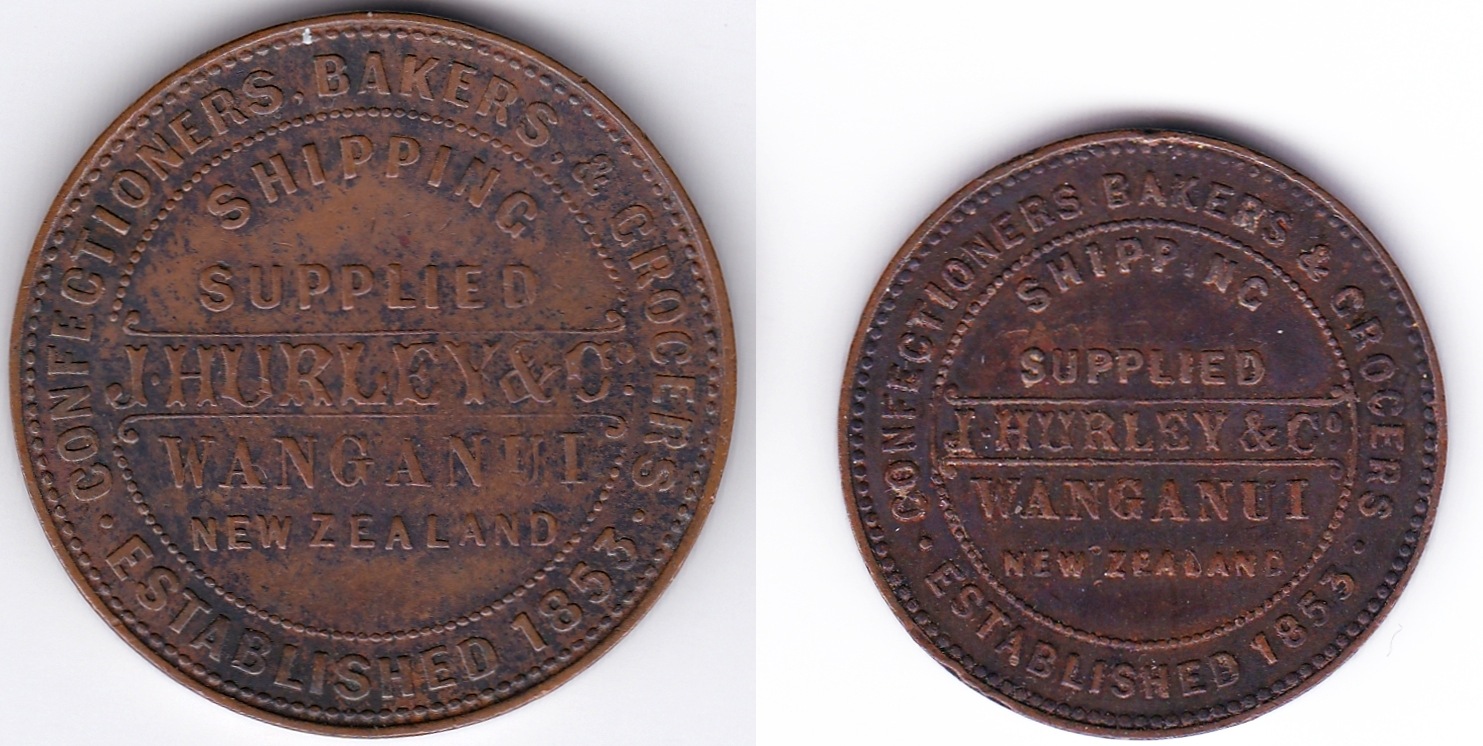 "If everything seems to be under control, you're just not going fast enough."
--- Mario Andretti
|
|
Moderator
United States
196100 Posts |
Nice examples! |
|
Pillar of the Community
4628 Posts |
Yes - Totally, British Bronze coins like the Penny and Halfpenny only had those words added with the 1860 Bun issue. Some coins like the Halfcrown and Crown remained denominationless much longer (Halfcrown in 1893 and Crowns only in 1927). Just reinforcing that theme, you showed a Halfpenny of Kirkcaldie and Stains - I have the Penny! 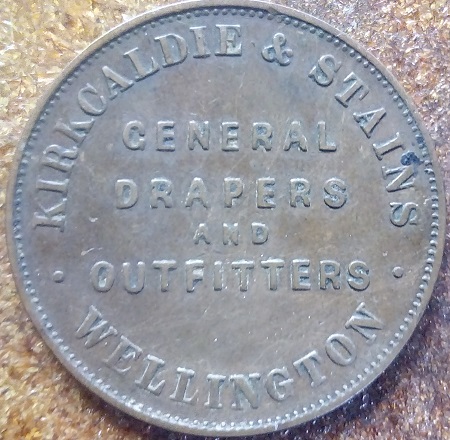 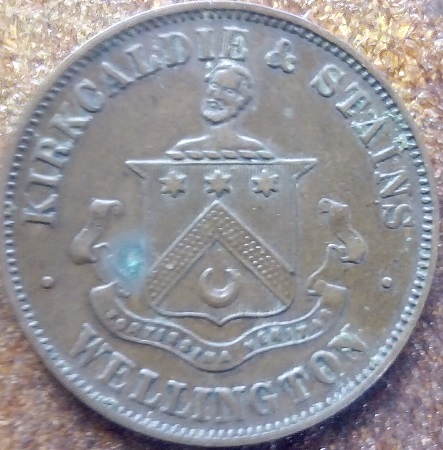 1875 Kirkcaldie and Stains Penny - gVF 1875 Kirkcaldie and Stains Penny - gVFIt is exactly the same design as the Halfpenny you showed but larger. The size is only 31mm and weighs just 8.7grams, less than a standard bronze penny. Roker suggests the mans head is possibly that of Mr Kirkcaldie. The pennies and halfpennies of this issuer are very common by our token standards and still easy to get now. John Kirkcaldie despite the name was English and Robert Stains was Scottish, their first selling endeavours started in the 1860s with them selling the cargo of a wrecked ship(!!). By the time this coin came out (c.1875 and minted by an unknown British mint) they had a 2 storey building. The building in Daltonista's photos dated from the 1900s - however behind this shell was an 1868 brick 3 storey building https://wellingtoncityheritage.org....rtment-storeThis is the original 1860s wooden building you would have walked into to spend your penny and halfpennies! 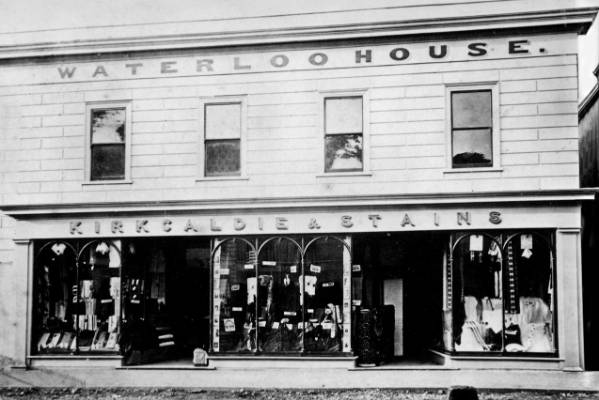 1860s - Waterloo House, (1860s - 70s photo) source, Stuff.co.nz 1860s - Waterloo House, (1860s - 70s photo) source, Stuff.co.nzPhotos of stores from this era are incredibly rare and especially in Wellington, which grew slower than other cities in NZ. It took until 1870 until Wgtn reached 10k of people, whereas the other cities hit that milestone by 1865. No doubt this building with its plate glass windows would have been very imposing in the 1860s and even 1870s. Wellington looked very frontier like until the 1900s. Most of the really old looking buildings there turn out to date from like 1903 rather than 1883. |
|
Pillar of the Community
4628 Posts |
The next coin is one of the most common and easy to find in the whole series. I have already shown worn examples of these tokens, but have splurged on a (fairly) nice example. 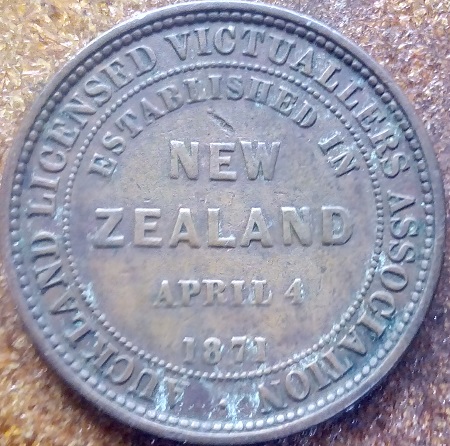 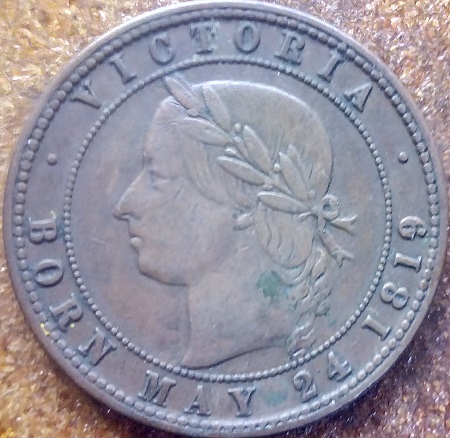 Auckland Licensed Victuallers - Penny Token 1871 or 1872 - VF/ gVF, light spots of verdigris Auckland Licensed Victuallers - Penny Token 1871 or 1872 - VF/ gVF, light spots of verdigris32mm Copper token struck by Joseph Moore of Birmingham in London. Moore according to Roker was a medallist of note. Compared to other tokens, this is very neat and the portrait of Queen Victoria is very competent mentioning her date of birth. The other side celebrates that the association was founded on April 4 1871 and these are commemorative pieces. The Auckland Licensed Victuallers Association was a group of Auckland Publicans who had a friendly Business association in the CBD of Auckland. They all had hotels and they met at the British Hotel (Circled). 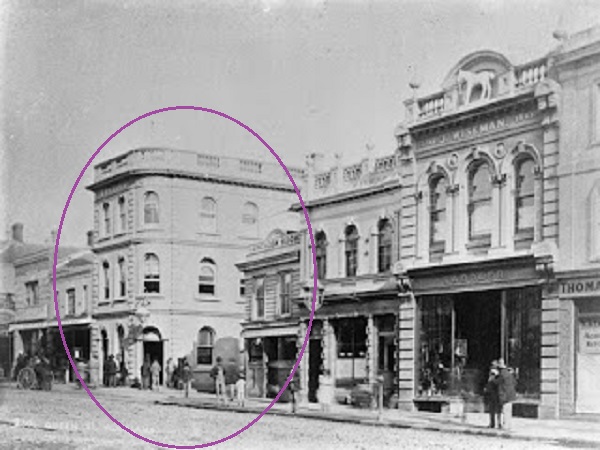 The British Hotel, Auckland (Queen and Durham Streets) c.1880 - Photo source - http://www.firstyearthamesgoldfield...st-1867.html The British Hotel, Auckland (Queen and Durham Streets) c.1880 - Photo source - http://www.firstyearthamesgoldfield...st-1867.htmlThe tokens were issued in HUGE numbers and as Roker mentions, that in 1873 some 50% of all copper coinage in use in New Zealand was tradesmens tokens. The Assiociation used these penny tokens for change in their bars. In the 1870s, the average glass of beer cost 2d or 3d and thus many small denomination coins were needed. Also we did not make our own bottles until a Crown cap bottling plant opened in 1922 (I did a dissertation on 19th century drinking patterns in NZ in my University days) and many bottles were recycled - usually black glass beer bottles (Lady's legs) and the reused green Champagne style bottles. Often returning a bottle got you a penny returned. Of course bar room brawls were common and many got smashed, hence why many are dug up today. These tokens no doubt saw much use and despite their commonness, most survive heavily worn and high grade ones, whilst not rare - do attract a premium. No doubt they were used well up to the mid 1880s, when imperial coin supplies improved. There are 3 types of this token, all are minor changes. The ALV became the Hospitality Association in the 1980s and evolved into the one of today - so a long start and 2021 is the 150th birthday of these tokens. In an era where all the pubs are shut due to a Covid 19 Lockdown! Edited by Princetane
08/31/2021 06:35 am
|
|
Moderator
United States
196100 Posts |
Very interesting! |
|
Pillar of the Community
4628 Posts |
Another day, another token. S Hague Smith, Ironmonger. 1840 - 1917 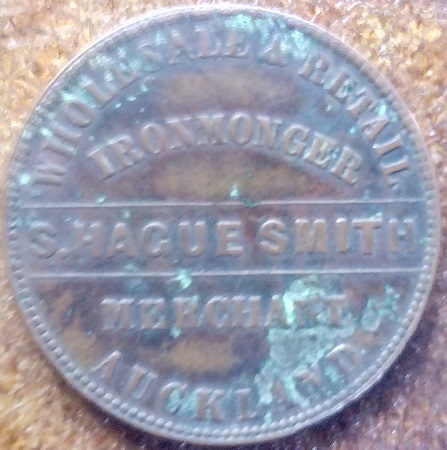 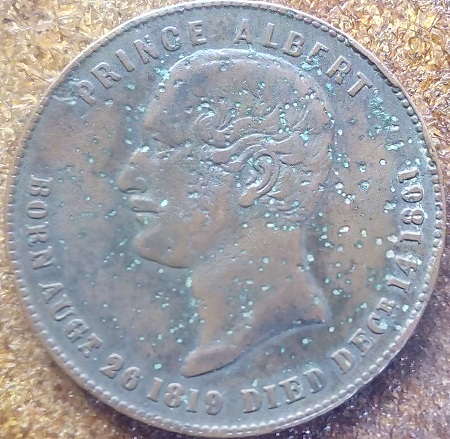 Samuel Hague Smith, Iron Monger, Auckland - Copper Penny Token 1862 - VF and some verdigris. Samuel Hague Smith, Iron Monger, Auckland - Copper Penny Token 1862 - VF and some verdigris.The token was minted by Heaton and Sons (Birmingham) in 1862 and 1863 and there are 3 types. Made out of copper and 34mm in diameter (Same size as old copper pennies 1821 - 1859). Another source claims it was minted by Stokes in Melbourne. Given there were 6 confirmed and possibly 7 varieties, it may be true some were minted in both places. The time is right (Pre 1867) for Stokes and for Heatons in the UK to still be using large copper blanks in the time of Bronze coinage seems strange, but this did happen with Tradesmen products, which were generally minted to a lower standard than imperial coinage. Also it was 1862, so they had just entered the Bronze coin era. One basic token design, 6 confirmed varieties. My coin is second variety with the A in "Merchant" looking like a re entry. This token is early and fairly common, the verdigris lets it down a bit - but the grade is high for this token which is usually found in VG or worse condition. There is a lot of sharp detail on Prince Albert's bust that goes beyond VF and near EF. The token announces his name and services with locations on one side and the other shows a bust of Prince Albert, the Consort of Queen Victoria who died in Dec 1861. This is a interesting token to show Prince Albert rather than her Majesty or a colonial/scenic/Maori scene. Hague- Smith was born in Lincolnshire in 1840, came to NZ in 1859 and was only 22 when this token was issued. Again subscribing to the ethos of the self made Pioneer man. He also fought in the New Zealand wars and was given a large chunk of land at Northcote on the North Shore according to Roker. His Iron Mongery was successful (Think all the verandas, posts and filigree work that you have on overdone Victorian buildings). He also owned ships and was a patriot loving Royalty. His steamers included the Prince Albert and Royal Alfred (After the Duke) and no doubt this influenced his choice of the Prince Consort on his coins. He also moved to Sydney in the 1870s, dabbled in Politics and ran the Colonial Mutual Insurance company, dying in 1917. Some more about Smith and fellow token issuer Benjamin Gittos https://timespanner.blogspot.com/20...history.htmlEdited by Princetane
09/01/2021 05:57 am
|
|
Pillar of the Community
4628 Posts |
My last one of the new tokens and most interesting. United Service Hotel, Auckland, Penny 1874 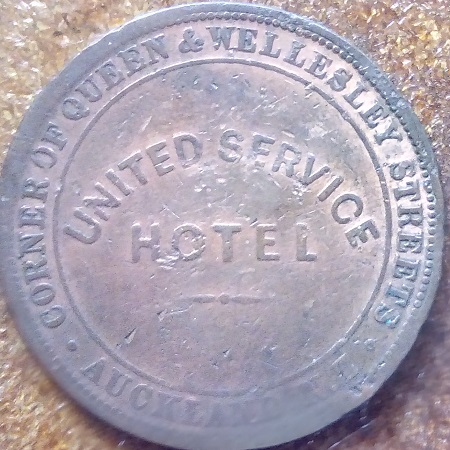 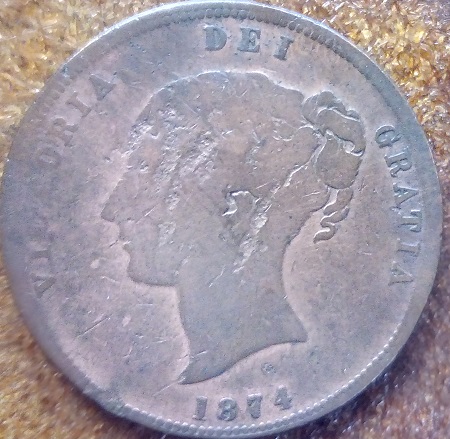 United Service Hotel, Auckland - Penny Token 1874 - Copper Cleaned Fine/VG condition. United Service Hotel, Auckland - Penny Token 1874 - Copper Cleaned Fine/VG condition.This one was cheap as its been cleaned and Victoria is worn away to a silhouette. Unknown British mint and made out of copper. The token is 34mm in size and by the standards of 1874, very basic. The portrait of Victoria is similar to the Young Head seen on 1838 - 1887 Silver and Gold coins, but more crudely executed. There are two types, United Service Hotel is straight on two lines on one and bowed like on this one. The coin is dated 1874. The United Service Hotel goes back to the 1850s, but the wooden building burnt down in a nasty fire in Dec 1873 (Some say it was an insurance fraud, as burning down unprofitable hotels was common in early Auckland). It was rebuilt in beautiful plaster covered brick in 1874, the same year as the token. 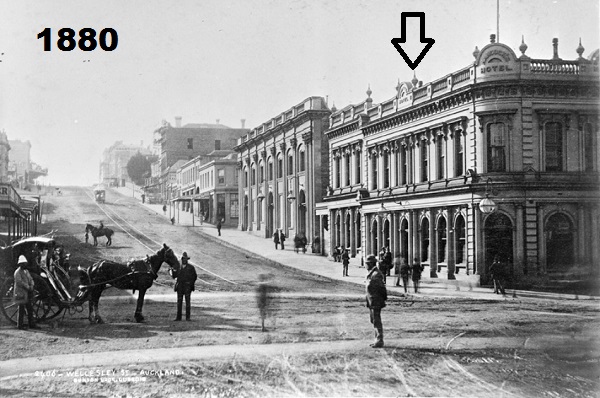 United Service Hotel 1880, Source - Early Auckland Images, City Rail Link - https://www.cityraillink.co.nz/earl...land-images/ United Service Hotel 1880, Source - Early Auckland Images, City Rail Link - https://www.cityraillink.co.nz/earl...land-images/(You can also see it in 1927 there) In the 1880s, one of the Hoteliers was charged with doing illegal sweeps (Gambling, racketeering) and fled to Australia. The pub always had a reputation as a central city waterhole and later as a student bar. Today it survives and is an Irish bar in one part, live music bar, an underground pokie bar and Travel Agency and cheap dairy. It is hemmed in by the large 1928/29 Smith and Caugheys Department store. 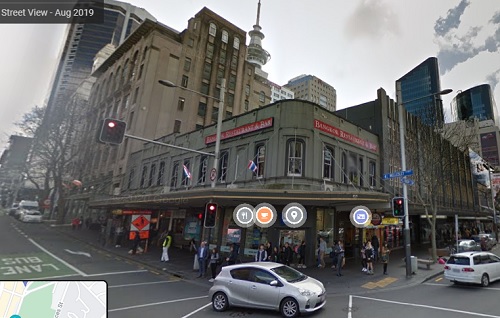 The Hotel in 2019 before Lockdown closures. - Source google maps. The Hotel in 2019 before Lockdown closures. - Source google maps.The elaborate Victorian door and window frames with parapet were removed in the 1930s and 1940s after nearby earthquakes saw this gingerbread Victorian fripperies as dangerous and the building was "Decoised" at the same time. Unlike the other tokens, we know very little about the issuers - but at least the building survives. Edited by Princetane
09/01/2021 06:32 am
|
|
Moderator
United States
196100 Posts |
Impressive! |
| |
Replies: 105 / Views: 11,358 |
To participate in the forum you must log in or register.
Disclaimer: While a tremendous amount of effort goes into ensuring the accuracy of the information contained in this site, Coin Community assumes no liability for errors. Copyright 2005 - 2026 Coin Community Family- all rights reserved worldwide. Use of any images or content on this website without prior written permission of Coin Community or the original lender is strictly prohibited.
Contact Us | Advertise Here | Privacy Policy / Terms of Use
|
| Coin Community Forum |
© 2005 - 2026 Coin Community Forums |
| It took 0.64 seconds to rattle this change. |
 |
|
| |
| |







 First Page
 Previous Page


 Posted 08/25/2021 01:22 am


