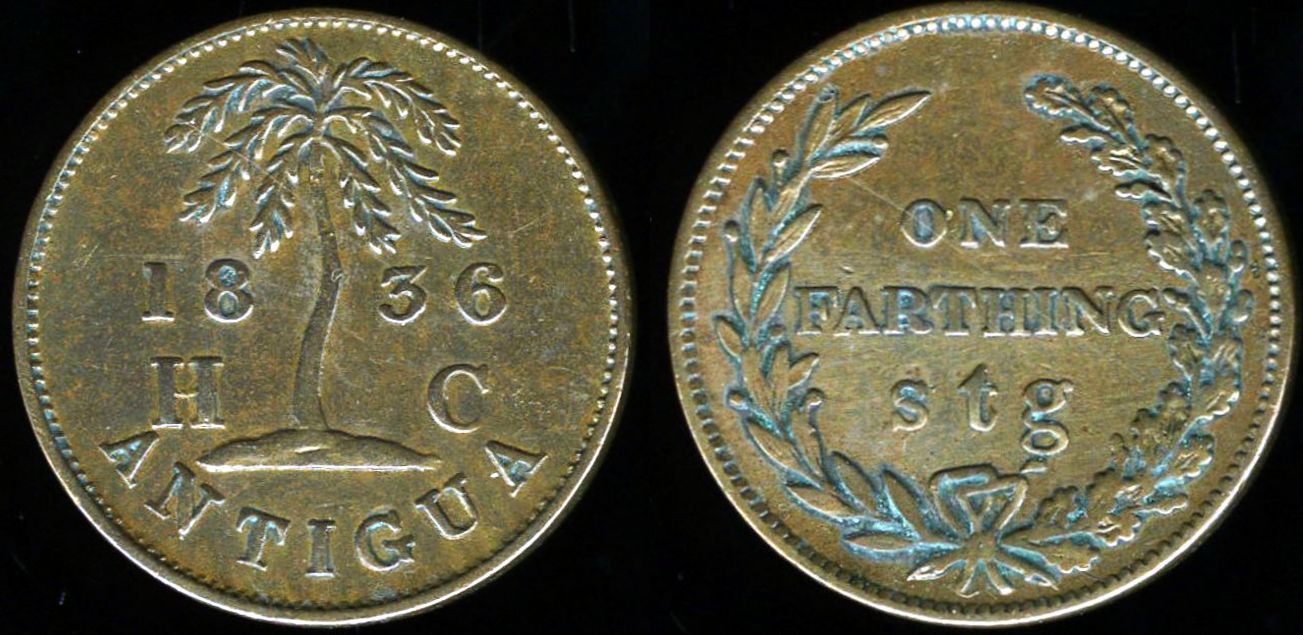
This 1836 farthing from Antigua, the only pre-Commonwealth money linked by name to that tiny Caribbean island nation, has been in my "Tokens of the British World" collection for a quarter century or so. In all that time, until this morning, I've never been able to figure out what the initials "stg" under the denomination meant...some sort of mintmark, I surmised. Jerry Remick's big black book on Commonwealth coins and tokens was my bible and stockbook for that collection, and the Pridmore books were my backup for varieties and more detailed research, but I don't recall ever finding anything specifically helpful on this question from either of those distinguished authors. Right now, I'd have to rearrange my attic to even find those books!
For the record, to digress a bit, the initials on the
obverse stand for Hannay and Coltart, who were tradesmen/merchants in St. Johns, Antigua's capital city. The token was issued circa 1850 and the date on it indicates the year their business was established, according to my notes on the 2x2 envelope (lined with a cotton sleeve, for the careful among us). That packet also indicates it's KM Tn1 and P1 (presumably Major Pridmore's designation).
Now just this morning, through the miracle of the Internet, I was able to track down not one, but two (!), sources for that little tidbit of information I'd been missing all those years. The "stg" turns out to be an abbreviation for "Sterling," as reported in the following two sources, now available on the WWW for perusal and downloading.
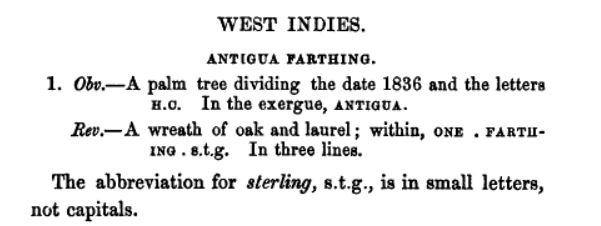
The first hit to appear in my Google search was published in 1862 by Henry Christmas, in an article entitled "COPPER COINAGE OF THE BRITISH COLONIES IN AMERICA." (
The Numismatic Chronicle and Journal of the Numismatic Society, vol. 2, 1862, pp. 191-212,
https://www.jstor.org/stable/42680077). Here's Mr. Christmas's citation:
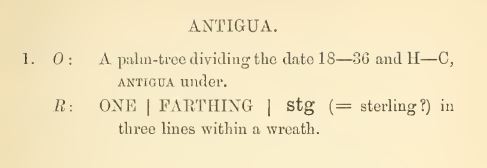
The next relevant citation is from James Atkins in his 1889 book:
...where on page 313 he notes with a question mark:
Taken together, that's good enough for me. Case closed!










 Posted 08/22/2021 3:04 pm


