



Coin Community Family of Web Sites Join Thousands of Coin, Bullion, & Money Collectors
Specializing in Modern Numismatics Join Thousands of Coin, Bullion, & Money Collectors Royal Canadian Mint products, Canadian, Polish, American, and world coins and banknotes. 300,000 items to help build your collection! Vancouvers #1 Coin and Paper Money Dealer Shop for APMEX Bullion on eBay!Coin, Banknote and Medal Collectors's Online Mall


Username:
Password:
Save Password
Forgot your Password?


This page may contain links that result in small commissions to keep this free site up and running.

Welcome Guest! Registering and/or logging in will remove the anchor (bottom) ads. It's Free!

Early Copper Weight Differences

To participate in the forum you must log in or register.
Author Previous TopicReplies: 3 / Views: 1,037Next Topic  
Pillar of the Community
MisterT's Avatar
United States
2003 Posts
 Posted 11/06/2021  12:20 pm Show Profile   Bookmark this topic Add MisterT to your friends list Get a Link to this Message Number of Subscribers
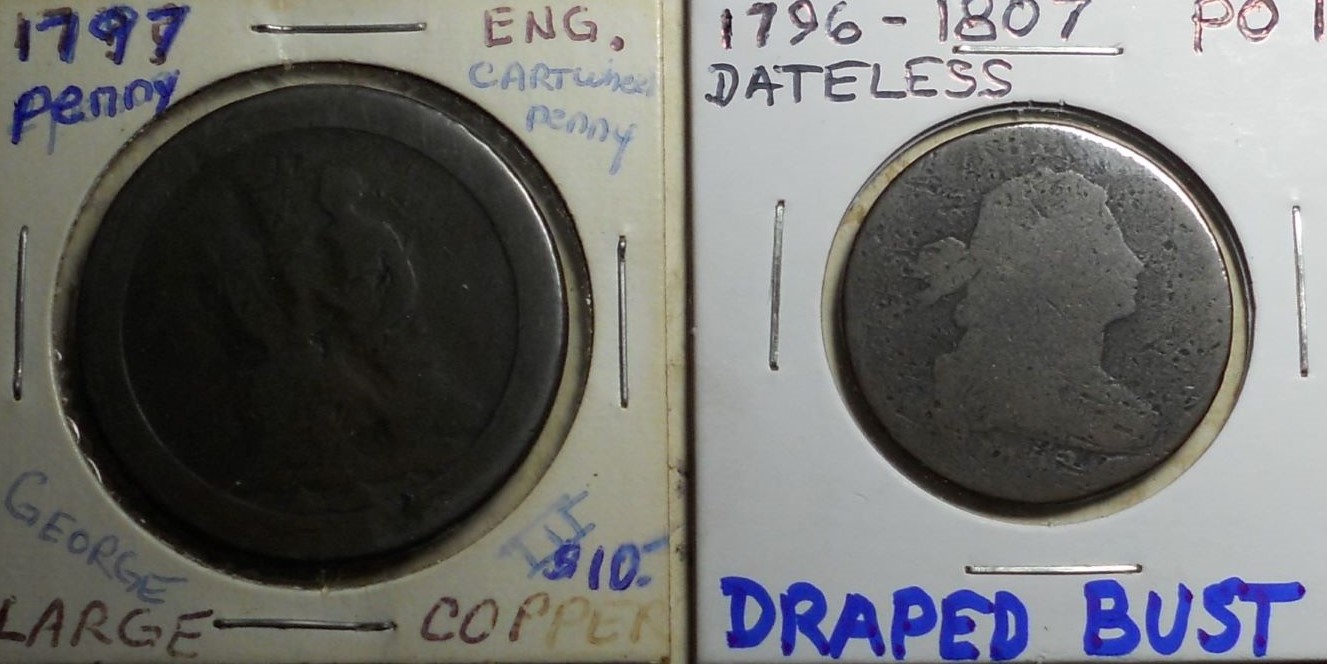
Perhaps it is not fair to compare a large foreign copper to that of an early U.S. copper, however considering that both coins circulated within the colonies, I couldn't help but noticing that the British Cartwheel Penny with a weight of 28.3 grams carried the same value as the U.S. Draped Bust Cent from the same period yet the Bust coin only weighed 10.98 grams. Seems to me that the British Cartwheel should have been worth almost Three Cents compared to the Bust cent at the time. Am I missing something here?
Early-Copper-Weight-Differences
Bedrock of the Community
Conder101's Avatar
United States
17884 Posts
 Posted 11/09/2021  07:42 am  Show Profile   Bookmark this reply Add Conder101 to your friends list Get a Link to this Reply
You are missing three things.

First the British cartwheel penny did not circulate in the colonies, it was struck 14 years after we had gained out independence and 4 years after we had our own mint producing coins.

Second the value of a British penny and a US cent were NOT the same. The US cent was much more closely related in value to the older lighter weight half penny of the 1770 - 1775 era. Those half pennies were the major circulating British coin in the colonies
The Spanish milled dollar was worth 100 US cents, but it was worth 57 British pence.

Third the weight of the cent was reduced in 1795. That British penny would have been closer to a little over two of the 13.5 gram pre 1796 cents.

Rising copper prices got to the British too and when the next pennies were struck in 1799, their weight was significantly reduced as well.
Edited by Conder101
11/09/2021 07:56 am
Pillar of the Community
MisterT's Avatar
United States
2003 Posts
 Posted 11/09/2021  3:39 pm  Show Profile   Bookmark this reply Add MisterT to your friends list Get a Link to this Reply
Conder, Interesting observations. I should have clarified one thing better. Since there is indeed a difference in the numismatic world between "Colonial" and "early", I should have more accurately referred to the circulation of the cartwheel during early 1800's. My understanding is that it was only minted in 1797. It must have circulated here at some point during the early 1800's and I assume that merchants of that time still had to conduct trade based upon the weight of a particular metal and not the denomination. As you can see, my example is heavily circulated and I was barely able to identify it. My assumption was that if say a 1800 Bust Cent was only worth 1 cent of copper at the time, then the much heavier cartwheel must have been worth almost three times as much. Even though the US mint began striking coinage in 1792, would not the foreign coinage still be of circulating value during the early 1800's? I don't know, just an interesting thought to ponder. Whenever I handle any old coin I always wonder who's hands it had been through.
Bedrock of the Community
Conder101's Avatar
United States
17884 Posts
 Posted 11/17/2021  06:21 am  Show Profile   Bookmark this reply Add Conder101 to your friends list Get a Link to this Reply
While unfamiliar gold or silver coins may have been accepted based on weight known pieces were taken based on denomination and accepted at se values (there were actually printed exchange rate tables) Copper coins before about 1790 were accepted more on size mainly in comparison to the British half penny. Around 1790 there was a glut of copper tokens and the acceptable value of pieces without a known or marked denomination fell drastically. So after 1790 most copper traded by denomination. As far as I know the Cartwheel two pence never circulated in this country but if it had it probably would have been accepted a 4 cents sice it was the the same as 4 half pennys and a cent and a half penny were of roughly equal value.

Foreign gold and silver coins did still circulate in the US until 1857 (some people think all foreign coins were legal tender until then the it was only specific ones and only are certain times) But copper was never legal tended and circulated only with the approval of the merchant and as a convenience in making change.
  Previous TopicReplies: 3 / Views: 1,037Next Topic  

To participate in the forum you must log in or register.


Disclaimer: While a tremendous amount of effort goes into ensuring the accuracy of the information contained in this site, Coin Community assumes no liability for errors. Copyright 2005 - 2026 Coin Community Family- all rights reserved worldwide. Use of any images or content on this website without prior written permission of Coin Community or the original lender is strictly prohibited.
Contact Us  |  Advertise Here  |  Privacy Policy / Terms of Use

Coin Community Forum © 2005 - 2026 Coin Community Forums
It took 0.28 seconds to rattle this change. Forums