Coin Community Family of Web Sites Join Thousands of Coin, Bullion, & Money Collectors
300,000 items to help build your collection! Specializing in Modern Numismatics Shop for APMEX Bullion on eBay!Vancouvers #1 Coin and Paper Money Dealer Royal Canadian Mint products, Canadian, Polish, American, and world coins and banknotes. Coin, Banknote and Medal Collectors's Online Mall Join Thousands of Coin, Bullion, & Money Collectors


Username:
Password:
Save Password
Forgot your Password?


This page may contain links that result in small commissions to keep this free site up and running.

Welcome Guest! Registering and/or logging in will remove the anchor (bottom) ads. It's Free!

A Lavishly Illustrated Short Course In George III's Silver Bank Tokens

To participate in the forum you must log in or register.
Author Previous TopicReplies: 5 / Views: 1,473Next Topic  
Pillar of the Community
daltonista's Avatar
United States
1058 Posts
 Posted 11/15/2021  5:10 pm Show Profile   Bookmark this topic Add daltonista to your friends list Get a Link to this Message Number of Subscribers
Britain's 1810-1820 "Regency Era" encompassed the last decade of George III's life and reign, when the Crown was basically going broke as a consequence of its far-flung foreign military adventures on land and at sea. During that period, the Bank of England (BOE) was authorized to supply, at its own expense, a necessity or emergency coinage in the form of silver bank tokens. These were issued 1811-1816 to help meet the dire need in Britain for widely accepted "legal tender" in the absence of the "regal" coinage the Crown and government could not afford to provide.

Shown in the photos below, which can be vastly enlarged with a mouse click, are most of my date set of these tokens. I have a few others, but they're slabbed (in MS grades), and I haven't yet got my iPhone photography and lighting skills at a level sufficient to meet that challenge. Speaking of which, apologies are in order here: none of the proof-like fields and lovely lustre and toning dripping off these tokens shows up in the photos below...entirely my bad.

The bank tokens circulated in two denominations: Three Shillings (3/-) and One Shilling Six Pence (1s 6d; 1/6d; or 18d). There was a Nine Pence pattern of the laureate head type (ESC 1478-80) struck in 1812 as well, in three varieties, but its issue was never authorized. Over the six-year span of their mintage, each denomination was issued in two types, the cuirassed or armoured bust of 1811 and 1812, and the wreathed laureate head of 1812-1816. The transition between the two types occurred in 1812, so both types were struck that year. Lewis Pingo is the engraver of record, at least for the obverse. The 3/- piece is 34mm in diameter and weighs in at 14.7g, while the 18d is 26mm and 7.35g.

For collectors who are so inclined, there are ten distinct varieties of the 3/- token, all of which depend on the number or orientation of leaves, acorns, and/or berries. (That count excludes some nearly unobtainable proofs and off-metal strikes in gold and platinum.) As for the 18d piece, no varieties are noted in Seaby's The English Silver Coinage (ESC) -- just the two types across six years, for a total of seven attainable examples to complete the set. Of the tokens in this series that were issued for circulation and are thus targeted by most collectors, there is only one monster rarity: the 3/- piece of 1816. These rarely come up for sale; if I see them twice a year, that's a busy year. Currently there's a PCGS-slabbed EF-45 example available on ebay at an odd BIN price of US $3,712.00.

Top row: 3 Shillings -- Armoured Bust, 1811 (ESC 408, Davis 47); Laureate Head, 1812 and 1814 (ESC 421 and 422, Davis 57 and 58).
Center row: 18 pence - Armoured Bust, 1811 and 1812 (ESC 969 and 970, Davis 61 and 63); Laureate Head, 1812 (ESC 971, Davis 64).
Bottom row: 18 pence -- Laureate Head, 1813-14-15-16 (ESC 976-77-78-79, Davis 65, 67-68-69).


A-Lavishly-Illustrated-Short-Course-In-George-III's-Silver-Bank-Tokens

A-Lavishly-Illustrated-Short-Course-In-George-III's-Silver-Bank-Tokens


"If everything seems to be under control, you're just not going fast enough."
--- Mario Andretti


Edited by daltonista
11/15/2021 5:14 pm
Pillar of the Community
JohnConduitt's Avatar
United Kingdom
725 Posts
 Posted 11/15/2021  5:58 pm  Show Profile   Bookmark this reply Add JohnConduitt to your friends list Get a Link to this Reply
Nice tokens. I went for one of each of the cheaper ones, but I didn't know there was a $4k variety! I'm definitely after one with the armoured bust next.

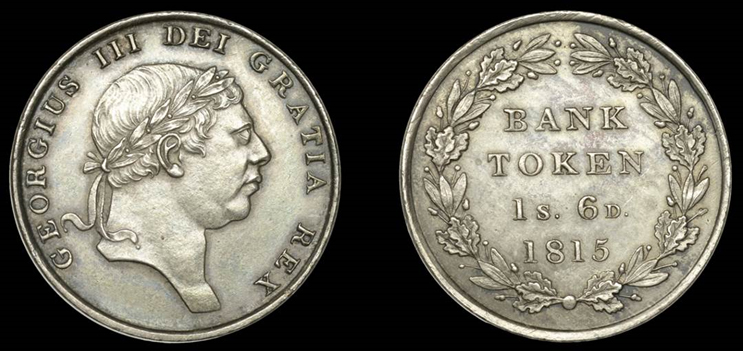
George III Eighteenpence Bank Token, 1815
A-Lavishly-Illustrated-Short-Course-In-George-III's-Silver-Bank-Tokens
Bank of England. Silver, 7.3g (S 3772).

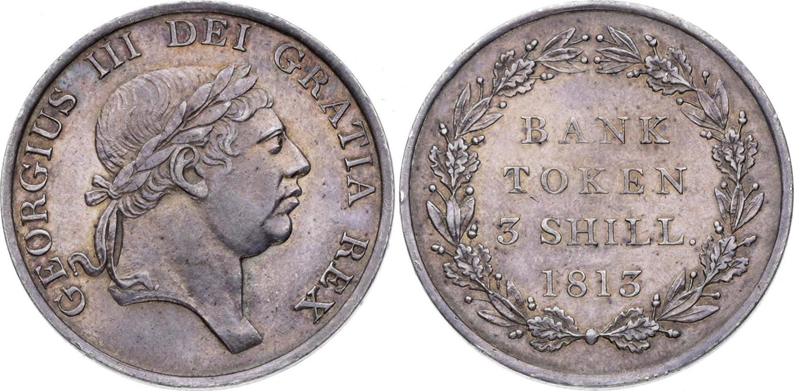
George III 3 Shilling Bank Token, 1813
A-Lavishly-Illustrated-Short-Course-In-George-III's-Silver-Bank-Tokens
Bank of England. Silver, 14.8g (S 3770).

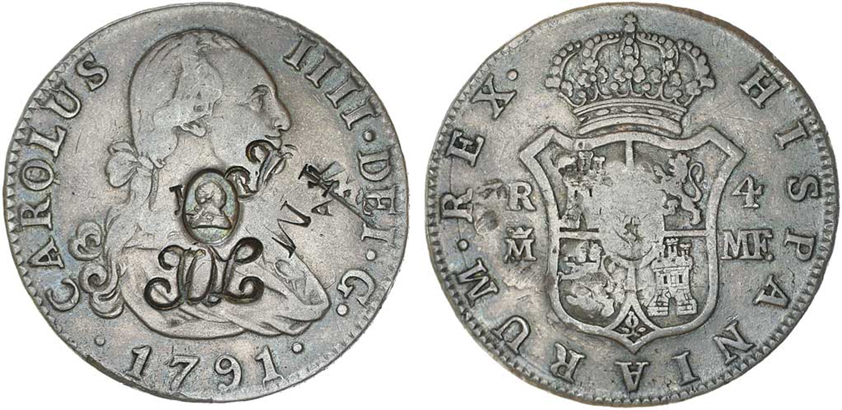
Before these tokens were issued, the Bank of England issued some emergency coinage using Spanish silver (when The Royal Mint seemed incapable of doing so):

George III Half Dollar, Countermark 1797
A-Lavishly-Illustrated-Short-Course-In-George-III's-Silver-Bank-Tokens
Madrid. Silver, 13.0g. Oval countermark on a Charles IIII four reales, 1791MF (S 3767).

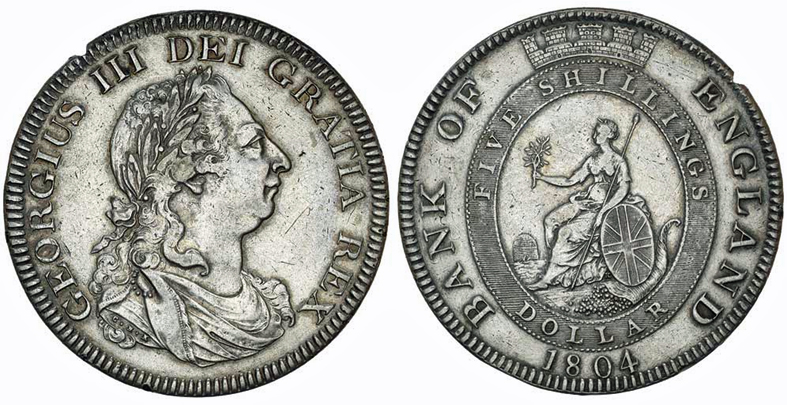
Matthew Boulton (who'd already produced copper tokens and Cartwheel one and two penny coins to help with smaller change) then persuaded the Bank he could do better. He produced these dollars by flattening Spanish 8 reales coins from the Bank's silver reserves:

George III Dollar, 1804
A-Lavishly-Illustrated-Short-Course-In-George-III's-Silver-Bank-Tokens
Soho, Birmingham. Silver, 27g (S 3768). Includes a test cut - the public really did not trust the coinage!
Bedrock of the Community
sel_69l's Avatar
Australia
21788 Posts
 Posted 11/15/2021  5:59 pm  Show Profile   Bookmark this reply Add sel_69l to your friends list Get a Link to this Reply
Coins illustrated would have to form one of the best quality collections of B.O.E. 3/- and 1/6 silver tokens outside of a museum.

I have only one representative in each of the denominations illustrated:
a 3/- laureate head of 1812, in gF and
a 1/6 laureate head of 1812, also in gF but with minor impact damage.

I also have a privately issued silver Eighteen Pence and two privately issued shillings, (all VF), a Bank of Ireland Six Shillings silver token in gF and a George 111 Oval over stamp Spanish 8 reales in vG.

(all British grading, so hardly a musuem quality collection)

Having a copy of
British Tokens and Their Values
is very helpful if you are collecting in this very interesting era of British numismatics.
Pillar of the Community
Princetane's Avatar
4628 Posts
 Posted 11/15/2021  8:43 pm  Show Profile   Bookmark this reply Add Princetane to your friends list Get a Link to this Reply
I think I just died and went to heaven. I don't have any as of yet.

Interesting how tokens were issued in 1816, the year of the great recoinage - so I suspect that 1816 dated circulation coins likely came out at the end of 1816 or even in 1817.

And I assume all are modern steam machine made coins (Collared) rather than the "milled" style of 1660 - 1787.
Pillar of the Community
JohnConduitt's Avatar
United Kingdom
725 Posts
 Posted 11/16/2021  06:35 am  Show Profile   Bookmark this reply Add JohnConduitt to your friends list Get a Link to this Reply

Quote:
Interesting how tokens were issued in 1816, the year of the great recoinage - so I suspect that 1816 dated circulation coins likely came out at the end of 1816 or even in 1817.

The Coinage Act 1816 wasn't passed until June, so presumably the Bank of England kept going with their tokens until then. Although only to the extent that a 1816 3 shilling token is now worth $4000...


Quote:
And I assume all are modern steam machine made coins (Collared) rather than the "milled" style of 1660 - 1787.

The mint moved to Tower Hill in 1810 and was fully operational by 1812. It came with steam presses. Matthew Boulton (who'd been making the 1804 dollars) had already developed the technology.
Valued Member
Canada
363 Posts
 Posted 11/16/2021  07:45 am  Show Profile   Bookmark this reply Add ironhorse to your friends list Get a Link to this Reply
These tokens circulated in Atlantic Canada in the time when small change and many other coins were in short supply. I've found the 3 shilling and the 18 pence on separate occasions and are among some of my favourite finds from metal detecting over the years. Coins from all over the globe show up at many of our early sites including Irish silver tokens from the same era.
Thanks for the great info on these tokens!
  Previous TopicReplies: 5 / Views: 1,473Next Topic  

To participate in the forum you must log in or register.


Disclaimer: While a tremendous amount of effort goes into ensuring the accuracy of the information contained in this site, Coin Community assumes no liability for errors. Copyright 2005 - 2026 Coin Community Family- all rights reserved worldwide. Use of any images or content on this website without prior written permission of Coin Community or the original lender is strictly prohibited.
Contact Us  |  Advertise Here  |  Privacy Policy / Terms of Use

Coin Community Forum © 2005 - 2026 Coin Community Forums
It took 0.25 seconds to rattle this change. Forums