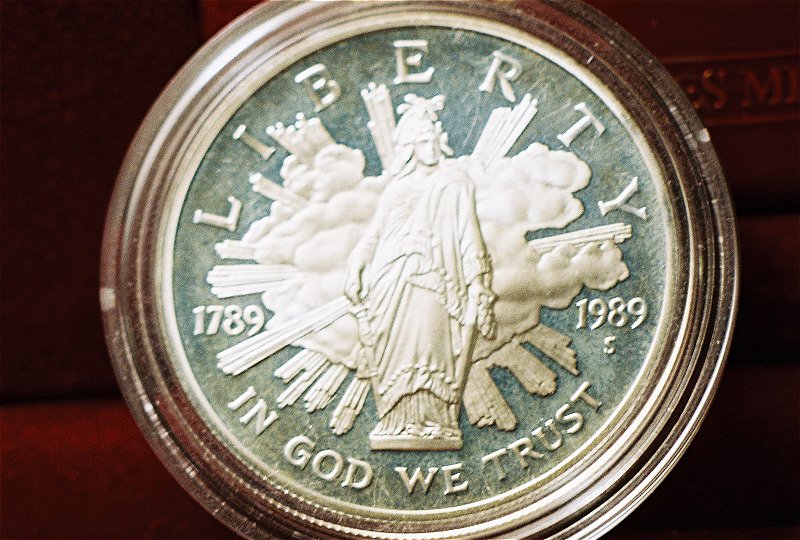
In 1989, the US Mint produced a three-coin program to commemorate the 200th anniversary of the first session of the US Congress. The coins were struck for the benefit of the United States Capitol Preservation Commission for its use in "providing for improvements in, preservation of, and acquisitions for, the United States Capitol" and "providing for works of fine art and other property for display in the United States Capitol and at other locations under the control of the Congress."
Per the authorizing legislation for the coins, the first $40 million in surcharge funds collected were to be deposited in the account of the Commission; surcharges collected above this level were to be deposited in the General Fund of the US Treasury for the purpose of reducing the national debt. To reach such a lofty surcharge goal, many millions of the program's coins would need to sold.
Congress authorized 1,000,000 Gold Half Eagles, 3,000,000 Silver Dollars and 4,000,000 CuNi Clad Half Dollars (a total of 8 million coins!). Sales, however, did not reach such levels, though they did surpass two million units overall. A total of 211,589 Gold Half Eagles ($5) were sold, plus 897,401 Silver Dollars and 931,650 CuNi Clad Half Dollars. With surcharges of $35/$7/$1, respectively, the coin's sales generated approximately $14.6 million in surcharges. As the collected surcharge total fell far short of the $40 million threshold, no funds were deposited in the General Fund of the Treasury.
The US Congress, and its two chambers - Senate and House of Representatives, was created by the US Constitution. It formally became the Legislative Branch of the Federal Government upon the ratification of the Constitution on June 21, 1788 when New Hampshire voted in favor of the document.
The first official meeting of Congress was held on March 4, 1789 at Federal Hall in New York City. This is the date being commemorated by the coin program.
CuNi Clad Half DollarThe obverse of the Congress half dollar presents a "head shot" of the
Statue of Freedom, the bronze statue that stands atop the dome of the US Capitol. The Statue was created by sculptor Thomas Gibson Crawford. Crawford was born in New York City on March 22, 1814. In 1835, he moved his home and studio to Rome, Italy where he stayed for the rest of his life. He died on October 10, 1857 in London, England, the result of cancerous eye and brain tumors that first cost him his vision, then his career and, ultimately, his life.
The plaster model of the statue was shipped to the US from Italy, in sections, after Crawford's death. The sections were cast in bronze at a foundry near Washington, DC. The final piece of the bronze statue was put in place atop the Capitol Dome on December 2, 1863. (Side Note: The statue was originally referred to as
Freedom Triumphant in War and Peace.) The coin's reverse presents a full view of the east face of the Capitol Building surrounded by a segmented ring of 13 five-pointed stars - seven above and six below.
Independent artist/sculptor Patricia Lewis Verani designed and modeled the coin's obverse and free-lance artist/painter William Woodard created the reverse design. US Mint Sculptor-Engraver Edgar Z. Steever IV modeled the reverse design.
1989 US Congress Bicentennial Half Dollar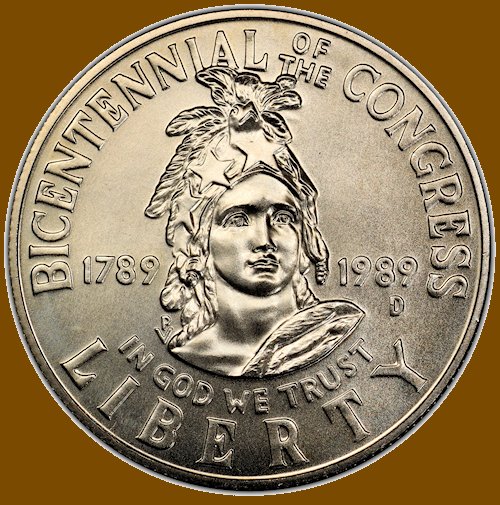
 Mintage Breakdown:
 Proof = 767,897 // Uncirculated = 163,753 // Total = 931,650.
Silver DollarThe 1989 Congress Bicentennial Silver dollar features a depiction of the bronze
Statue of Freedom that tops the US Capitol. Clouds are seen behind the Statue, with rays of sunlight bursting out from behind in all directions.
From the web site of the Architect of the Capitol:
"Statue of Freedom is a classical female figure with long, flowing hair wearing a helmet with a crest composed of an eagle's head and feathers. She wears a classical dress secured with a brooch inscribed "U.S." Over it is draped a heavy, flowing, toga-like robe fringed with fur and decorative balls. Her right hand rests upon the hilt of a sheathed sword wrapped in a scarf; in her left hand she holds a laurel wreath of victory and the shield of the United States with 13 stripes."Statue of Freedom Atop Capitol Dome 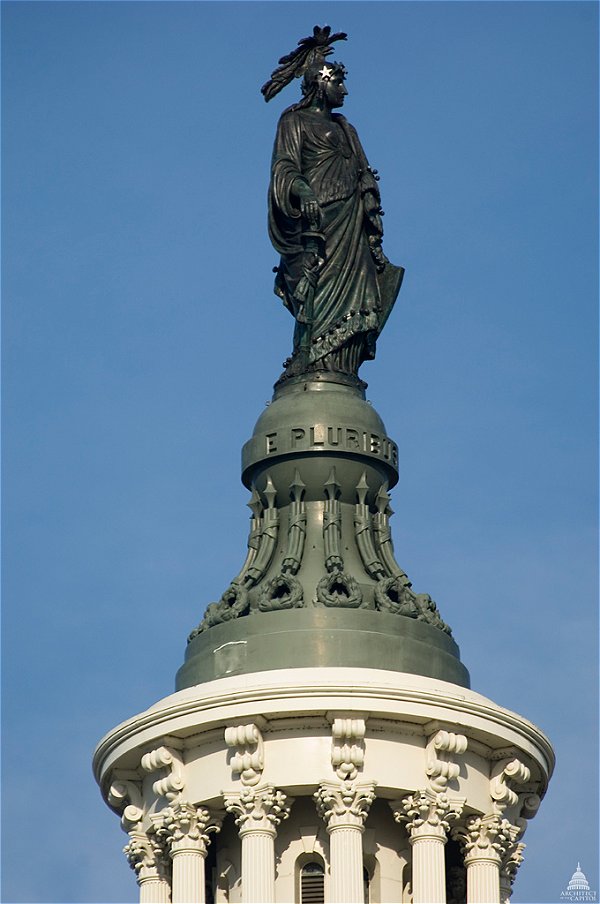 (Image Credit: Architect of the Capitol web site, http://www.aoc.gov. Public Domain.)
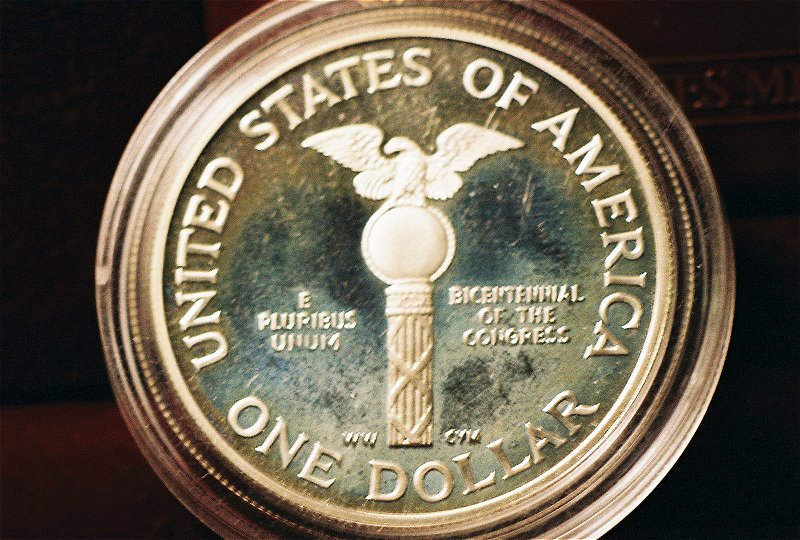
The coin's reverse presents the silver Mace of the House of Representatives. The mace depicted on the coin has been used in the House by the Sergeant at Arms since 1841; the first House Mace was authorized in 1789 but was lost when it was destroyed by fire in 1814 during the War of 1812 with Britain. Between 1814 and 1841, a wooden mace was used.
For a good description of the Mace plus excellent images of it, see the entry at the House of Representatives web site:
Mace of the House of Representatives.
The coin's designs are the work of the artist William Woodward; the designs were modeled by the Mint's Chester Young Martin.
1989 Congress Bicentennial Silver Dollar
 Mintage Breakdown:
 Proof = 762,198 // Uncirculated = 135,203 // Total = 897,401.
Gold Half EagleThe reverse of the Half Eagle incorporates the Gilded Eagle and Shield that is found atop the canopy that is over the chair of the President of the Senate (i.e., the US Vice President) in the Old Senate Chamber. The actual Shield includes 26 stars, one for each State of the Union at the time the Shield was created (circa 1838). Due to the perspective/viewing angle used for the coin, not all of the stars of the Shield are visible. When I inspect my example of the coin under magnification, I can discern 20 of the stars.
Vice President's Dais and Canopy from Southwest - US Capitol, Old Senate Chamber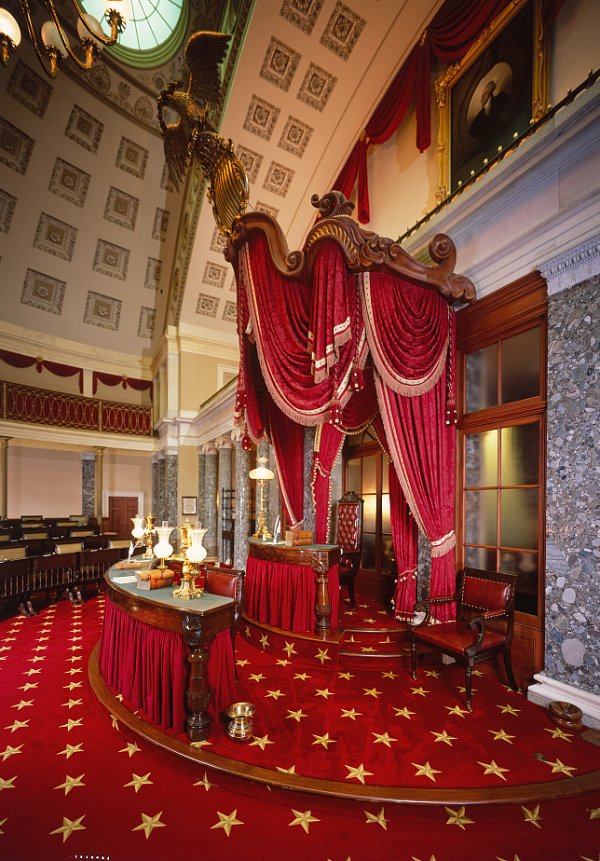 (Image Credit: Library of Congress, Prints and Photographs Division, Public Domain.)
The coin's obverse is dominated by a depiction of the Dome of the US Capitol. Commemorative dual-dating - "1789-1989" - is presented below the dome.
US Mint Sculptor-Engraver
John Mercanti was responsible for the designs (and subsequent modeling) of both sides of the gold coin. His "JM" initials are seen below the Eagle and Shield on the reverse.
1989 Congress Bicentennial Gold Half Eagle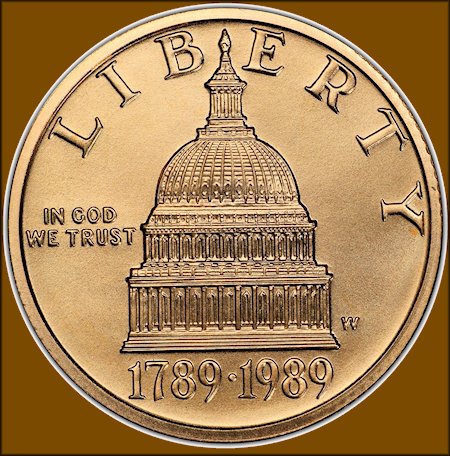
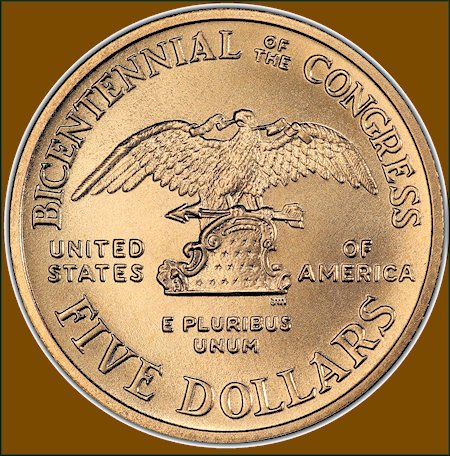 Mintage Breakdown:
 Proof = 164.690 // Uncirculated = 46.899 // Total = 211,589.
The Regular (and Pre-Issue) prices of each coin were:
- CuNi Clad Half Dollar: Proof - $8.00 ($7.00) // Uncirculated - $6.00 ($5.00)
- Silver Dollar: Proof - $29.00 ($25.00) // Uncirculated - $26.00 ($23.00)
- Gold Half Eagle: Proof - $215.00 ($195.00) // Uncirculated - $200.00 ($185.00)
No "Young Collectors Set" was produced for the program, though it would have been an ideal set to offer. Such specialty sets were not yet part of the Mint's repertoire.
For a discussion of the symbolism of the stars on each of the coins, check out:
-
1989 Congress Bicentennial Half Dollar - Coins with Stars Thread-
1989 Congress Bicentennial Silver Dollar - Coins with Stars Thread-
1989 Congress Bicentennial Gold Half Eagle - Coins with Stars ThreadFor related posts about the 1989 Congress Bicentennial Silver Dollar, have a look at:
-
1989 Congress 200th A Mint At Washington, DC-
1989 Rotated Congress Bicentennial DollarFor other of my posts about commemorative coins and medals, check out:
Commems Collection.



 Posted 12/02/2021 10:03 am