| Author |
 Replies: 10 / Views: 1,270 Replies: 10 / Views: 1,270 |
|
|
Pillar of the Community
United States
790 Posts |
After a recent trip to Korea, I found that I had probably purchased a bunch of fakes (no problem, the cost was so low that even as fakes, they are worth it to me, less than 20c each). However, it got me thinking about all the other coins in my collection (especially the coins purchased in Korea on previous trips). First off, as a crude method, would the actual weight of a "coin" compared to the weight listed in Krause be a good method (mostly Asian coins, but some others as well)?
What kind of weight change can I expect with use? If a coin is Unc, it should weigh very near the listed weight. I assume there is a rule of thumb to go with this, if a coin is G, then it should weigh about X% of the listed weight. Anyone know what weight loss to expect for different grades?
|
|
|
|
Pillar of the Community
United Kingdom
1077 Posts |
Good question, I would like to know too. Also can a coin weigh too much? I have a coin I am suspicious about. It weighs 26.78 grams and krause says it should weigh 26.70 grams Is that possible?
I am going to check out the specific gravity but even then how will I know? It could be a fake made of silver!
|
|
Bedrock of the Community
United States
10982 Posts |
Planchet weight can easily vary +/-2%, particularly on older coins. It's very tough with silver or copper coinage to authenticate by weight alone because their densities are very close to numerous other metals. Counterfeit coinage can also be of the actual metal composition as an original.
Gold bullion coins are pretty easy to verify as actual gold bullion due to their very high density. If a gold coin is of the correct diameter/thickness/weight, then you know it's real gold (or a more expensive metal like platinum).
Weight loss for different grades would vary tremendously by series but all coins shed weight as they wear down to lower grades. The wear should be (and usually is) factored in when buying/selling "junk silver". Quicksilver's coin weighing 0.08 grams over nominal is not unusual for MS & AU coins. That's only 0.30% over nominal and well within range.
|
|
Pillar of the Community
 United States
790 Posts |
But if a coin is very low grade and harshly cleaned, what is the maximum loss I might expect?
|
|
Bedrock of the Community
United States
10982 Posts |
Quote:
But if a coin is very low grade and harshly cleaned, what is the maximum loss I might expect?
I don't have any objective data to give you but -5% seems reasonable based on what I've seen and heard. |
|
Bedrock of the Community
United States
20753 Posts |
Quote:
Good question, I would like to know too. Also can a coin weigh too much? I have a coin I am suspicious about. It weighs 26.78 grams and krause says it should weigh 26.70 grams Is that possible?
I am going to check out the specific gravity but even then how will I know? It could be a fake made of silver!
Exactly what I've been telling people. There are many cases of China making Silver coins with pure Silver. They know that if the coins are tested they would show that they are indeed Silver and most people would never think a fake would be the same or better than the original. The purpose of using pure Silver is to be able to sell a coin for numismatic purposes so a few dollars in Silver can bring hundreds or even thousands of dollars. And now that they have gone to making the fake slabs the coins are in, so much the better. That is why it is possible for a fake to outweigh it's original. Naturally a planchet of the original coin could also be varied and never notice since tolerances are acceptable. And as to what a coin should weigh by loss of material from wear, that is really almost impossible to evaluate. |
|
Bedrock of the Community
United States
12437 Posts |
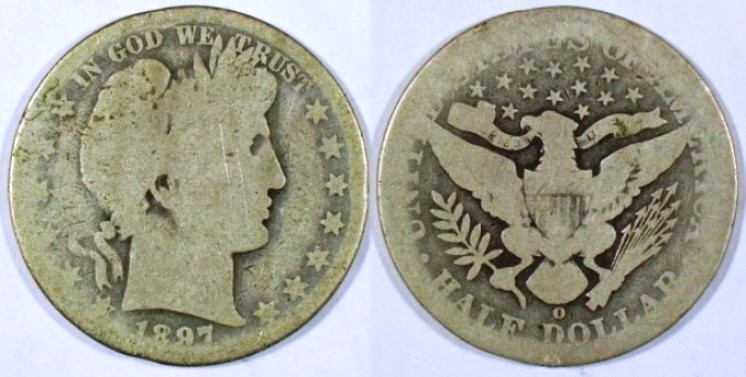 I graded this Barber half as FR-2. Spec for a Barber half is 12.5 grams, this one weighed 11.4 grams so that is close to a 9% loss. I think Barbers tend to be on the extreme end of weight loss but +/-5% is a good rule of thumb. Doing SG tests on base metal coins is probably a poor determiner of authenticity because if a coin is supposed to be bronze or copper or another cheap metal, then it would be easy and inexpensive to use the same type of metal. SGs are best for determining the authenticity of precious metal coins since a forgery is much more likely to not use the precious metal. |
|
Pillar of the Community
United Kingdom
1077 Posts |
The thing is a lot of these fakes are not necessarily of very rare coins, which I don't understand.
I suppose the SG test is more relevant then, if the original was silver for example. More likely that they are not using silver for the fakes.
If a coin is rare it seems almost pointless doing the SG thing then.
|
|
Bedrock of the Community
United States
20753 Posts |
Quote:
The thing is a lot of these fakes are not necessarily of very rare coins, which I don't understand.
I too will never understand that one. For example why do people replate the 1943 Steel Cents with Zinc. Some with Chrome. Makes no CENTS since they end up selling for about $0.25 or less. A decent grade, unrecoated one will sell for more. I must be missing something there. A dealer once showed me a pile of poorly made cents dated in the 70's that were stamped out of sheets of Copper. I guess if the counterfeiter made several million of them he could buy groceries with them. I've seen many fake coins of no numismatic value dates so what was the purpose? For the same amount of effort and profit, could have got a job at Walmart greeting people. |
|
Rest in Peace
United States
9104 Posts |
Don't forget the fake nickels made during WWII they used to be mentioned in the RedBook. They were obviously made to spend. |
|
Bedrock of the Community
United States
20753 Posts |
Quote:Don't forget the fake nickels made during WWII they used to be mentioned in the RedBook. They were obviously made to spend. I almost forgot about those. I guess if your out of work, no money at all coming in a few cents is a lot of food. |
| |
Replies: 10 / Views: 1,270 |
|










 Posted 01/28/2009 5:20 pm


