PCGSPart 1: 1915-1928 - It Got SpentClassic United States commemorative silver half dollars were produced over a 63-year span from the first coin, the 1892 Columbian Exposition Half Dollar, and culminating with the 1954 issues of the Washington/Carver Half Dollar. Fifty different design types, including the 1893
Isabella Quarter and 1900 Lafayette Dollar, are included in both the 50-piece commemorative type set or in the 144-piece complete commemorative set, inclusive of all different date and mintmark combinations as well as major varieties.
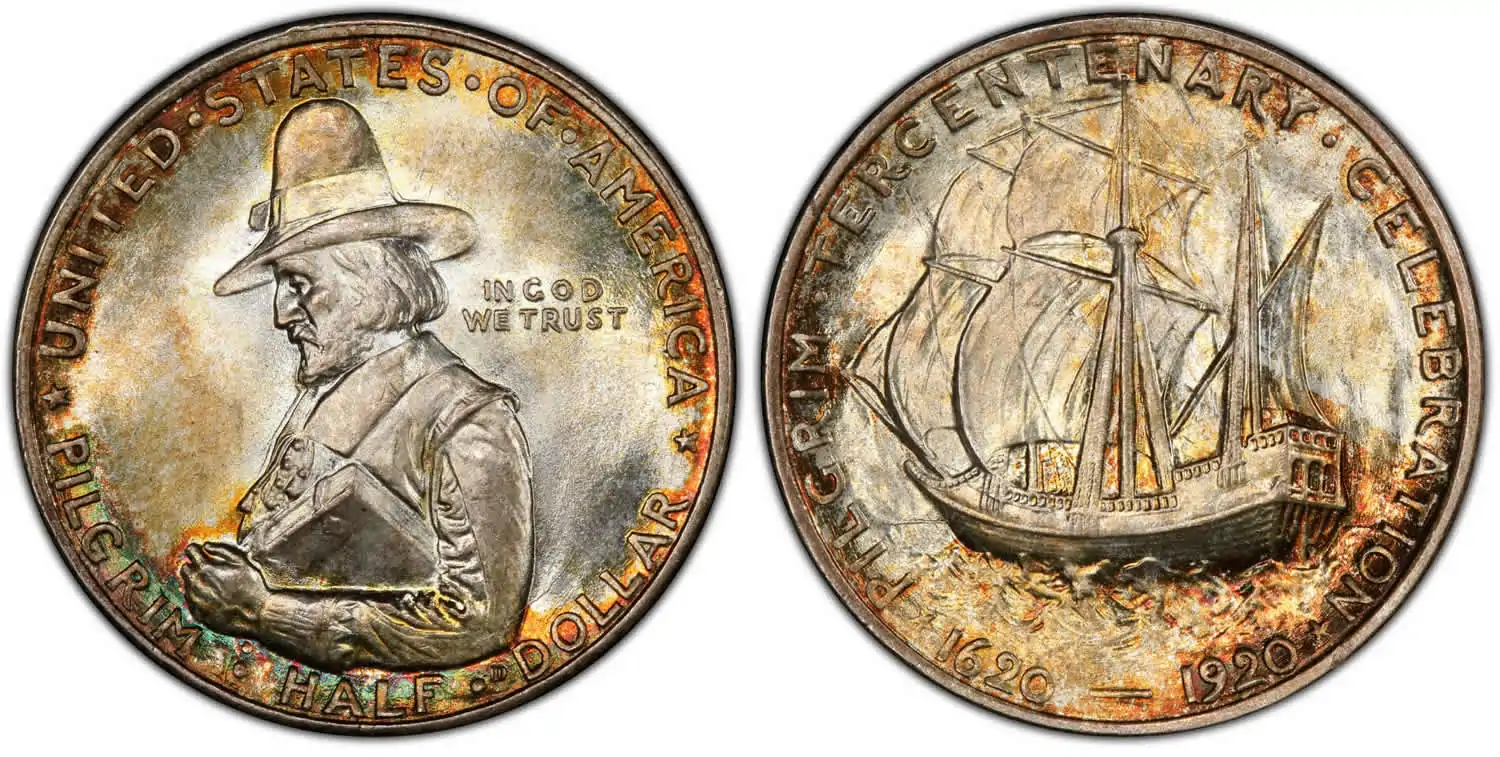 The 1920 Pilgrim Half Dollar was one of the most popular commemorative half dollars of its day.
In this four-part article series we are going to examine the particulars behind a certain segment of classic commemorative half dollars struck from 1915 through 1928 - what I call the "first-third" period.
On a practical basis, most collectors embarking on building a set of classic U.S. commemoratives start with the 50-piece type set because it will give them at least one example of each design. Depending on time and budget some continue with the 144-piece set. Although there are dozens of ways to collect U.S. commemoratives, there is certainly no wrong way. However, I have some tips that can help make your commemorative coin endeavors - whatever they may be - come a little more easily.
When collecting, I suggest pursuing the most challenging coins in a set first, as these coins are usually the most difficult to find and often the most expensive to purchase. If and when you see a nice example, you should keep in mind another might not be available soon. This is especially pertinent when talking about classic U.S. commemoratives.
Many collectors and dealers know that most of the early United States commemorative half dollars produced in the 1910s and '20s were neither produced in huge quantities, nor were they hoarded - unlike the case on both counts for many of the commemorative issues from the 1930s, '40s, and '50s. Low mintages are largely responsible for the relative paucity of these coins on the marketplaces, but there was another major factor behind why so many of these 16 different half-dollar issues struck from 1915 through 1928 are so hard to find today: the Great Depression.
Sure, there are exceptions, but just the "timing" of issuance for many of these commemorative types had much to do with their scarcity today. The Great Depression, which lasted from 1929 until the start of World War II, was tough on everyone. Those commemorative half dollars saved for posterity from the teens and '20s were often spent in the '30s during the worst of the economic travails. Fifty cents was a lot of money then.
There are several relatively common issues. After the massive production of Columbian Exposition Half Dollars in 1892 and 1893, no commemorative halves were issued until the Panama-Pacific Exposition Half Dollar of 1915. Many unsold coins remained after the Columbian Exposition, and some were eventually released into circulation. The fact that commemorative coins had been released into circulation at face value would haunt the commemorative silver and gold programs for decades. After all, many argued, they're only worth their face value.
The 1925 Stone Mountain Half Dollar also saw a large mintage of more than 1.3 million, while over a quarter of a million 1923-S Monroe Half Dollars were struck. Curiously, these two issues, beside the Columbian Exposition Half Dollars, were the ones I encountered most frequently in my early career. Like the Columbian Exposition Half Dollars, both Stone Mountain and Monroe Half Dollars were spent. While they always carried a premium over face value, a large quantity wound up in circulation, particularly in the wake of the Great Depression.
One of the points I want to make about the early U.S. commemoratives is that their scarcity and their demand today are both a result of the timing of the Great Depression. The economic troubles of the time resulted in many commemorative issues being spent at face value, thus markedly lowering the remaining supply of those issues-especially in higher grades. Additionally, most of the commemorative issues prior to the Great Depression were limited to only a single issue, but for only four different varieties.
Much of the demand today for these early commemoratives is due to their single issue type. As a rule, more collectors are looking for the examples to place into 50-coin type sets rather than pursuing them for a 144-coin collection. The scarcity issue relating directly to the Great Depression is difficult to prove, per se, but basic statistical observations support the argument of diminished supply.
Let's consider the mintages of these coins during the first-third era, as we'll see below in the list of issues by order of mintage (beginning with the lowest):

1922 Grant Star - 4,256
1921 Alabama 2X2 - 6,006
1921 Missouri 2X4 - 9,400
1928 Hawaiian - 10,008
1921 Missouri - 11,400
1925 Vancouver - 14,994
1921 Alabama - 16,014
1921 Pilgrim - 20,053
1915-S Panama-Pacific - 27,134
1927 Vermont - 28,142
1920 Maine - 50,028
1922 Grant - 67,405
1925-S California - 86,594
1918 Lincoln / Illinois - 100,058
1926 Sesquicentennial - 141,120
1924 Huguenot - 142,080
1920 Pilgrim - 152,112
1925 Lexington - 162,013
1923-S Monroe - 274,077
1925 Stone Mountain - 1,314,709
Certainly higher demand and lower supply for these first-third commemoratives make them more attractive in comparison to later issues I'll discuss further in the following parts of this four-part series. We'll look at the commemorative series in its entirety for some more perspective in terms of production and promotion. Why are the first third coins particularly special in terms of the entire series?
In part three we'll discuss the heavy production and some of the promotions used to market commemorative half dollars. Why did so many of the Philadelphia-Denver-San Francisco (or PDS) sets remain wholly undistributed for decades after their issue? And when did the hyperproduction of commemorative half dollars really start? In part four we'll discuss the final issues of commemorative half dollars as well as a couple of the famous dealers who handled them.
Part 2: 1933-1939 - Heavy Production & PromotionWhen did the heavy production and widespread promotion of classic commemorative half dollars really start?
In part one of this four-part article series, I made the argument that higher demand and smaller supply for the "first third" of U.S commemorative half dollar types had much to do with the timing of the Great Depression. Mintages don't tell the whole story, but higher PCGS population numbers for circulated-grade coins from that production era bolster the argument that "they got spent."
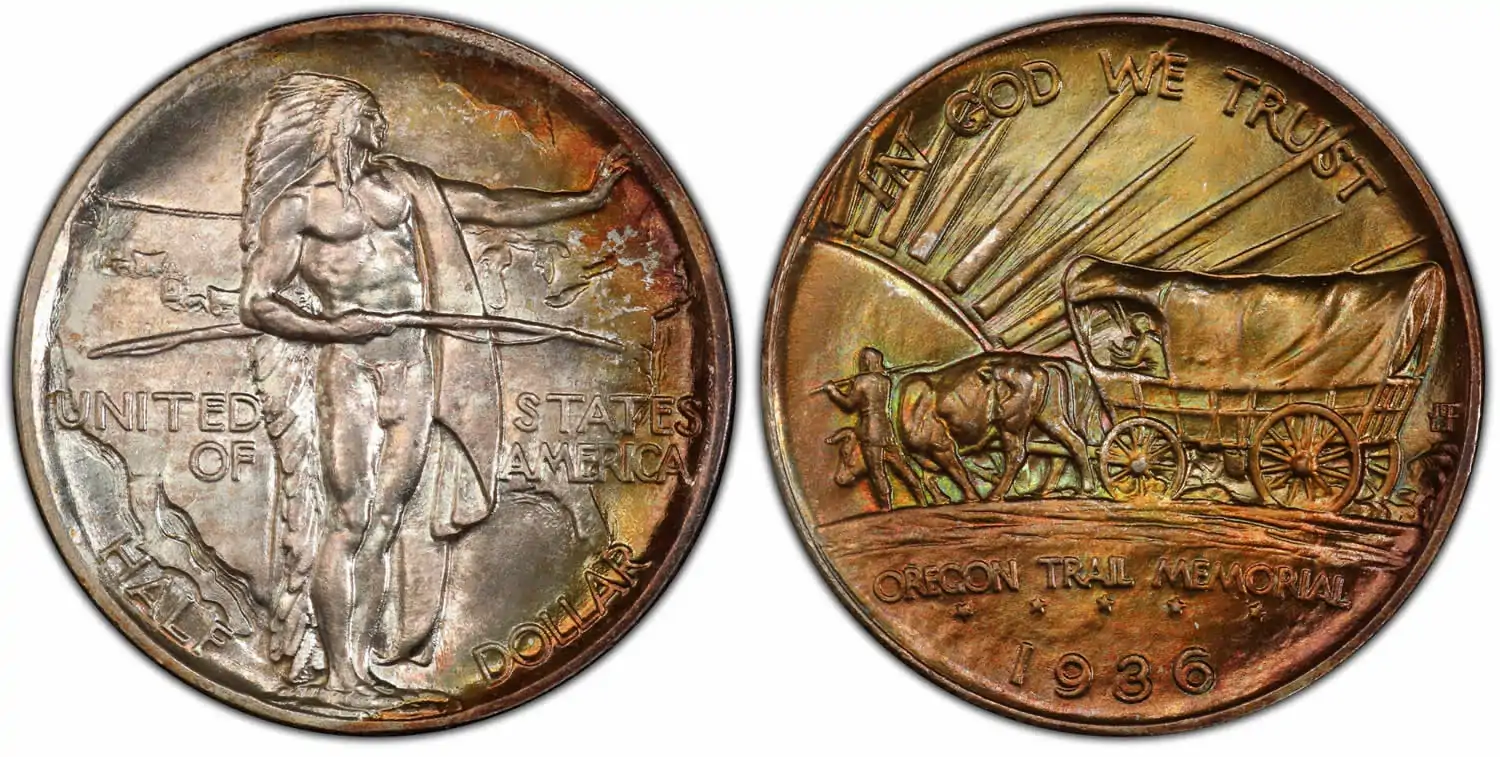 The 1936 Oregon Trail Half Dollar, one of the most heavily promoted commemorative coins released during the crescendo of the United States Mint commemorative coin program in the mid-1930s.
 Multiple issues of a given design type of commemorative half dollar had occurred from the very beginning, yet single-coin issues were the norm prior to the Great Depression. Two different Columbian Exposition Half Dollars had been minted in both 1892 and 1893. The Pilgrim Half Dollar was issued in 1920 and 1921. In 1921, the 2X4 was added to the Missouri commemorative design to create a second coin to help spur sales. Curiously, also in 1921 a 2X2 was added to the Alabama commemorative type and in 1922 a star was added to the Grant Half Dollar.
A collector will want one of each, right?
While there is little direct evidence suggesting that the early Oregon Trail issues purposely promoted a Denver Mint issue in 1933 to "inaugurate" a P-D-S (Philadelphia, Denver, and San Francisco) set, the argument can be made that issuance of the same design from all three mints set a precedent for the issuance of P-D-S sets issued from 1935 and after. The question is who had the idea first?
When the Oregon Trail Half Dollar was issued in 1926 with issues struck in both Philadelphia and San Francisco, a whole new plan must have become evident. And yet, no P-D-S commemorative trios were struck prior to the Great Depression, which began in 1929 and lasted up until World War II. Although the first three of 14 different Oregon Trail Half Dollars were produced (1926, 1926-S, and 1928) prior to the Great Depression, I've always felt the Oregon Trail was the first heavily promoted U.S. commemorative issue.
For starters, the issuance of the Oregon Trail in 1926 and continuation of production into 1939 marks the opening salvo of turning commemorative series into multiyear - and multimint - endeavors. After the 1933-D Oregon Half Dollar, multiple-issue commemorative types (and especially P-D-S sets) became common.
Some promoters suggested more money could be raised for their causes if more coins were made available to the public - an idea that spun to life just ahead of the "mintmark craze" for collecting other denominations.
This is a good place to make an important point regarding commemorative issues from 1933 on... The large mintages of many issues has been a boon for collectors in terms of quality and availability. Unlike the first-third issues, the vast majority of these pieces from the 1930s and forward never saw circulation. In general terms, quality levels are significantly higher, too, because the worst of the Great Depression was passing and fewer of these (then) more recent issues were being spent.
In 1934, four different commemorative issues were minted. Of these, the only single-issue coin, the Maryland Half Dollar, was joined by a fifth Oregon Trail emission, the 1934-D, as well as the first-year coins from the Boone and Texas programs. Interestingly, both the 1934 Boone and Texas issues were only from the Philadelphia Mint; P-D-S sets for both types would be produced from 1935 to 1938.
By 1935, production of commemorative half dollars was ramping up. That year, the U.S. Mint struck seven different commemorative designs yielding a total of 16 different issues. Just three single-issue coins were made in 1935: Connecticut, Hudson, and Spanish Trail, each of which is considered more difficult to obtain. Meanwhile, the 1935-S San Diego and all the 1935 P-D-S sets (Arkansas, Boone, and Texas) are readily available in the bulk of Mint State grades.
The commemorative half dollar program peaked in 1936, when 21 different design types fielding 34 issues were struck. The commemoratives from 1936 basically represent one quarter of one's commemorative set. If working on a 50-piece type set the single issue coins from 1936 comprise 13 of the 50 total coins, or 26%. What's more, in 1936 alone, those 34 aforementioned issues totals nearly one quarter - 24% - of all the 144 different classic U.S. silver commemorative issues ever made.
The commemorative wave ebbed after 1936. Across 1937, 1938, and 1939, only 31 combined issues were minted. Just three of those were single-year standalone types: Antietam, Roanoke, and New Rochelle. The other 28 coins include those from ongoing P-D-S sets and the single outlier 1937-D Oregon Trail Half Dollar.
By August 1939, Congress put the commemorative coin program on hold, so to speak. World War II soon came to the fore, and no further U.S. commemorative coins would be produced until 1946, when the Iowa the last single coin issue was minted. Yet, shortly after the end of the war, besides the 1946 Iowa, the Booker T. Washington series of P-D-S issues began in 1946 and ran through 1951, with 18 total issues. The Washington-Carver program was minted from 1951 to 1954, sporting 12 total issues. None of these post-WWII issues sold well.
Many of these multiple-issue commemorative types are mini-sets within themselves. To that point, finding high-end examples of all the Arkansas or Washington-Carver types can be quite challenging. When all was said and done, the full P-D-S sets spawned by the Arkansas, Boone, Oregon, Texas, Booker T. Washington, and Washington-Carver programs account for 88 of the 144 different silver commemoratives issued from 1892 through 1954. That's nearly two-thirds - 62% - of that entire series! Just this percentage alone bolsters the argument that pursuing first third commemoratives more aggressively might be to the collector's advantage.
The heavy production of many of these later commemorative issues has led to grade rarity disparities. A significant portion of later-date commemoratives, partly because they remained unsold (sometimes for decades) past their issuance, remain in better Mint State grades. Yet, despite enormous quantities of uncirculated coins being saved, many of these issues are super scarce in higher grades.
In parts three and four of this four-part series we'll discuss the preponderance of multiple-coin P-D-S commemorative issues from 1935 and after. We'll also follow the commemorative program through 1954 and discuss some of the promoters (and promotions) of commemorative half dollars. Finally, we'll delve into the hoards (mainly in dealer inventories) of commemoratives that existed well into the 1970s.
Part 3: PromotionsThe secret to a good product promotion is having a ready supply. When 1921 Pilgrim Half Dollars were produced, despite many 1920 coins remaining unsold, it became evident that the catalyst for producing a particular commemorative may be somewhat flexible. The 1920 Pilgrim Half Dollar commemorated the 300th anniversary of the Pilgrims' landing in 1620. The continuation of the Pilgrim Half Dollar with pieces dated for 1921 therefore wasn't literally tied to marking the 300th anniversary of an event that occurred in 1620.
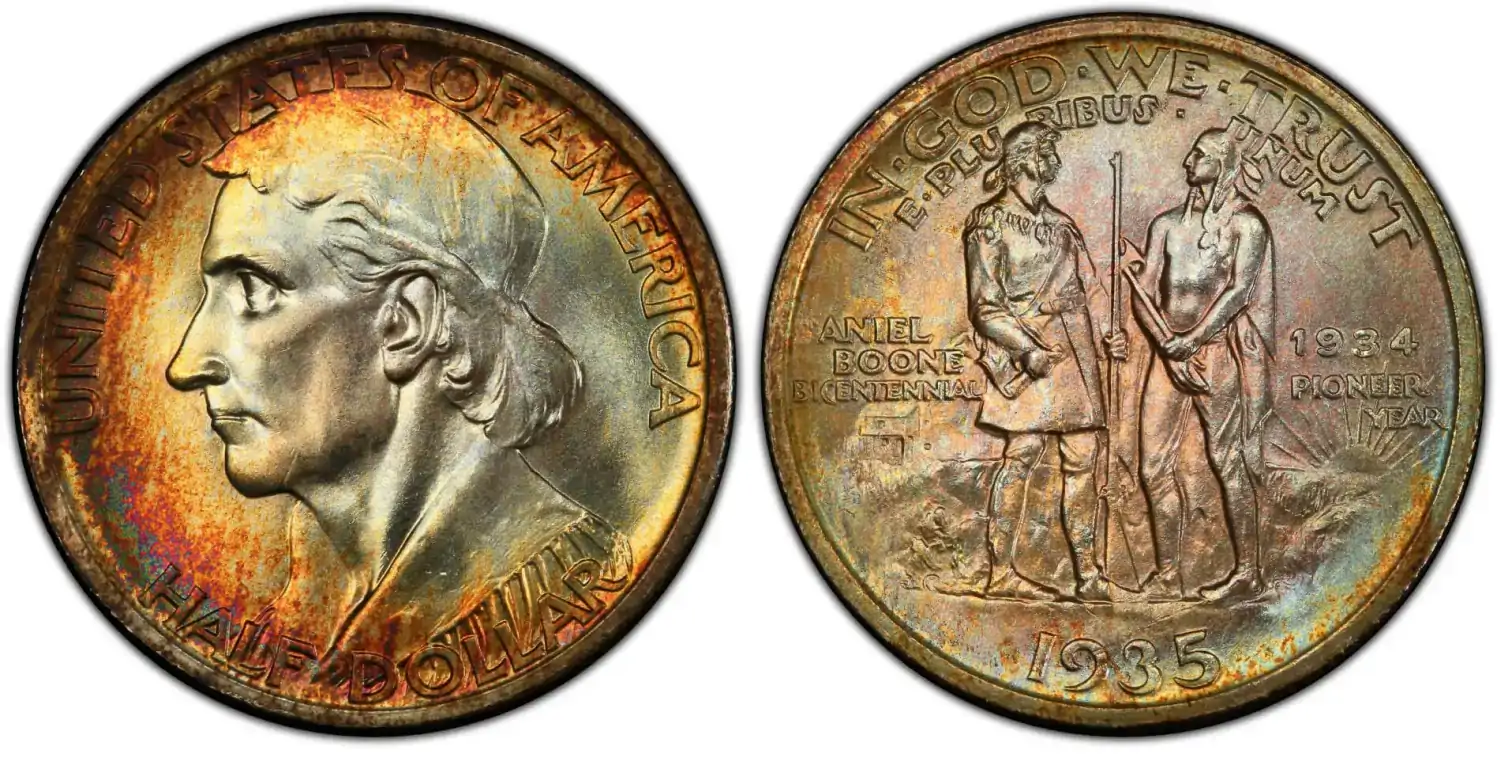 The 1935/1934 Boone Half Dollar was an outcropping of increasing promotion and marketing of the commemorative half dollar program, which by the mid-1930s was spawning dozens of different issues each year.
Multiple coins produced of a given type really exploded in the years of economic improvement following the start of the Great Depression, which began in 1929 and deepened in the early 1930s. One of the most illustrative stories of the multi-year commemorative types is the Oregon Trail Half Dollar, which was first struck in 1926 and continued until 1939. Many believe the Oregon Trail Half Dollar was proposed by a group of New York businesspersons. While the Oregon Trail Memorial Association did include New York businesspersons, the original idea for the issue was years in the making. The organization had approached Gutzon Borglum, who designed the Stone Mountain Half Dollar, about designing a coin, but he required too much time and wanted more than they were willing to pay.
On the suggestions of the
American Numismatic Society, the committee enlisted the husband-and-wife team of
James Earle Fraser (
Buffalo nickel) and
Laura Gardin Fraser to create what became one of our most iconic commemorative designs. The obverse side bearing a depiction of a wagon was designed by James while the reverse anchored by a Native American was designed by Laura.
Despite widespread embrace of the design, sales numbers were significantly lower than hoped. As with the Pilgrim Half Dollar that preceded it, the Oregon Trail coin saw production beyond its original production year. Later mintings in 1928 were approved, yet those coins remained unsold in Treasury holdings through 1933 - five years later. In a deal involving Scott Stamp and Coin Co., the "bill" for the 1928 Oregon Trail coins was finally paid because they wanted to see 1933-D Oregon Trail coins, but the Treasury wanted to square away the 1928 coins first.
Like most stories, there's more to it. Originally, the Oregon Trail Memorial Association, headed by Ezra Meeker (who had traveled the trail in 1852 with his family), was responsible for the authorization of the Oregon Trail Half Dollar. In 1926, Meeker - then 95 years old and representing the association - appeared before Congress. Meeker was photographed with President Calvin Coolidge after he signed the legislation into law on May 17, 1926. Evidently quite impressed, Congress authorized six million coins with no restriction on what mint would strike the coins. Is it any surprise that, with virtually no limit on production quantities (nor time limits) and no restrictions on any combinations or permutation of issues, 11 additional issues of Oregon Trail coins were made in 1933 through 1939?
Meeker, who died in 1928, had little to do with the actual sales of the Oregon Trail coinage. The Oregon Trail Memorial Association (a group of New York businesspersons) continued producing Oregon Trail issues from 1933 to 1939 despite thousands of coins remaining unsold from 1926 and 1928. And, despite thousands of unsold coins, issue prices continued rising for the coins as the years progressed.
Certainly other commemorative promoters had the same idea.
P-D-S issues were born in 1935 with a continuation of two current designs and the addition of a third. The Boone and Texas designs saw their first P-D-S issues in 1935, with the 1935 Arkansas P-D-S coins also debuting. In another example of heavy production, promoter C. Frank Dunn from Lexington, Kentucky, issued extra limited mintage Boone issues in 1935 from both Denver and San Francisco with a small "1934" inscription on the reverse and mintages of only 2003 and 2004, respectively, for the Denver and San Francisco coins. When paired with the loftier mintage of 10,008 mintage for the 1935/4 Philadelphia issue, there was now a 1935/1934 P-D-S Boone set in addition to the 1935 P-D-S set.
Meanwhile, nearly the entire run (7,500 of just 10,008 total mintage) of Hudson Half Dollars were bought in speculation that their small mintage would make them promotable. The 1935 Hudson was similar to the 1928 Hawaiian Half Dollar in mintage, which had sold out very quickly at $2 per coin seven years earlier. Advertised at $1 each, a New York coin dealer quickly made a deal to purchase 7,500 coins for 95 cents each. The City of Hudson, with only 2,508 remaining examples, sold out almost immediately. Shortly after, anyone needing the coin for their set could purchase one for about $5!
Although there were quite a few dealers who handled large groups of commemoratives in later decades, B. Max Mehl, famous Fort Worth, Texas, coin dealer, bought and sold thousands of coins with incredible promotions and advertising in both his Star Coin Encyclopedia and Mehling List for more than 50 years. Never shy about promoting an item, Mehl figured heavily in many of the commemorative issues from the 1930s.
Because of his extensive advertising and his Star Coin Encyclopedia, Mehl's exposure and the ability to see what he was selling - and for how much - is readily available. Mehl was a coin dealer who promoted his product. If he could buy merchandise (he was confident he could sell) at a lower price, why would he not?
 A circa-1930 B. Max Mehl price list for various U.S. commemorative coins. Courtesy of Vic Bozarth.
As early as 1917, Mehl "sopped up the unsold remainders for close to face value" on 1916 and 1917 McKinley Gold Dollars that remained unsold after their issue. Mehl was known to acquire deals of unsold commemoratives in bulk for little or no premium over face value after initial sales had been exhausted. Many early commemorative issues would also have been acquired in bulk to supply "his ever growing Mehling List."
The majority of our commemorative issues were produced from 1933 and after. Of our 50 different commemorative types, 28 of the 50 were produced from 1933 to 1939 and 86 of 144 different issues were struck between 1933 and 1939. This seven-year window would comprise the majority of all U.S. commemoratives produced and, of course, the heaviest production figures.
In part one of this four-part series, I discussed the significance of the "first third" of commemorative issues minted prior to the Great Depression. In Part Two, I covered the evolution of the marketing of commemoratives. Not only were many different issues produced, but there were multiple coin variations, often in the form of P-D-S sets, produced for the same type. In part three, I explain some of the authorization, production, and sales issues for many of the post-1932 issues produced, despite little demand.
In part four, I touch on some of the history of commemorative coins that have shaped how we collect them today. Was the collector in 1936 overwhelmed to find they needed to buy 34 different commemorative coins dated "1936" just to keep their set current? Most likely.
Part 4: End of the RoadThere were many coin dealers who jumped on the commemorative bandwagon, so to speak. Why wouldn't they? There were dozens of cool new issues, most with exciting stories. Despite the interesting coins with great narratives, by the late 1930s the lights were beginning to dim on the commemorative coin program.
Many like major coin dealer B. Max Mehl made a market in many of the coins they sold, offering both buy and sell prices for those coins. Despite several books on the subject and numerous dealers attempting to market commemorative half dollars, the 1939 P-D-S sets of the Arkansas and Oregon Trail Half Dollars essentially served as more of an afterthought than products stemming from strong collector demand.
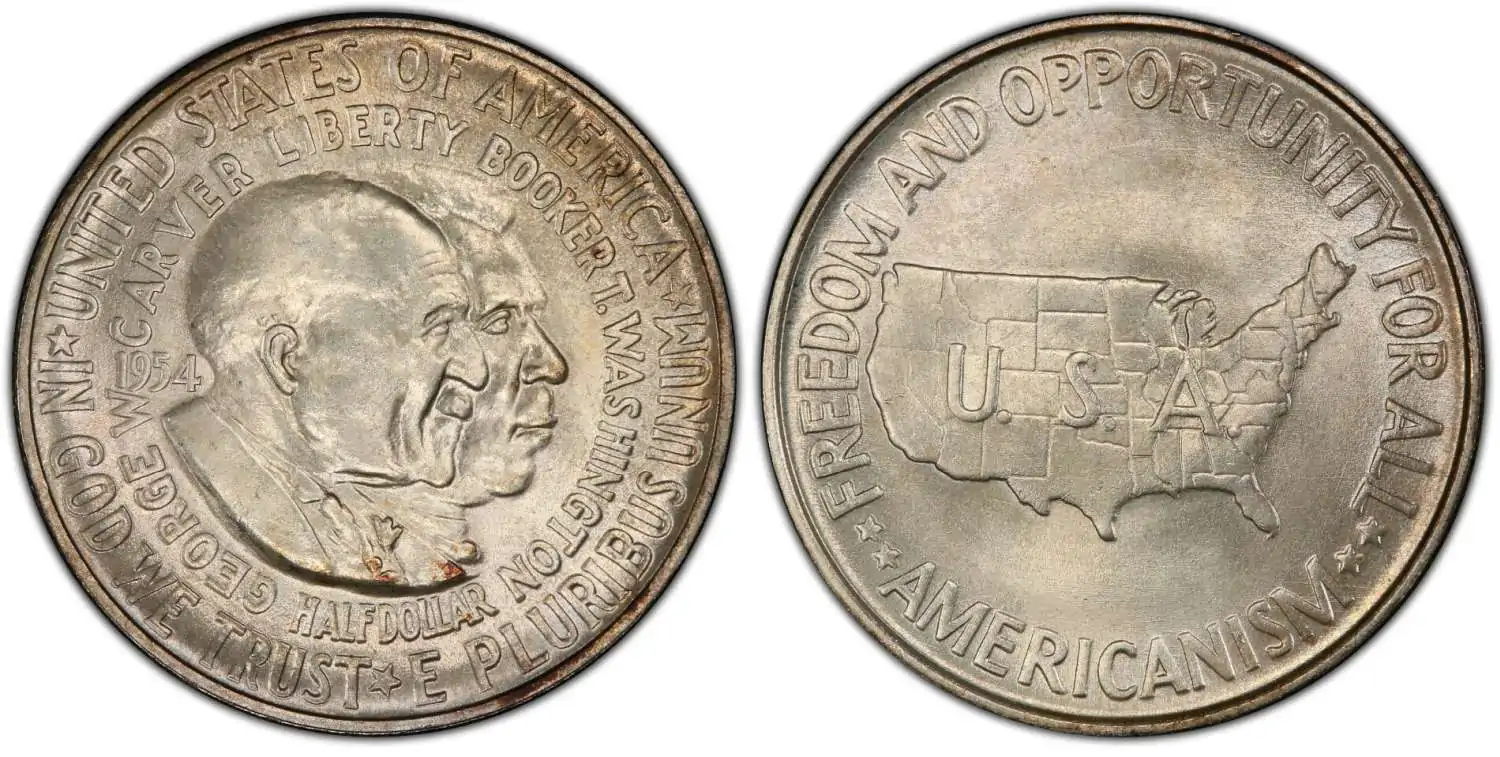 The 1954 Washington-Carver Half Dollar represents the last of the classic commemorative coin program, which ran from 1892 through 1954
Unsurprisingly, on August 5, 1939, Congress passed an act to prohibit the production or release from Treasury stocks of commemoratives authorized prior to March 1, 1939. Only 2,000 of the 1939 Arkansas P-D-S sets and 3,100 of the 1939 Oregon Trail Half Dollar P-D-S sets were produced. Because stocks of earlier dates of both Arkansas and Oregon Trail issues existed and were available to the public at little over face value, virtually none of these two 1939 P-D-S sets sold well. Ironically, numismatists today benefit from many of the issues that sold poorly in the past.
Many might think World War II was partly responsible for the demise of commemorative half dollar issues after the late 1930s, but the U.S. entry into the war was two years later, in 1941. Q. David Bowers states in his book Commemorative Coins of the United States: A Complete Encyclopedia, "The market for existing commemoratives continued its drift downward, which had begun in late summer 1936 when the boom peaked, which touched bottom around 1940-41. After that point, supply equaled demand, most speculators had sold out, and market levels reflected what collectors were willing to pay."
Interestingly, the market for collector coins, despite the poor commemorative market, really took off during the later 1930s. Of course, World War II affected the market, but new coin albums debuting prior to the war proved exceptionally popular at the time. Incidentally, the introduction of these albums accelerated the pursuit of all the different mintmarked coins in a given series versus collecting just one of each date - a common approach among earlier collectors.
World War II did affect the production of U.S. coins, but well prior to the end of the war in 1945 many had suggested that both proof coinage, suspended in 1942, and commemorative coin issues be continued after the eventual conclusion of the war. Indeed, prices in 1944 and 1945 for most collector issues rose considerably. Commemorative half dollars were still cheap, but collector demand had returned nicely. Aubrey Bebee of Bebee's Stamp and Coin in Omaha, Nebraska, made a specialty of the series, offering a huge selection of all commemorative - especially the P-D-S sets.
Although I have little direct experience with Mehl, during my wholesale rare-coin career I purchased hundreds of commemorative coins - oftentimes P-D-S sets - that had been originally sold by Bebee's. Sometimes these coins were in original packaging from Bebee's, but the cellophane on many P-D-S set coins (usually original) used by Bebee's was quite distinctive and (for their time) fairly good for coin preservation.
In Conclusion.Every coin has two sides. Yes, many commemoratives saw heavy promotion and often significant surpluses that remained unsold for years at a time. But, would we have the wonderful supply of U.S. commemoratives that we have today had dealers like Mehl, Bebee, and others not marketed these coins from the get-go?
Indeed, collectors have many numismatic avenues they can pursue, but classic commemorative half dollars offer a multitude of exciting options. Depending on your collecting goals, focusing on the more difficult early "first third" issues should ease building a 50-piece type (or complete 144-coin) commemorative set in terms of both budget and difficulty. Later, post-Depression issues not only exist in higher grades, but they are also often more easily available. With the classic commemorative program ending in 1954, nearly 30 years would elapse before the next commemorative coins would roll off United States Mint presses in 1982.
Despite a sometimes tumultuous past, classic U.S. commemoratives remain one of the most exciting series that one can embark on collecting. Spanning two centuries, two world wars, and innumerable historic moments that help define our society and world today, the classic commemorative coins of 1892 through 1954 offer collectors challenges and joys like no other United States series.
 Check out Classic Half Dollar Commemoratives on ebay
.






 Posted 05/18/2023 3:47 pm





