| Author |
 Replies: 14 / Views: 1,284 Replies: 14 / Views: 1,284 |
|
|
Pillar of the Community
United States
7067 Posts |
Nothing too special here. But, since I don't pick up many coins these days (been focusing on the antiquities), figured I'd post it. Just received this past week, from the latest FSR auction, and added today to my Elymais gallery: 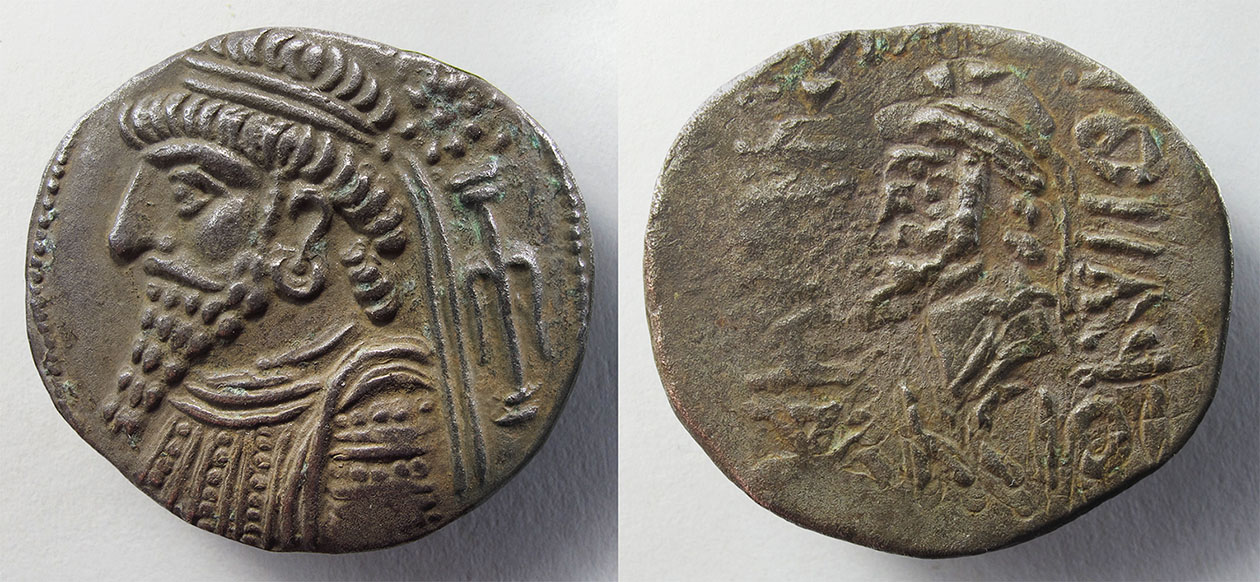 Uncertain Early Arsacid Kings BI tetradrachm, late 1st century BC to early 2nd century AD Van't Haaff 10.1.1-1 variant (no pellet to left of anchor) Frank had the coin listed as Kamnaskires V, the last of the kings of the Kamnaskirid line prior to the Arsacid clan taking over Elymais. However, based on the degraded reverse bust - an example of what I have argued elsewhere is a systematic, prolonged, politically-based erasure of reverse iconography that was meaningful to the Kamnaskirids - I am calling it an early entry from the "Uncertain Early Arsacid Kings". If the coin was a Kamnaskires V, the reverse bust would be much clearer. |
|
|
|
Moderator
 United States
34575 Posts |
Well done Bob! Frank seems to know his stuff pretty well so well done with this cherry pick.
"If you climb a good tree, you get a push."
-----Ghanaian proverb
"The danger we all now face is distinguishing between what is authentic and what is performed."
-----King Adz
|
|
Pillar of the Community
United Kingdom
1168 Posts |
A very interesting post, Bob.
The obverse portrait on this coin is very nicely detailed, and the difference between it and the reverse is quite striking. (No pun intended.)
Would the die maker have deliberately degraded the reverse image, or were the reverse dies used well after their useful life?
|
|
Pillar of the Community
 United States
7067 Posts |
Thanks, gents. Quote:
Would the die maker have deliberately degraded the reverse image Yes, that's precisely what we see with these. It's a fascinating occurrence in ancient numismatics. Given the preservation of decent, comprehensible obverse portraiture throughout the reigns of the so-called Early Arsacid Kings, the reverse degradation was certainly intentional. Here's a pic of some coins from this period of Elymaean history. I don't know that these are in chronological order (since individual king's names were not written on these undated issues), but it's fun to imagine that they were. Notice the progressive degeneration of the reverses. 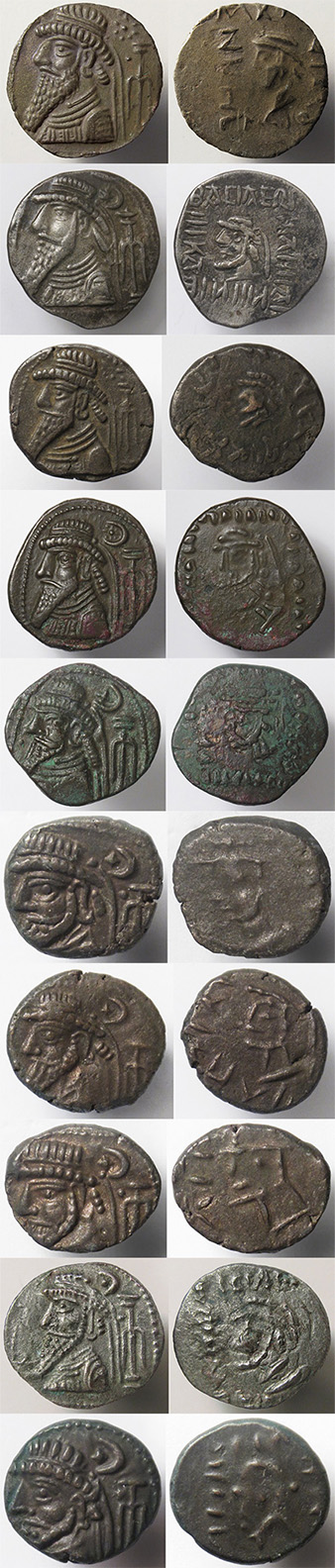 Here are some comments I made in another forum: "One of the interesting things about this sub series in Elymaean numismatics is the degeneration of the reverse bust over a number of decades, during which time the obverse busts remain intact and comprehensible. The gradual degeneration can only be an intentional, slowly performed erasure done by the new Arsacid Dynasty which replaced the previous Kamnaskires Dynasty. The reverse portrait was a carryover from coins of the so-called Later Kamnaskirid Dynasty, and I believe it may have represented the progenitor of that family, Kamnaskires I, the first ruler of Elymais. Regarding the purposeful, progressive degeneration of the reverse by the Arsacids, van't Haaff states, "the issuers of these coins wanted to change the iconography to break with the previous kings, but they were sensitive to the fact that abruptly changing the iconography would hinder the acceptance of the coinage in local trade." So, I think we can view the Arsacids' slow physical erasure of that portrait as an attempt to methodically eliminate the Kamnaskirids from the collective memory. My speculation that the reverse portrait might be the Kamnaskirid Dynasty's progenitor is perhaps on shaky ground - but it sure makes sense given the visual evidence of extended erasure, doesn't it? On the other hand, even if, as some believe, the reverse image is that of Herakles, Zeus, Belos, or other mythological figure, I think that the Arsacids must have been threatened by its association with Kamnaskirid rule. Perhaps the god/hero (if that's what he is) was a visual statement about the legitimacy of Kamnaskirid rule? I believe that the accompanying reverse legends, that along with the bust get degenerated over time, were a carryover from the reverses of the last coins of the Kamnaskirids, and it read" ΒΑΣΙΛΕΩΣ / ΚΑΜΝΑΣΚΙΡΟΥ / ΤΟΥ ΕΓ ΒΑΣΙΛΕΩΣ / ΚΑΜΝΑΣΚΙΡΟΥ, usually interpreted (according to van't Haaff) as "King Kamnaskires, grandson of King Kamnaskires." So, the bust, whether a mythological hero or flesh-and-blood progenitor of the dynasty, seems to have been connected with the lineage of the Kamnaskirids and the legitimacy of their rule. And thus it became a target of the Arsacids, who might well have feared repercussions if they eliminated it immediately upon wresting control of Elymais." Edited by Kamnaskires
04/10/2022 10:27 pm
|
|
Pillar of the Community
United States
3863 Posts |
Nice acquisition, and fascinating story on this series of coinage!
Member of SPMC, FCCB, ANA and ANS. My U.S. Classic Commemorative Complete Set: https://www.NGCcoin.com/registry/co...sets/278741/ |
|
Pillar of the Community
Russian Federation
5186 Posts |
TBH, when I look at the reverse of the OP coin, what jumps out is not so much the degraded bust, as the strange thin lines all over the place.
Is it an overstrike? A double strike? In either option, how come nothing's visible on the obverse? Pretty sure doubled dies weren't yet possible back then.
|
|
Pillar of the Community
United Kingdom
1168 Posts |
This is indeed fascinating, Bob.
I learn something new every day, and there are so many twists and turns with these ancients to keep the interest levels high. From the images it is clear that the degraded reverses were deliberate, and it was an astute long term move by the Arsacids to go forward in this manner. It would not ruffle any feathers, and as you say, it would only be a matter of time before the Kamnaskirids were erased from the collective memory.
|
|
Moderator
United States
23731 Posts |
Always nice to see these type of coins.
|
|
Pillar of the Community
 Spain
2752 Posts |
What an interesting thread!
That's a lovely addition Bob! Wonderful detail on the ob!
Is there any other series of coins where a complete dynasty fades into oblivion?...
|
|
Pillar of the Community
United States
7067 Posts |
Nothing comparable to this slow and intentional erasure, Paul. At least not that I know of.
|
|
Pillar of the Community
United States
7067 Posts |
Recently won four more Elymaeans, which arrived this week. Among them is the tet below, another of the "Uncertain Early Arsacid Kings" of Elymais. This time it's a van't Haaff 10.3.1-1A, with the variety defined by the two crossbars on the anchor, the star within the crescent, and the lack of a pellet alongside the anchor. Seems I am officially back to coin collecting. Feels good. 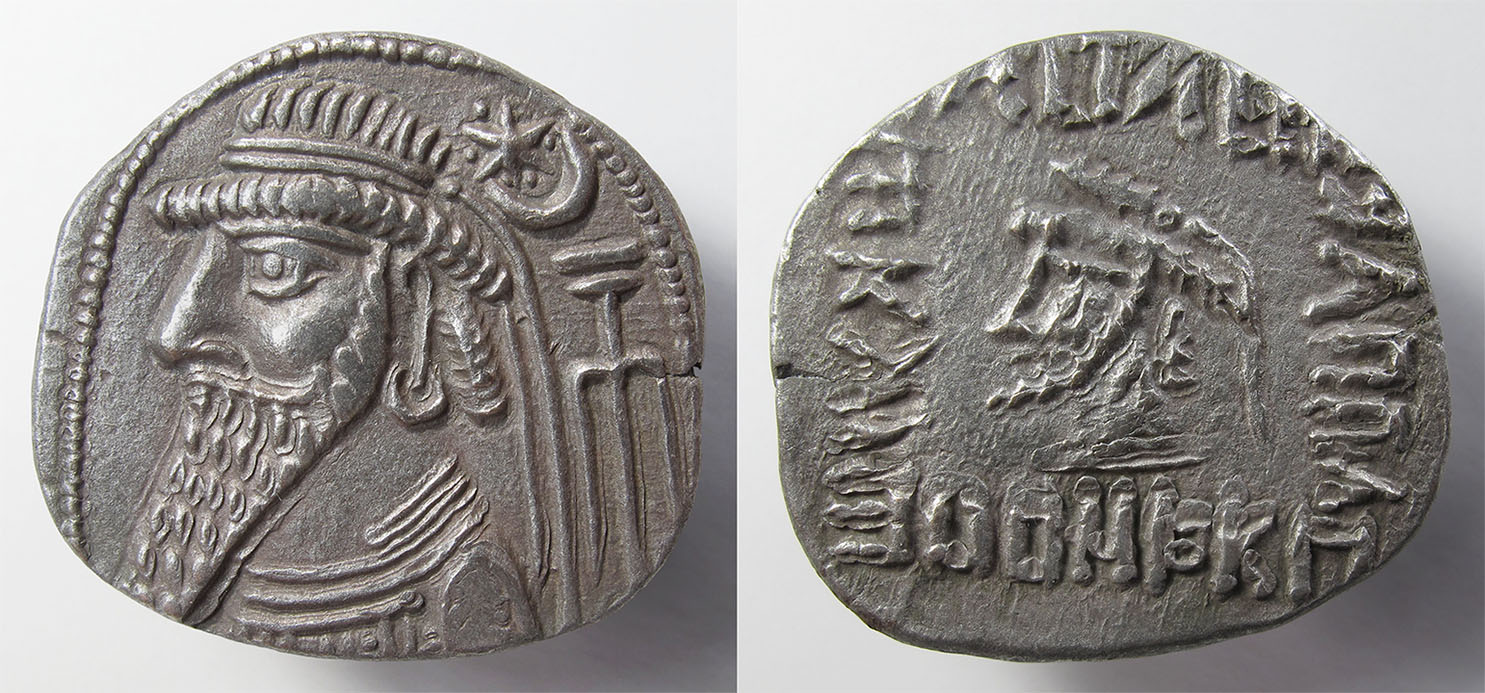 |
|
Pillar of the Community
Spain
2752 Posts |
Lovely example Bob   Bob's back on coins! You'll need another cabinet  I assume some of your weaponry and pottery compliment the coinage you collect? |
|
Pillar of the Community
United States
7067 Posts |
Quote:
I assume some of your weaponry and pottery compliment the coinage you collect? It's an interesting question given the auction win yesterday (the latest dagger). More on that in a future post. But, generally, yes: My preferred geographical area is ancient Iran. Such great history there. Much (but not all) of the weaponry is from that area, as are the coins. Elymais was at the north end of the Persian Gulf, in western Iran. I'm a bit more of a generalist with regard to the pottery, but my favorite pieces are from ancient Iran. |
|
Pillar of the Community
United Kingdom
1168 Posts |
It's nice to see you back in the realm of coins again, Bob. Another superb example. |
|
Pillar of the Community
United States
7067 Posts |
|
| |
Replies: 14 / Views: 1,284 |
|







 Posted 04/10/2022 9:58 pm


