i fond this on wikipidia
The Inclusion of Government Paper Money
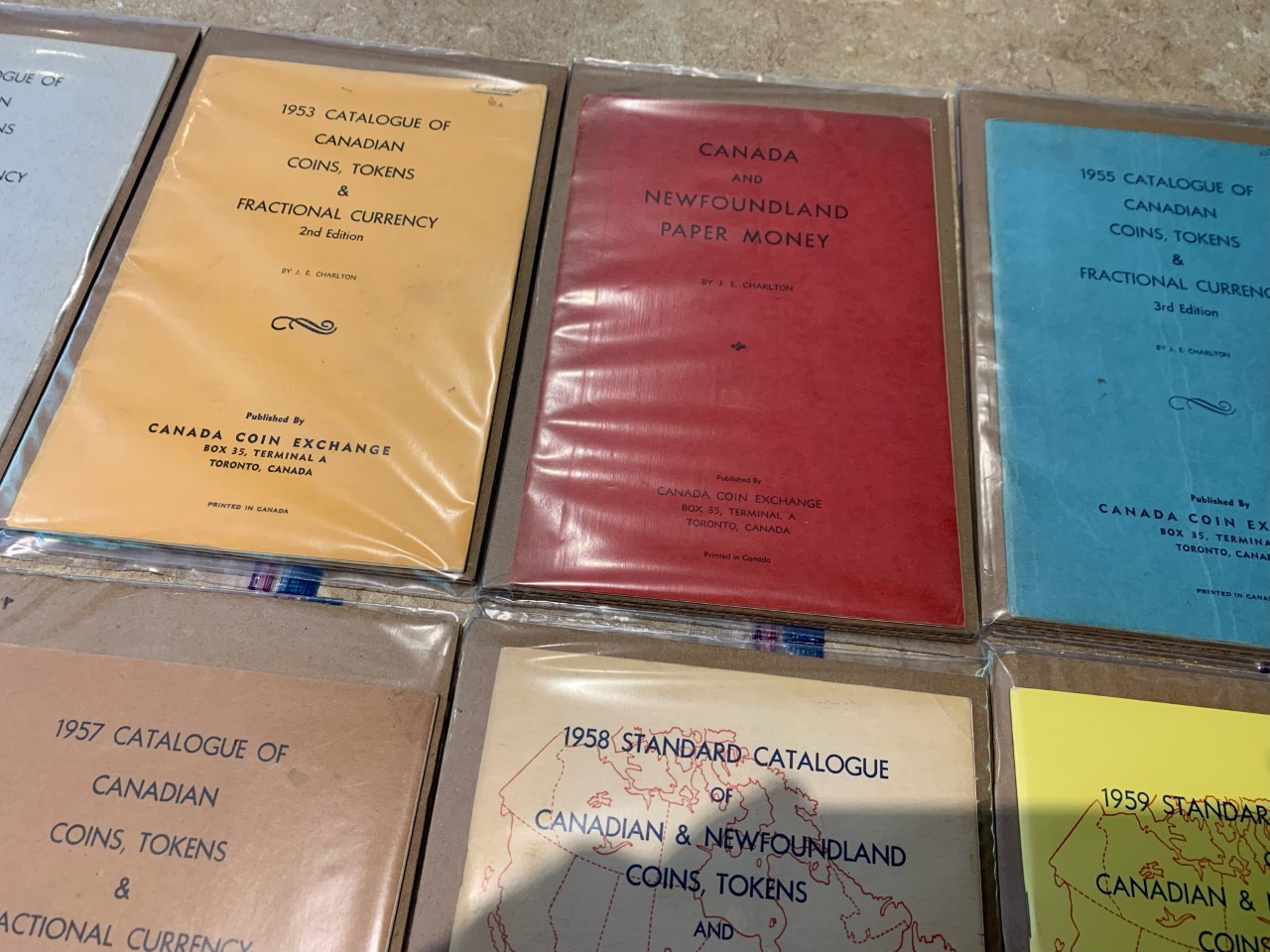
For the first time, Jim Charlton also included government paper money issues of Canada and Newfoundland in its catalogue listings. This resulted in renaming the catalogue from the Catalogue of Canadian Coins, Tokens & Fractional Currency to the Standard Catalogue of Canadian Coins, Token & Paper Money.
But the inclusion of paper money in the catalogue was not without its difficulties. Jim Charlton had long desired for his catalogue to reflect the growing interest in paper bills. When he explored the possibility in 1954, he encountered obstacles given that he had not received permission to publish such a catalogue with illustrations of paper money from the Bank of Canada and the Department of Finance. Doing so would contravene the Criminal Code (section 471(b)551).
At the same time that Charlton was exploring the possibility of incorporating bank note illustrations, James Elliott Jr. was independently working on a paper money catalogue. But, unlike Elliott who published his catalogue without illustrations, Charlton took a risk and published a modest catalogue on Canadian and Newfoundland government paper money with a 1955 issue date using reduced size note face illustrations. Charlton was hopeful that no action would be taken against him by the Government of Canada. Years prior in 1947, the Department of Finance had not instigated legal proceedings against W.H. Kernohan of Forest, Ontario who had released educational material in the form of a chart featuring banknote illustrations. As Jim Charlton stated about Kernohan, "So, I figured to myself, 'if he can do that, I think I've got a good case if they decide to come after me.'"[15]
Nonetheless, fearing seizure of the printed matter, Charlton kept the majority of the publications in the basement of his brother's residence in Mississauga, Ontario.[16] Luckily, no such seizure occurred and in fact, the Central Bank ordered a copy of the catalogue. It was soon thereafter that Elliott released a second catalogue with full illustrations of paper bills, using fronts and backs.[17]
The new format and content was well received in a book review printed in The Numismatist's December 1959 issue. Hailed as a "milestone in Canadian numismatics," Charlton's catalogue was recommended for "the shelf of any collector interested in Canadian numismatics, or wishing to appreciate the place of these important series in the world picture."[18]





 Posted 06/15/2022 5:32 pm





 to the Community!


