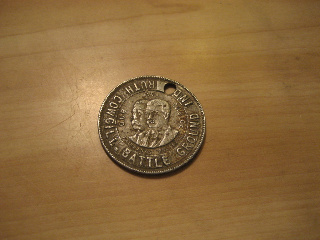
Let me show you what I mean.
Here's a medallion produced by the mechanism I'm talking about:
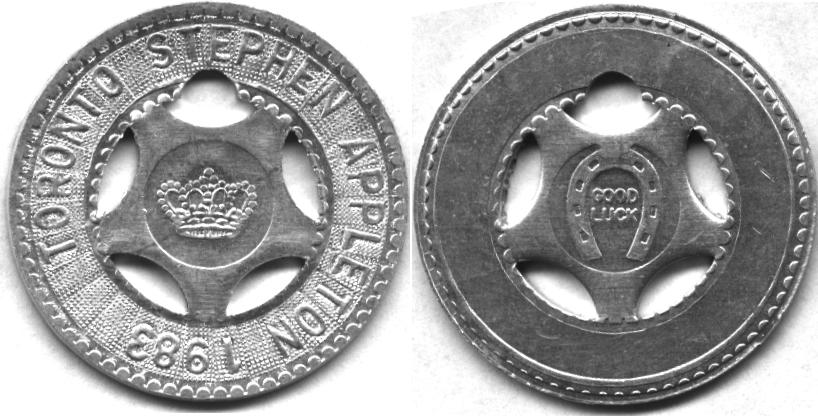
I made it myself, at the main railway station in Toronto (Canada) while the family waited to catch a train there in 1983. It, too, is made of aluminium. The side with the text on it would have originally looked the same as the other side, only without the slight rippling.
The machine to produce these things resembled a cross between a one-armed-bandit and an old-style "dymo" labeller. You put in a quarter or two to start the process, and a blank medal was fed into the machine. I think I even got to select the central crown, from a half-dozen possible options.
There was a big dial on the front, which you turned until the letter you wanted was selected. You then pulled the lever, which punched that letter onto the medal. Then the coin was rotated slightly, so the next letter could be stamped. The holes in my medal (and presumably the hole in yours) would have been used to lock the medal in pace as it turned. This process was repeated, one letter at a time, until all the possible slots were filled, at which time the finished medal was ejected.
I know these machines have been around for over a hundred years (I have seen an example produced on a machine here, in Australia, which looked very similar to mine, dating from the late 1890's or early 1900's), so it's entirely possible your medal was produced on such a machine.
The thing that persuades me most of all about this being how your medal was made, is the straight line at the beginning of the text, right of the R in Ruth. That's exactly what a "blank" space looks like on a medal made like this. Radial lines also occur all the way around, evenly spaced between the letters, just like you can see on mine. You can see it best between the period and the B in Battle; I suspect that either the period die was slightly worn, or the lever wasn't pulled down quite as hard there.
Don't say "infinitely" when you mean "very"; otherwise, you'll have no word left when you want to talk about something really infinite. - C. S. Lewis






 to the forums Cyrus91.. you can use photobucket to upload pictures then place links to them in your posts. We really would need pics to be able to tell.

 Posted 02/14/2009 8:07 pm