Dies don't "ooze" anywhere. They're made of hardened steel, with a melting point far higher than anything the presses can achieve through general use. When dies fail, they crack, rather than melt or deform like that.
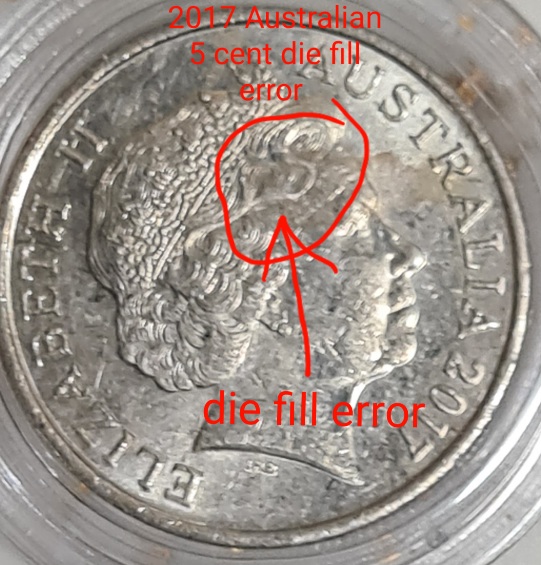
What you're seeing here is a "
Grease Filled Die".
As I noted in one of your earlier threads, high-pressure modern coining machinery uses high temperature grease, rather than regular lubrication oil. This grease is solid at room temperature, kind of like wax. "Used" grease, after tens of thousands of pumps of the dies back and forwards, is usually filled with microscopic bits of worn-off metal, and is even more solid and metal-like at room temperature.
When the run of a coining press stops, the warm dies get a chance to cool down, and any grease still stuck to the die cools and solidifies. It stays there, in the cracks and crevices of the die, the next time the presses start up again. The result is a coin featuring a "
Grease Filled Die".
"
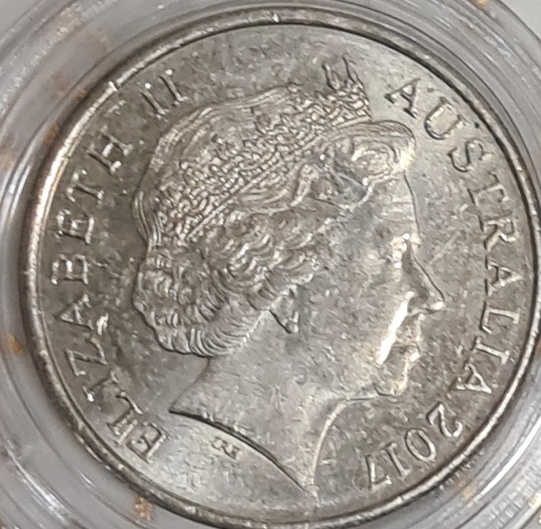
Grease Filled Die" and "worn die" can look similar, in terms of "the detail is missing". But as a general rule, grease-fill shows up on the low points of the die - which are the high points of the coin. Die wear shows up on the high points of the die, which are the low points on the resultant coins. And there, in the middle of the queen's hair and forehead, is a "high point" on the coin, and thus a "low point" on the die.
"Grease-filled die" can also look a lot like plain old wear from circulation, since the same high points that are vulnerable to grease-fill are vulnerable to circulation rub; you can tell the difference on a high grade coin because the rest of the coin is lustrous and uncirculated and doesn't appear to match up with the "worn spot". But on a worn heavily circulated coin, greasers are notoriously hard to ID. Fortunately, that's not a problem here.
I don't think "greasers" see too much of a premium from error collectors; they're not considered a "major error", nor even a variety, unless the "bald spot" or "mising detail" is particularly noteworthy.
Don't say "infinitely" when you mean "very"; otherwise, you'll have no word left when you want to talk about something really infinite. - C. S. Lewis









 Posted 08/19/2022 06:38 am





