Quote:
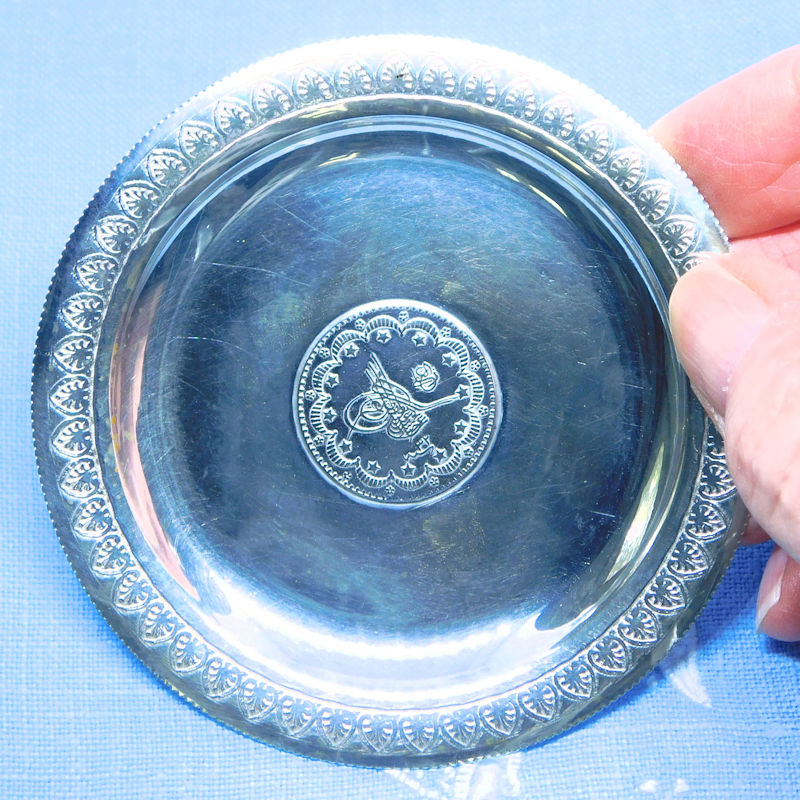
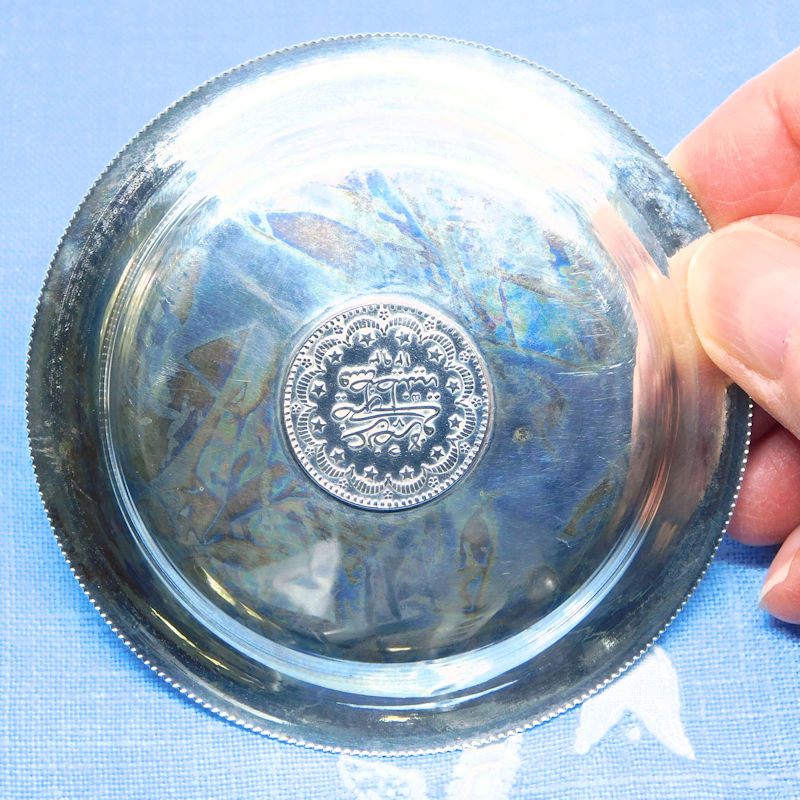
I would love to know the date, denomination and current reigning emperor etc. for these coins, as well as the reason for in-setting them into a saucer.
Calculating the date of an Ottoman Empire coin requires some mathematics, as well as a calendar converter.
The date is given in two parts: the "Accession year" is the year ( in the Islamic calendar) when the sultan in
herited the throne - in this case, the number is "1293", written at the bottom of the coin in the second pic (only you're holding the coin upside-down, so it's at the top of the picture). Then there is the "regnal year", counting the years since the accession date. In this case, that number is "32", written beneath the "toughra" symbol in the first pic. To get the actual year of issue, therefore, we have to calculate 1293 + 32 - 1 (the "minus one" needs to be there because AH 1293 is reckoned as Year 1, not Year Zero). This gives us an Islamic calendar year of 1324.
Converting Islamic Calendar dates to AD dates is complex, because the Islamic year has only 354 days, so there isn't a 1:1 correlation. You can do the maths ((1324 x 354 / 365.249)+623 = 1906.22), or you can look it up on an Islamic Calendar converter, like
this one. This tells me that AH 1324 began on 25th February 1906 and ended on 13th February 1907. Thus, "1906" is the usual converted date for this coin, though there is a small chance the coin was struck in early 1907.
The coin was indeed minted in Istanbul, or "Qustantiniyah" as it was known at the time, and is the name recorded (in Arabic) on the coin as the mint-city. As such, you will find it listed under "Turkey" in the coin catalogues.
The Ottoman Sultan at the time was Abdulhamid II. HIs name is actually on the coin: the "toughra" I mentioned earlier, the squiggly thing in the middle of the top pic, is actually the Sultan's signature, written in a particularly ornate way. This doesn't actually help much with the ID, since all toughras tend to look very much alike. They are always written with three "masts" and a "prow", deliberately designed to look similar to a sailing ship.
Now, for your final question: why is it in a saucer? I think we can at least partly answer this question with one simple observation: your parents bought it, did they not? Would they have bought it if it were simply a silver coin by itself? Probably not; even if they were coin collectors, these coins are common enough that selling them as coins rarely gains much profit or interest. So in that sense, it's "mission accomplished" for the silversmith. It doesn't really have, or need, any further justification for its existence - there is no particular tradition in Turkey about making ceremonial or decorative objects out of coins. It is almost certainly of "modern" make - that is, made in the 1960s, rather than the 1900s.
Unfortunately, a coin colelctor will most likely frown upon such a coin, because it is impossible to remove it without damaging the coin; the coin is likely already damaged by the act of attaching it into the plate. So any value it possesses is from its artwork and silver content, not as a coin.
A final note on legality: in Turkey, even back in the 1960s, it was illegal to sell to tourists any coins dating from prior to the reign of Abdulhamid II, but coins from Abdulhamid II onwards were totally legal. So, no Turkish laws were broken in making and selling this item.
Don't say "infinitely" when you mean "very"; otherwise, you'll have no word left when you want to talk about something really infinite. - C. S. Lewis












 to the Community!


 Posted 08/25/2022 2:43 pm


