











 to CCF!


 Posted 09/26/2022 10:00 pm


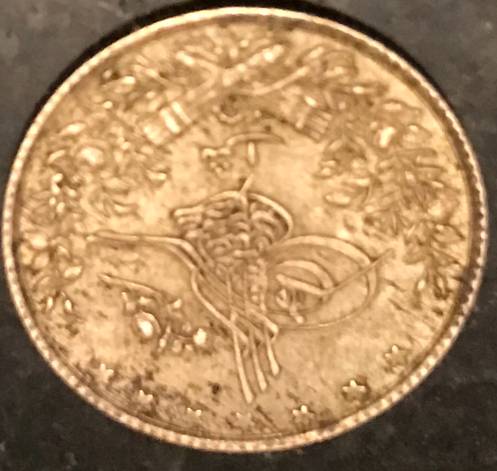
Your bottom picture is upside down.
The squiggly thing on the bottom picture is called a "toughra", and it's actually the ornate signature of the Sultan. Below that (above that, on your upside-down picture) is written "1 sh", which is abbreviation for "1 qirsh".
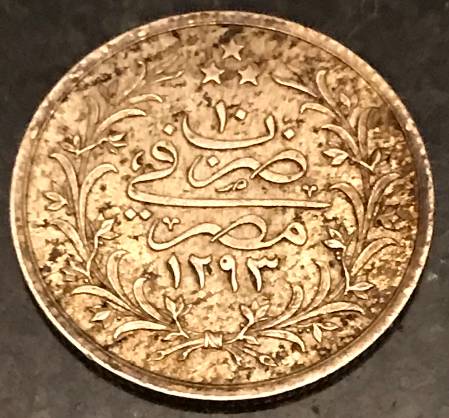
Working out the actual year of issue takes a bit of math. On the reverse, we have "1293" as the accession year, and "10" as the regnal year. to get the actual year of issue, we need to add those two numbers together, then subtract 1. 1293 +10-1=1302. This is of course the Islamic calendar year, to convert to an AD date, we either do more complex maths or look up a calendar converter website. In this case, AH 1302 began on 21st October 1884 and ended 9th October 1885. So calling it the equivalent of "1885" would be most probable, though "1884" wouldn't be wrong either; "1884/5" would be most correct.
The squiggly thing on the bottom picture is called a "toughra", and it's actually the ornate signature of the Sultan. Below that (above that, on your upside-down picture) is written "1 sh", which is abbreviation for "1 qirsh".
Working out the actual year of issue takes a bit of math. On the reverse, we have "1293" as the accession year, and "10" as the regnal year. to get the actual year of issue, we need to add those two numbers together, then subtract 1. 1293 +10-1=1302. This is of course the Islamic calendar year, to convert to an AD date, we either do more complex maths or look up a calendar converter website. In this case, AH 1302 began on 21st October 1884 and ended 9th October 1885. So calling it the equivalent of "1885" would be most probable, though "1884" wouldn't be wrong either; "1884/5" would be most correct.
Don't say "infinitely" when you mean "very"; otherwise, you'll have no word left when you want to talk about something really infinite. - C. S. Lewis


