| Author |
 Replies: 13 / Views: 4,062 Replies: 13 / Views: 4,062 |
|
|
Valued Member
United States
326 Posts |
  I have collected coins for over 20 years but never been interested in errors of any sort. A friend of mine recently received this dime in his change and was curious what I could tell him about it. Can someone please help me out?
|
|
|
|
Bedrock of the Community
United States
62064 Posts |
How thick is the coin on the right? Looks like it was ground down with something and the heat turned the color a little. The Center looks different than you would image for 1/2 of a coin. Almost looks like they may have tried to make a button out of it?
|
|
Valued Member
 United States
326 Posts |
The coin is about 5/6th of the thickness of the dime on the left. The piece in the center is raised a bit and is the same thickness as the dime on the left.
The surface of the "odd" dime is mirror like with no scratching. The coin is like nothing I've ever seen before. I actually was thinking about sending it to PCGS for them to authenticate but was curious if anyone here could shed any light on it.
|
|
Bedrock of the Community
United States
62064 Posts |
Maybe others may shed some light on the coin. I know its post mint damage. The big clue is that the rim on the OBVERSE is missing. So it has been tampered with. Maybe Mike Diamond Will see something I'm missing? He is the Error coin expert.
|
|
Pillar of the Community
United States
1807 Posts |
How big is that spot in the middle. I'm thinking some science electronic experiment with a 1/4" or 3/8" flat washer.
Edited by rockdude
02/23/2009 7:54 pm
|
|
Valued Member
United States
326 Posts |
Spot in the middle is about the size of an eraser on a pencil.
|
|
Pillar of the Community
United States
2752 Posts |
A lathe, milling machine, or similar device was used to remove much of the obverse face. I've seen lots of coins vandalized in this fashion.
Error coin writer and researcher.
|
|
Bedrock of the Community
United States
12437 Posts |
 The oddly colored area is the phase where the copper core is bonded to the outer CuNi layer so essentially the entire outer layer was lathed/machined to expose the inner core. For some reason, a small portion of the outer layer was left in the center, only the maker could tell you why. Most of the time, the entire side is removed to create a one-sided coin or to attach it the another one-sided coin to create a coin with two heads, two tails, or even two denominations. Sending it to PCGS would be a waste of money as it is definitely just a damaged coin and not an error of any kind. |
|
Bedrock of the Community
United States
62064 Posts |
I just noticed something as I was leaving this thread. Look at the darker copper area on the defaced coin. Think about this a bit?
|
|
Valued Member
United States
326 Posts |
What about the dark copper area Coop?
|
|
Bedrock of the Community
United States
62064 Posts |
That's what I noticed. You can see where the bust WAS.
|
|
Pillar of the Community
United States
1882 Posts |
Quote:
Think about this a bit? My thinking cap is on... |
|
Bedrock of the Community
United States
62064 Posts |
Here is another clue. 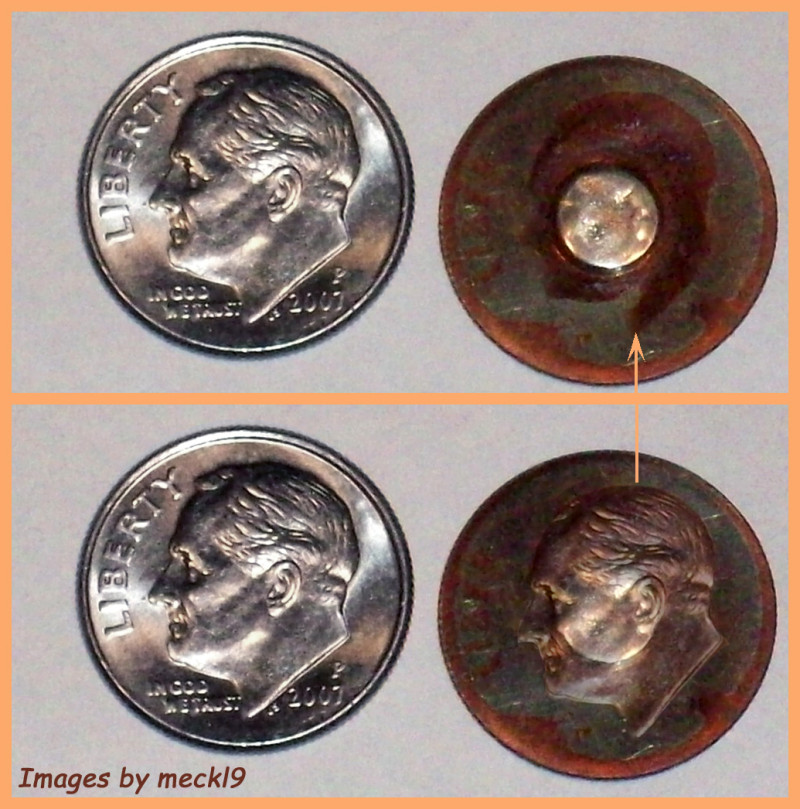 |
|
Pillar of the Community
United States
1882 Posts |
Coop, you'll have to spill more beans. :)
I've been assuming that Mike Diamond's description is accurate, and that the original striking pressure left the center layers of the coin discolored where his bust (and the letters of LIBERTY) should be.
|
| |
Replies: 13 / Views: 4,062 |
|









 Posted 02/23/2009 7:42 pm


