Coin Community Family of Web Sites Join Thousands of Coin, Bullion, & Money Collectors
Coin, Banknote and Medal Collectors's Online Mall Vancouvers #1 Coin and Paper Money Dealer 300,000 items to help build your collection! Royal Estate Auctions - $1 Coin AuctionsJoin Thousands of Coin, Bullion, & Money Collectors Royal Canadian Mint products, Canadian, Polish, American, and world coins and banknotes. Specializing in Modern Numismatics


Username:
Password:
Save Password
Forgot your Password?


This page may contain links that result in small commissions to keep this free site up and running.

Welcome Guest! Registering and/or logging in will remove the anchor (bottom) ads. It's Free!

Help Identifying A Few Older Coins That I Have Found. (Id: Mostly Ancient Rome)

To participate in the forum you must log in or register.
Author Previous TopicReplies: 9 / Views: 1,879Next Topic  
New Member

United States
3 Posts
 Posted 02/25/2009  11:47 pm Show Profile   Bookmark this topic Add silas to your friends list Get a Link to this Message Number of Subscribers
Hello everybody. I'm new to the forums. Someone refered me here from another site that I frequent.

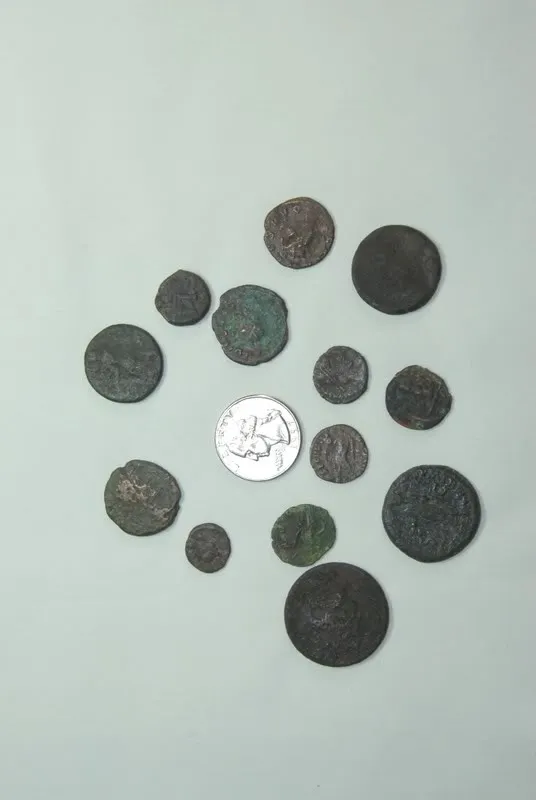
A friend of mine bought an old dresser from an antique dealer. We were prepping it for refinishing and found these hidden in the back bottom. There are about four times as many as this but I just posted the ones I thought would be of most interest.

Anyone have any info on any of these, or know where I can find out?

Any help would be appreciated.


Help-Identifying-A-Few-Older-Coins-That-I-Have-Found.-Id:-Mostly-Ancient-Rome
Edited by silas
02/25/2009 11:49 pm
Pillar of the Community
manila galleon trade's Avatar
Spain
1361 Posts
 Posted 02/26/2009  12:05 am  Show Profile   Bookmark this reply Add manila galleon trade to your friends list Get a Link to this Reply
I don't know anything about roman coins but you are very lucky to find these nice coins.
Pillar of the Community
Spider5689's Avatar
United States
2269 Posts
 Posted 02/26/2009  12:21 am  Show Profile   Bookmark this reply Add Spider5689 to your friends list Get a Link to this Reply
Some of the coins you have are Silver Grossos from Venice. They appear to be produced before 1400. One coin is the Emperor Commodus. One coin in particular is a from the Byzantine Empire with Justinian I on the obverse. You also have coins from the Papal States. It appears the former owner was a collector of coins from Italy, whether they date back to the Roman Empire, Republic of Venice, Byzantine Empire, or the Papal States.

It seems the former owner did label some of these coins. The bottom picture is difficult for me to see because of the size.
Pillar of the Community
EgCollector's Avatar
Egypt
3470 Posts
 Posted 02/26/2009  06:09 am  Show Profile   Bookmark this reply Add EgCollector to your friends list Get a Link to this Reply
Lucky you
Pillar of the Community
DL20K's Avatar
Poland
3201 Posts
 Posted 02/26/2009  06:18 am  Show Profile   Bookmark this reply Add DL20K to your friends list Get a Link to this Reply
I'll go for the obvious:

#11 is a Nazi 10 reichspfennig minted in zinc (1940). Mintmark A = Berlin. First year of issue. 212+ million issued.
Very common, but relatively good grade, many of those are just hideous with pitting or the 'zinc disease' - it looks like this piece doesn't have either of them.
Moderator
Learn More...
Sap's Avatar
Australia
16859 Posts
 Posted 02/26/2009  08:35 am  Show Profile   Bookmark this reply Add Sap to your friends list Get a Link to this Reply
Looks like someone's either forgotten to remove their collection, or passed away without telling their relatives where they'd hidden the coins.

Most of the ancients and mediaevals have more-or-less been identified for you.

#1: Roman empire, emperor Commodus. If it's "laureate head", then it'll be an as. Reverse has a seated figure with a shield and spear; looks most like Roma seated to me. So it should be something like this example (except that's a sestertius, or 4-as coin). Listed in the Sear catalogue as number 5884, dated to 189 AD and this one probably has a value probably in the $30 to $60 range.

#2: Venetian Republic, silver grosso of Doge Antonio Venier (1382-1400 AD). In mediaeval times, Venice was one of the most powerful nations in Europe, and the "Doge" (the g is pronounced like a j; it's related to the English word "Duke") was the selected ruler. I don;t have a catalogue to value these coins properly.

#3: The portrait looks second century Roman, but the language might be Greek, making this a Roman Provincial coin. I'd really need to see the other side to tell you more.

#4: The Roman one is too well worn to tell much frm that picture (the other side might be more informative). The Venetian one is from the time of the Doge named on the 2x2.

#5: This one's a copper as from the Roman Republic, before the days of the Emperors. The obverse shows Janus, the Roman two-faced god after whom January was named; the reverse shows the prow of an ancient ship. These were struck It appears it's previous owner was unable to get a more accurate date than "sometime around 100 BC", and presumably made the photocopies / pictures to send to experts to help him identify it, back in the days before the Internet (aren't you lucky? ).

#6: The Venetian one is from the time of Doge Giovanni Soranzo (1312-1328). The others look like Late Roman bronzes, typically worth $5 to $10 each.

#7: This one's identified for you: Papal States, 1 baiocco 1748. In mediaeval and early modern times, right up to the unification of Italy in the 1860's, the Pope ruled a large slice of central Italy as a temporal prince, as well as his role as spiritual head of the church. In that sense, the Papal states can be seen as the precursor to the Vatican City (only the Papal States were much larger).

#8: Byzantine Empire, copper follis of emperor Justinian I. In the Byzantine monetary system, there were 40 nummi to a follis; the large "M" is the denomination mark - "M" is the Greek numeral for "40".

#9: a couple more Venetians, from the Doges named. "Billon" (not "billion") is a word that means "base-silver" - it contains silver, but it's not very pure. "tornesello" is the name of this small denomination.

#10: All the information you need is on the envelopes. The one on the left is a Roman Provincial coin from Antioch, the biblical city in what is now southern Turkey, during the time of emperor Vespasian. The one on the right is a "city commemorative" from the late Roman period, circa 330 AD. "Cyzicus" was a city in what is now north-western Turkey; the Romans had a mint there.

#11 has been done.

#12: there are numerous late Roman bronzes and similar coins here, like the ones mentioned at 6. The larger ones appear to be earlier Roman bronzes; we'd need to see the other sides to identify them properly.
Don't say "infinitely" when you mean "very"; otherwise, you'll have no word left when you want to talk about something really infinite. - C. S. Lewis

New Member
United States
3 Posts
 Posted 02/26/2009  10:36 am  Show Profile   Bookmark this reply Add silas to your friends list Get a Link to this Reply
Thanks for the information everyone. I think it's pretty cool to hold something that's around 1500-2000 years old. The imagination can run rampant when doing so. Just trying to imagine where all each coin had been, what it has bought, what the people who spent it might have looked like, What they were wearing. It really blows my mind. Of Course the "Am I rich?!?" thought runs through the mind also.

Well I guess I have some researching to do. I'm going to go through the others that I mentioned and see what I can find out about those also.

How should I continue my journey? These pictured are the only ones that had any written records attached to them. The rest are loose coins.
Moderator
Learn More...
echizento's Avatar
United States
23731 Posts
 Posted 02/26/2009  12:41 pm  Show Profile   Bookmark this reply Add echizento to your friends list Get a Link to this Reply
, You have a very nice group of coins there.
Moderator
Learn More...
Sap's Avatar
Australia
16859 Posts
 Posted 02/27/2009  05:10 am  Show Profile   Bookmark this reply Add Sap to your friends list Get a Link to this Reply
If you wish, simply post your coins here in the ID Required forum, and we'll do our best. If possible, have only one coin per thread - they're easier to keep track of that way.

Once you get the hang of reading the lettering on Roman coins, this site is invaluable for identifying the coins yourself - the Wildwinds partial inscription search. Simply type in the letters you can read, and it finds all the coins in it's database that have those letters in that order.

If you know the city of issue or emperor, the main Wildwinds index is also good for just browsing and trying to find a match.
Don't say "infinitely" when you mean "very"; otherwise, you'll have no word left when you want to talk about something really infinite. - C. S. Lewis

New Member
United States
3 Posts
 Posted 02/28/2009  5:45 pm  Show Profile   Bookmark this reply Add silas to your friends list Get a Link to this Reply
Those sites sound like just the ticket.

Thanks
  Previous TopicReplies: 9 / Views: 1,879Next Topic  

To participate in the forum you must log in or register.


Disclaimer: While a tremendous amount of effort goes into ensuring the accuracy of the information contained in this site, Coin Community assumes no liability for errors. Copyright 2005 - 2026 Coin Community Family- all rights reserved worldwide. Use of any images or content on this website without prior written permission of Coin Community or the original lender is strictly prohibited.
Contact Us  |  Advertise Here  |  Privacy Policy / Terms of Use

Coin Community Forum © 2005 - 2026 Coin Community Forums
It took 0.29 seconds to rattle this change. Forums