South Dakota became the 40th (or was it the 39th) State to join the Union on November 2, 1889. South Dakota was admitted to the Union on the same day as North Dakota - during the same signing ceremony - it is listed as the 40th State due to alphabetical order vs. known signing order.
Here's a note prepared about the North Dakota/South Dakota Statehood situation by the South Dakota Historical Society Foundation for the
Aberdeen News. The quote is taken from an article titled - "Much Celebration at Statehood in 1889." Here's a link to it:
Much Celebration at Statehood in 1889.
"After some debate, the two documents, unlooked at, were laid face downward on the desk on a sheet of paper and then they were shuffled together. When this stage of the game had been reached, the proclamations were turned face upward and protected by the sheet of paper upon which they had been laid. The sheet was slipped aside until the blank spaces for the presidential signature was exposed; the autograph was appended to each, the ink allowed to dry, the proclamations turned over once more and again vigorously shuffled. The two Dakotas were admitted to the Union of States, and although one was ahead of the other just the length of time it took the president to write his name, history will never be able to record the name of the leader."The geographic road to state boundaries for South Dakota went through many stages. Most of the area of present-day South Dakota was included in the Louisiana Territory that the US purchased from France in 1803; a minor section in its northeast corner was secured via treaty with Great Britain in 1818. After Louisiana became a state, the remaining Louisiana Territory land was renamed as the Missouri Territory - it continued to include land that would become South Dakota. In March 1861, the Dakota Territory was created in the northern region of the Missouri Territory; it was divided into the Dakota Territory, the Montana Territory and the Wyoming Territory in 1868. In 1889, the Dakota Territory was split into North and South and the journey to Statehood was in the home stretch!
Dakota Territory Circa 1861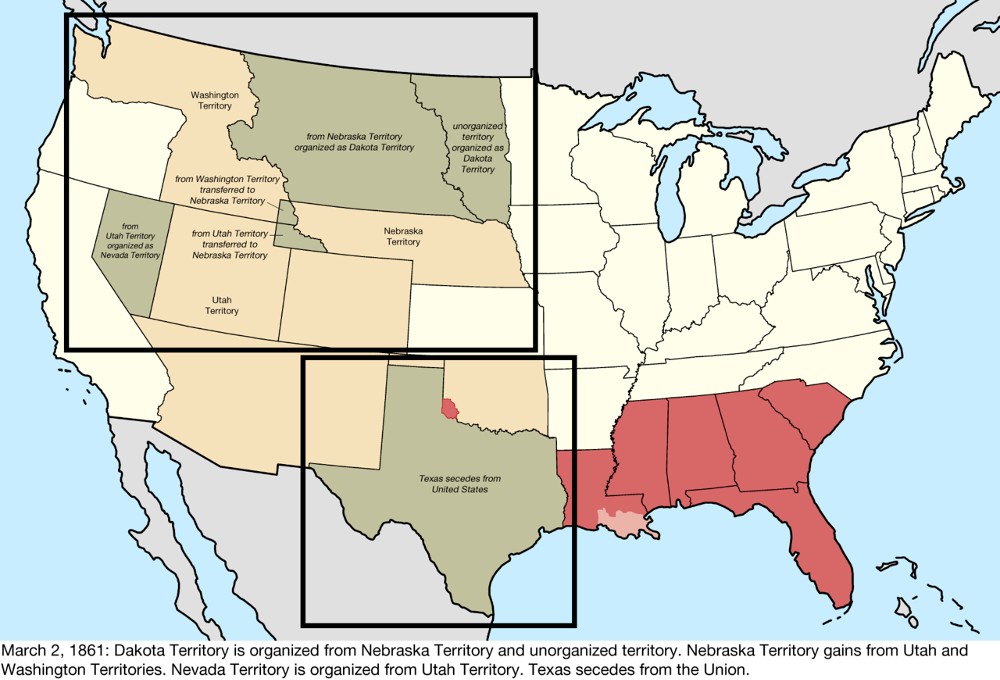 (Image Credit: Golbez. CC BY-SA 3.0 https://www.creativecommons.org/licenses/by-sa/3.0, via Wikimedia Commons.)Dakota Territory Divided Circa 1889
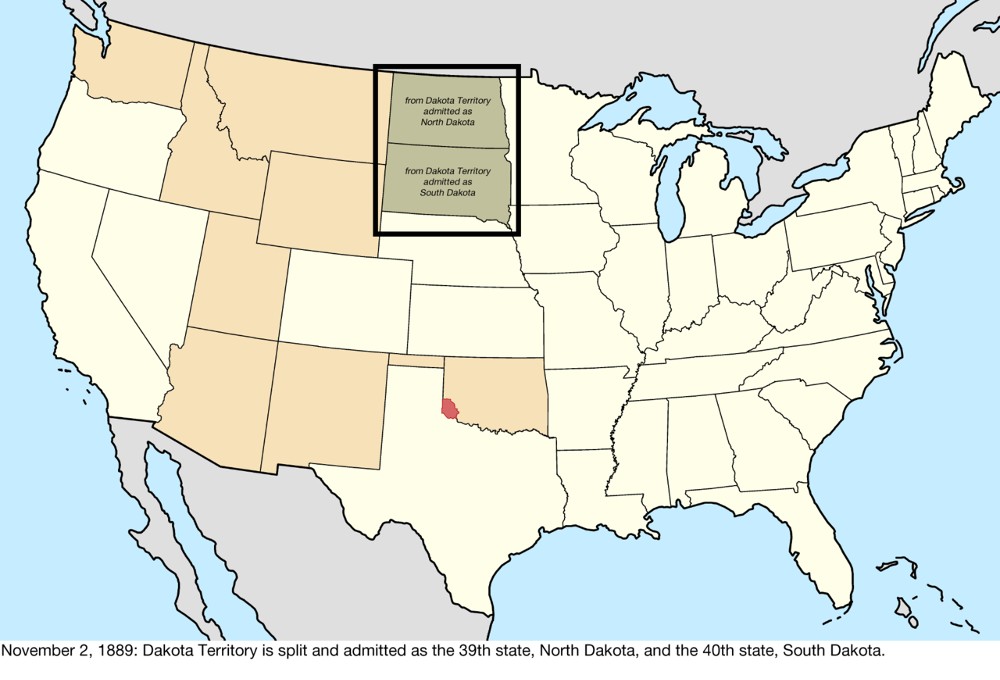 (Image Credit: Golbez. CC BY-SA 4.0 https://www.creativecommons.org/licenses/by-sa/4.0, via Wikimedia Commons.)
A bill calling for 50-cent pieces "in commemoration of the fiftieth anniversary of the admission of the State of South Dakota into the Union" was introduced in the Senate by William John Bulow (D-SD) for himself and John Chandler Gurney (R-SD) in May 1939 during the 76th Congress. The bill was immediately referred to the Senate Committee on Banking and Currency.
The bill specified a mintage of up to 25,000 coins to be struck at a single US Mint facility. All coins were to bear the date "1939" and coining authority was to expire one year after the bill's enactment. The coin's sponsor/beneficiary was the State of South Dakota Fiftieth Anniversary Commission, and it was allowed to order its coins "at such times and in such quantities" as it desired. Net proceeds from sale of the legal tender coins were to be used to help defray Commission expenses regarding its commemoration of the 50th Anniversary.
The bill was never reported by the Senate Committee, nor was it ever considered by the Whole Senate or House of Representatives. The bill died for lack of action with the adjournment of the 76th Congress.
In 1939, the US Post Office Department issued a one-for-four commemorative stamp that marked the 50th Anniversary of Statehood for North Dakota, South Dakota, Montana and Washington.
1939 Four States Stamp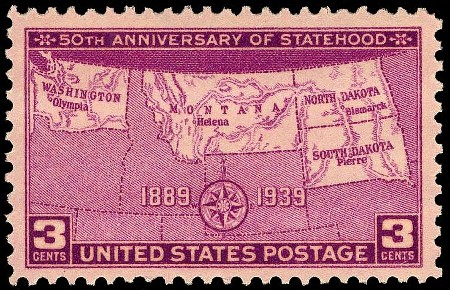
I've written before about a coin proposal for Washington's Statehood Anniversary:
-
1939 Washington Statehood 50th AnniversaryNeither North Dakota nor Montana had coin bills introduced on their behalf.
For more of my topics on commemorative coins and medals, including many more What If? stories, see:
Commems Collection.







 Posted 01/01/2023 11:38 pm


