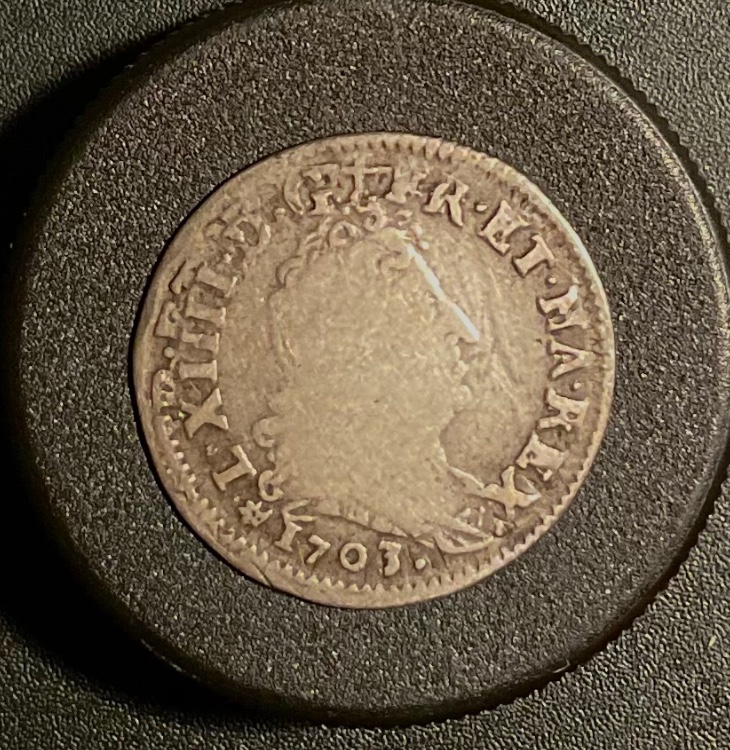
It is a good question and the simple answer is: No, there is no simple way to determine the denomination for smaller silver French coins from this period. You need a reference book like Gadoury's Monnaies Royales Françaises which lists all coins with weight, diameter, and their value (and where applicable, how the value changed over time). Alternatively, you can get a lot of that information from Numista for instance, although in less structured form.
A more complete answer requires diving into the complex monetary system used in France before the French revolution (that is, what is usually referred to as the royal period). At that time, France had a system based on the livre (originally a weight unit). The livre was divided into 20 sous or sols (both names were used). A sou/sol was in turn divided into 12 deniers. (To collectors of UK coins that looks familiar, and it is indeed the same division as pound - shilling - pence.) The complication was that for all but smaller denominations, the coin system was only loosely connected to the monetary system. So, there were coins with denominations from 1 denier up to (I think) at most 30 sols (which denominations existed varied over time). And although 30 sols = 1½ livre, there were no livre coins. Instead there was a silver coin named ecu - but without denomination expressed on the coin - with fractional coins 1/2 ecu, 1/4 ecu, etc down to - this also varied over time - as little as 1/24 ecu. In addition, there were coins without denomination that did not readily fit into the simple fraction system, like 5 sols at a time when an ecu was valued at 3 livres 16 sols, so they were called 5 sols even though that was not expressed on the coin.
Thus the value in livres of an ecu was not fixed. It was set by royal decree and could change at the discretion of the king when he saw fit to, for instance, increase the value of the royal treasury by decreeing that all ecus should from now on be worth not 4 livres, but, say, 4 livres 10 sols. Practical for the king, could be an annoyance for ordinary people. A similar principle was applied to gold coins, the so called louis d'ors, also without a fixed value. But let's stay with the silver coins.
The largest silver coin, the full ecu, was originally valued at 3 livres at its introduction in 1641. The last ecu of 1792 was valued at 6 livres. During those 151 years, the value had varied from 3 livres up to 15 livres (for a short period around 1720). The systematic overstrikes performed 1690-1723 were part of a scheme that combined revaluation of coins (ecus and their fractions, as well as louis d'ors) with filling the royal treasury (the many wars France got involved in during those years were very costly).
In principle the scheme worked like this: Old coins were mandatorily brought to the mint, overstruck with a new design (that was cheaper than melting them and striking new coins) and assigned a higher value, and coins amounting to the same value were returned. Only, now that the coins were worth more, fewer coins were returned ... The "surplus" coins went to the treasury. One can imagine that people were not overly thrilled by this trick, but it was not a good idea to have any issues with what the King by the Grace of God had decided.
Still, for the larger silvers it is possible to determine which coin it is, if not what value it had. Full ecus always measured 38-41 mm across and weighed 23-31 grams. 1/2 ecus: 32-36 mm, 11-15 g. 1/4 ecus until 1718 measured 26-30 mm, weighed 7-8 g. From 1718 1/5 ecus took that place, with slightly smaller measures: 27 mm and 5-6 g. For the even smaller ecu fractions, it gets more fuzzy, and reference literature has to be consulted. We may note that the smallest non-denominational coin, the 1/24 ecu, was valued at 2½ sols, so the ranges of coins with and without denomination overlapped.
That was an overview, skipping some details and exceptional issues ...








 Posted 01/14/2023 11:16 am





