PCGS - This $50 stunner was born from merchant demand for large-denomination currency during the California Gold Rush. Yet, the House rejected the idea in 1857.
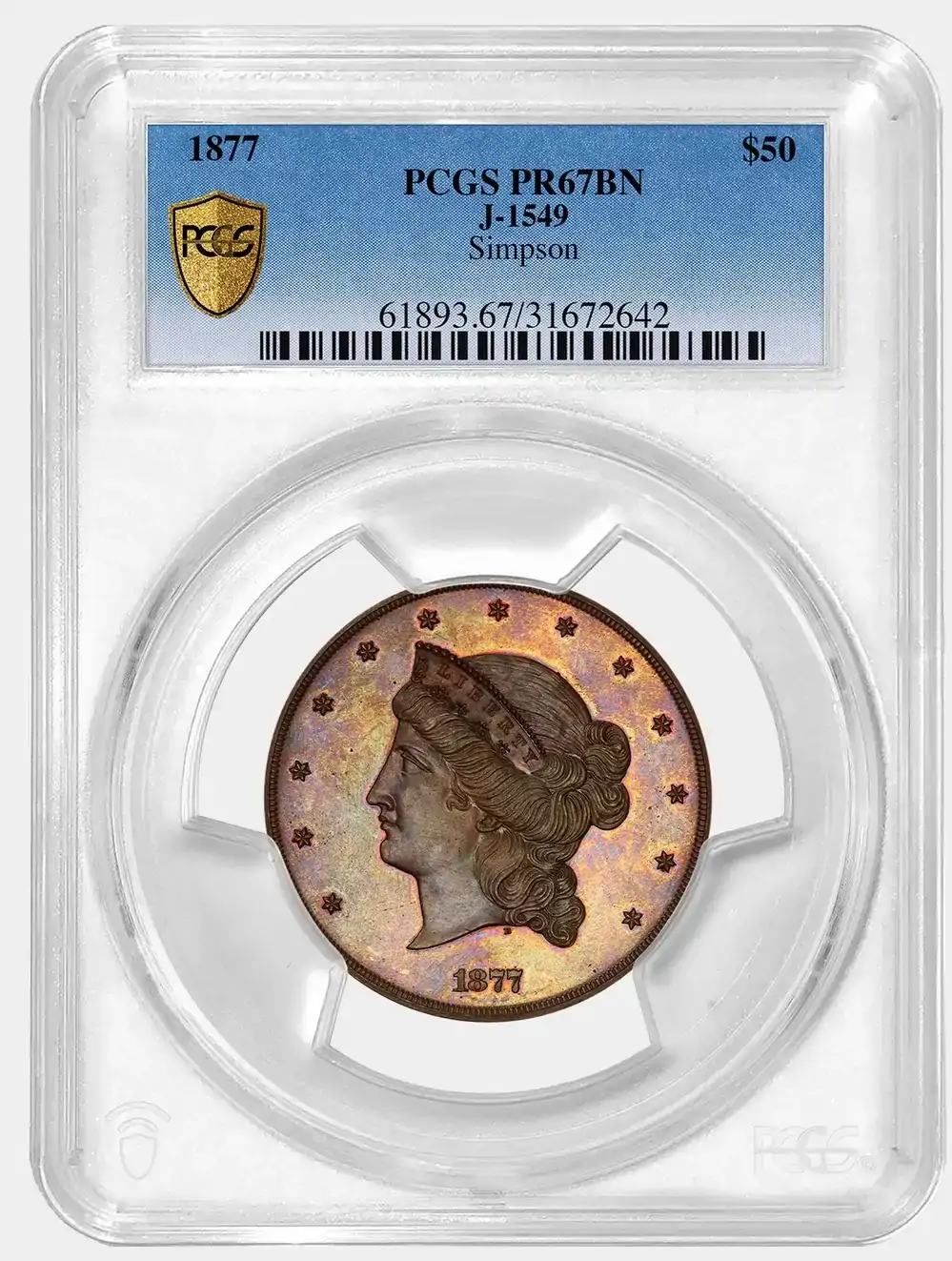
Revived in 1877, it was struck with both Small and Large Head designs, with this specimen being a Small Head. In PCGS PR67BN, this non-gilt copper piece is the finest of the 7 reportedly known examples. It last sold for $408,000 in January.
 Check out Half Union Related Items on ebay
.
 Auction Description
1877 Half Union, Judd-1549, PR67 Brown
Extremely Rare 50 Dollar Pattern in Copper
Only Non-Gilt Example in Private Hands
Ex: Sieck-Queller-Simpson
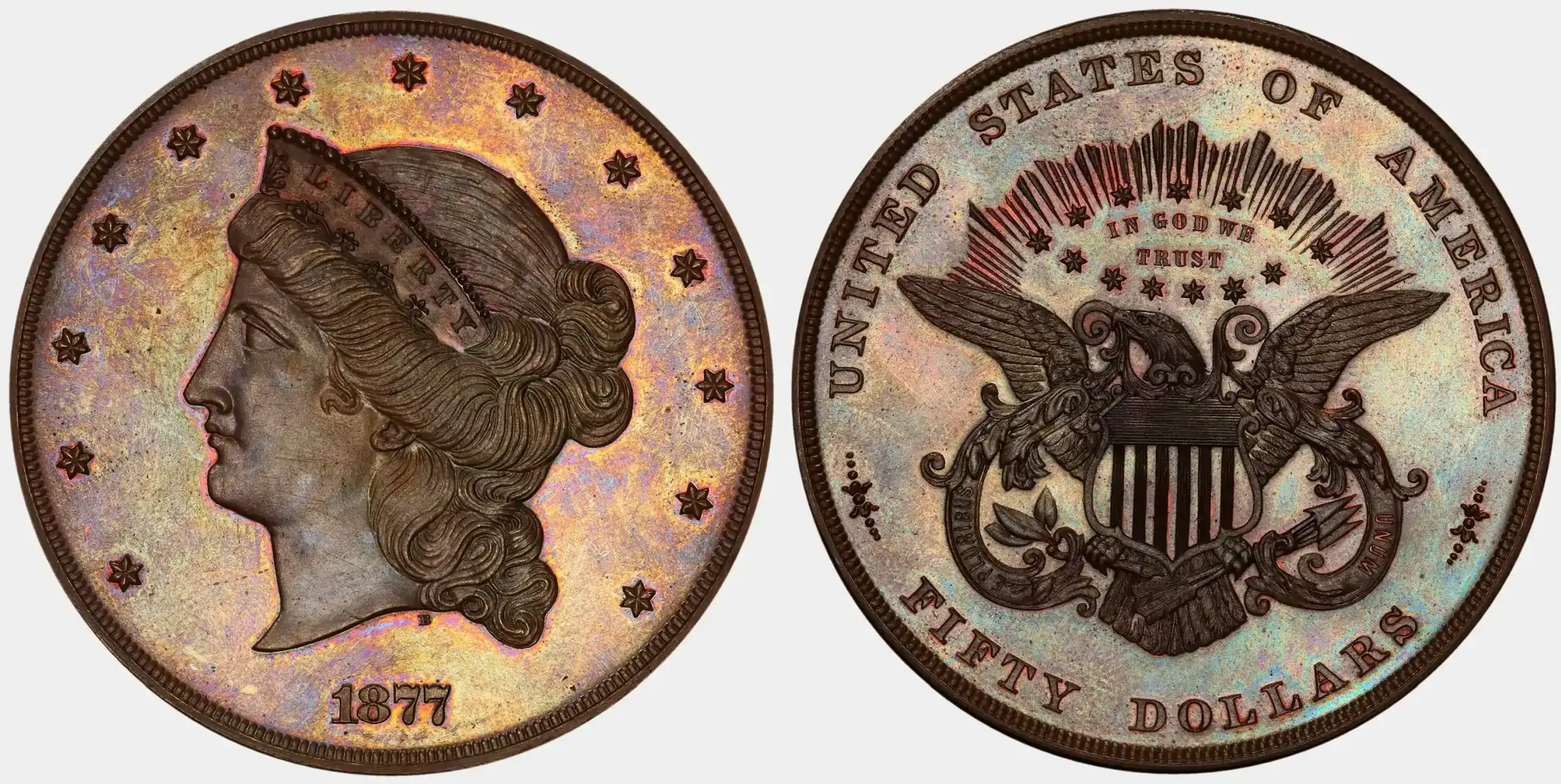
1877 $50 Half Union, Judd-1549, Pollock-1722, R.7, PR67 Brown PCGS. Ex: Simpson. The 1877 half union, Judd-1549, is one of the most famous rarities in the U.S. pattern series. U.S. Patterns.com has confirmed the existence of just seven different examples, of which four have been gilded at some time, possibly before they left the Mint. Of the three non-gilt examples, two are included in institutional collections at the Connecticut State Library and the Smithsonian Institution. Heritage Auctions is privileged to present the finest-known example of this iconic pattern issue, and the only non-gilt specimen in private hands, in this important offering.
DesignDiameter: 2 inches; thickness: 1/8 inch. The
William Barber Small Liberty Head design. Liberty faces left, with a coronet bearing her name, its top border ornamented with beads and four stars along the bottom (a key feature in differentiating between the varieties in early auction descriptions). Her hair is thick and wavy, and a B in the field just below the truncation (unusually, not on the neck) stands for Barber. Thirteen stars ring the border, with the date 1877 below. The star and letter punches are from the same set used on contemporary double eagles. One notes that IN GOD WE TRUST, as on the Judd-1547, is clearly hand-punched: IN GOD WE is not in a regular arc, and some of the letters are tilted slightly left or right from their intended positions. The Small Head shows the tip of the coronet below star 6, while the Large Head shows the tip between stars 5 and 6, and the date is considerably further away from the bust truncation on the Small Head. The two lowest curls on Liberty are rounded, rather than pointed, as on the Large Head.
The reverse (same as the Large Head) is also basically the same as the contemporaneous double eagle, but detailed differently, the most obvious difference being two small decorative elements at the rim on each side, between UNITED STATES OF AMERICA and the denomination FIFTY DOLLARS. Struck in copper with a reeded edge. The majority of known specimens have been gold-plated, possibly in the Mint. This design was also struck in gold (Judd-1548), with a single example known in the National Numismatic Collection at the Smithsonian Institution.







 Posted 08/29/2025 2:53 pm





