In May 1956, Noble Jones Gregory (D-KY) introduced a commemorative half dollar bill in the House of Representatives that called for coins to be struck "in commemoration of the one hundredth anniversary of the city of Paducah, Kentucky, and in honor of the late Senate Alben W. Barkley."
(Note: The bill's title, as originally published, has a typo: "Senate" should be "Senator;" it was corrected in the official record.)Paducah was chartered as a city in Kentucky in 1856 - this was to have been the milestone event commemorated by the coin. Originally called Pekin, the area became a focus of European settlement roughly four decades earlier; its location at the confluence of the Ohio and Tennessee Rivers made it an attractive site. The area would go on to be jointly inhabited by European settlers and indigenous Native Americans, who are said to have lived together peacerfully. The local tribe was known as the Padouca.
The layout of the city was formalized in 1827 with the arrival of William Clark, Superintendent of Indian Affairs for the Mississippi-Missouri region. Its name was changed from Pekin to Paducah, in honor of the local Native Americans, and the town was incorporated in 1830. Its status as a port city on popular travel and trade water routes enabled and fueled its growth.
Paducah, KY - Early River Scene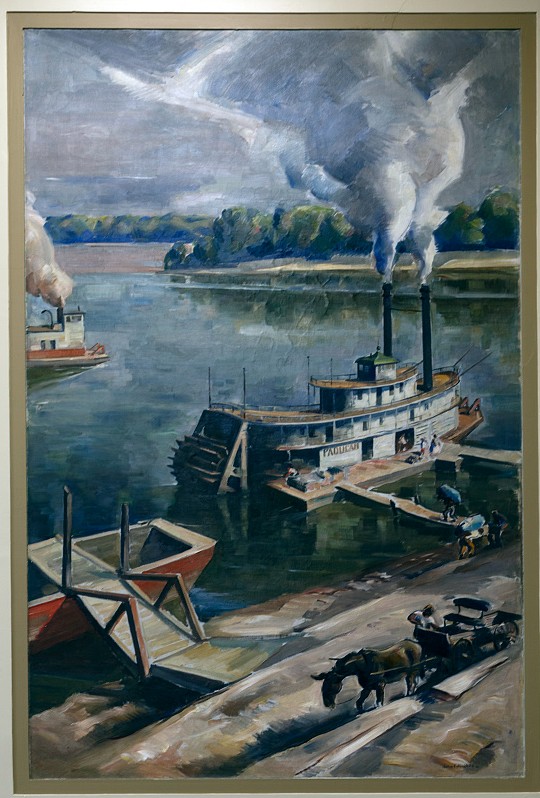 (Image Credit: Library of Congress, Prints and Photographs Division. Photograph of painting at the Federal Building and U.S. Courthouse, Paducah, KY. Public Domain).
Alben William Barkley was born in a log cabin on November 24, 1877 in Wheel, Kentucky.
(Interesting Note: His birth name was Willie Alben; he changed it to Alben William when he became old enough to do so.) After opening a law practice in Paducah and getting involved in local politics, he won election to the US House of Representatives from Kentucky and served between 1913 and 1927); he represented the State's 1st District which included Paducah. He later was elected to the US Senate and served from 1927 to 1949, and then again from 1955 until his death on April 30, 1956. Between his two stints in the Senate, Barkley served as the US Vice President under Harry S. Truman. While in office, he was a strong advocate for US participation in the fledgling United Nations.
Senator Alben William Barkley, Circa 1930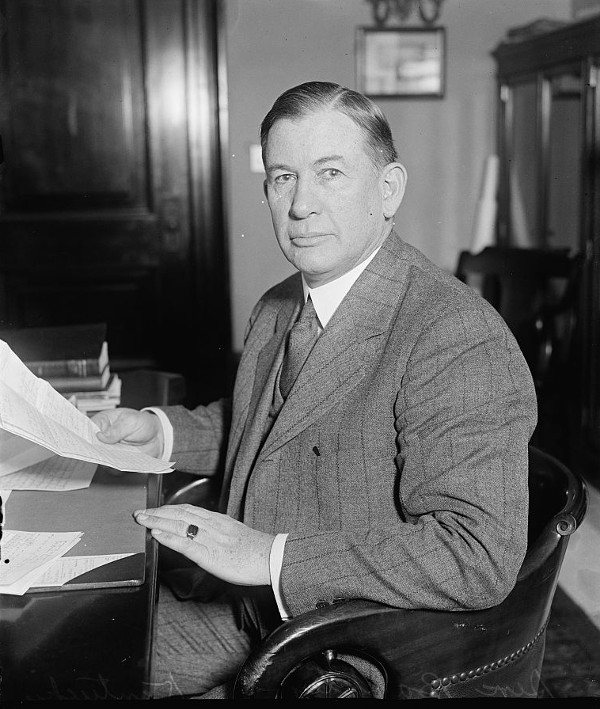 (Image Credit: Library of Congress, Prints and Photographs Division. Public Domain).
If I were a betting man, I would bet that Representative Gregory had intended to introduce a standalone bill that called only for a Paducah, KY half dollar but that Barkley's death gave him an opportunity to "up the ante," so to speak, and add a popular national figure to the objectives list for the coin. Barkley's death on April 30, preceded Gregory's bill by just two weeks.
The bill called for the production of a
minimum of 500,000 half dollars (without a specified upper limit) and did not include any stated restrictions on the US Mint facilities that could be used for production. With such a significant volume to be struck, it is a distinct possibility that multiple Mints would have been engaged, and that "completist" collectors would have needed to seek out more than one mint marked coin. The coin was intended to be a circulating half dollar commemorative to be issued in 1956; the bill did not make any reference to the Benjamin
Franklin half dollar already in circulation, so it is likely the Paducah/Barkley coin was not meant to replace it but rather supplement it.
Upon its introduction, the bill was referred to the House Committee on Banking and Currency. It was never reported out, however, and never considered on the floor of the House or Senate. When the 84th Congress adjourned in July 1956, the bill died for lack of action.
Though the memorial coin did not work out, Barkley's service to the country was not overlooked by the US Congress. In 1949, it awarded him a Congressional Gold Medal; bronze duplicates were made available to the public.
If this post made you wonder about dual-purpose commemorative coins, check out:
-
Dual Purpose Commemorative CoinsFor other of my topics on commemorative coins and medals, including many more What If? stories, see:
Commems Collection.










 Posted 04/15/2023 10:35 am


