Hello all,
I'm not sure if I'm posting this in the right section, so if the mods could move it please if it isn't, I'd be grateful.
A question has presented itself following the receipt of my 1826 bronzed proof farthing back from NGC. I don't normally send coins off to be graded, but I do with any proofs that I get, and I'm quite happy to buy them if they are already graded and the coin is worth it. I have asked this question on another forum, and wanted to get further opinion please.
The coin has been returned as an 1826 BARE BUST, but it is in fact the 1826 BARE BUST BRONZED variety (see images)

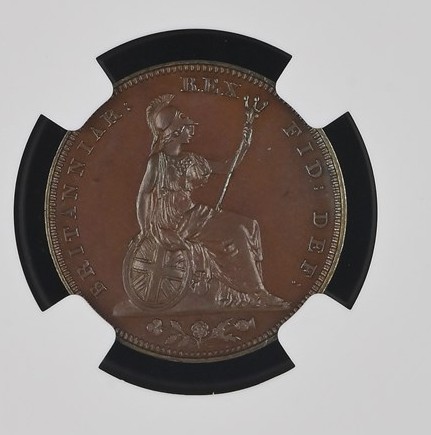
I have raised this with NGC who have replied with the following:
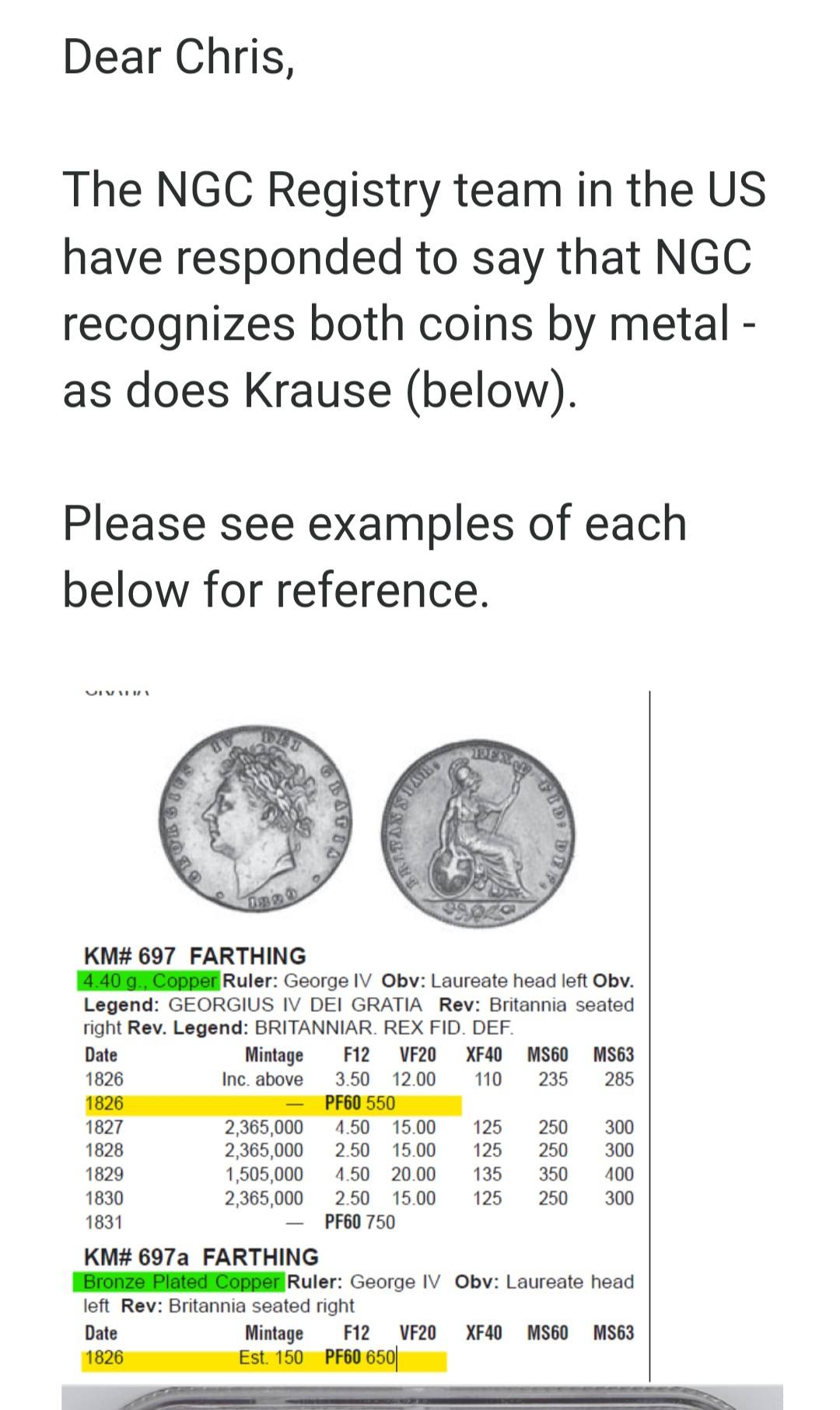
I have checked into this, but I'm not familiar with Krause as I use Peck and Spink for my information. Spink has only one proof noted for 1826 farthings, whereas Peck has two noted. Peck has the bronzed proof as the more common of the two varieties, with the copper proof being classed as rare.
The point I'm making is that according to the Krause screenshot above, the bronzed proof had an estimated mintage of 150, yet NGC have graded 26 specimens, which equates to 18% or thereabouts of that mintage. I find that figure highly improbable bearing in mind the purported scarcity. Also, these coins regularly crop up at auction (not necessarily graded), and can be seen with dealers very regularly.
Looking at the reply from NGC, do you think it is worth persisting in trying to get this attribution corrected, or will they not change it?










 Posted 05/26/2023 2:07 pm


 to the Community, Olek1984!


