|
This page may contain links that result in small commissions to keep this free site up and running.

Welcome Guest! Registering and/or logging in will remove the anchor (bottom) ads and the security checks. It's Free!
To participate in the forum you must log in or register. | Author |
 Replies: 10 / Views: 847 Replies: 10 / Views: 847 |
|
|
CCF Master Historian of Commemorative Coins
 United States
12640 Posts |
As I note at the start of each of these "Melting Pot" posts, I've written multiple times about the subject coin(s) - here the Monroe Doctine Enunciation Centennial Half Dollar - and prefer not to repeat too much of those previous posts here, so check out the links below for my previous posts on the topic coin(s) which provide more detail about the anniversary, the coin itself and the involvement of the US Congress that brought about its creation.For this edition of "To the Melting Pot" I offer up an "Almost" story that had a very different outcome vs. what the coin's sponsors had anticipated. In 1923, the 100th Anniversary of US President James Monroe's 1823 address to Congress that outlined the US' policies toward European intervention in the Western Hemisphere and/or European attempts to colonize countries in South America - such acts would be viewed as hostile acts against the US - was celebrated with a commemorative half dollar. The coin was sponsored by the American Historical Revue and Motion Picture Historical Exposition and the Los Angeles Clearing House (beneficiary and financial backer of the coin, respectively). The Act that authorized the coin, allowed for up to 300,000 coins to be struck. The Mint struck 274,000 of the coins in May and June of 1923 at San Francisco and delivered them to the Clearing House for sale/distribution at the Exposition, at local banks and via mail orders. The Exposition was staged from July 2 through August 6, 1923 in Los Angeles, California. Overall, the Exposition was poorly attended by the general public and only marginally supported by the movie industry. The Monroe Doctrine Centennial, while a subject worthy of commemoration, never seemed a good fit for a Los Angeles-based Exposition about movies, no matter how hard it tried to promote its "American History" educational aspects. The odd pairing was recognized at the time and likely contributed to the coin's lukewarm sales reception. (I've written about the lengthy debate held in the House of Representatives regarding the coin proposal - access it via the "Commems Collection" link below.) Slow coin sales resulted in just 27,000 (approximately) being sold at $1.00 each. Here's where the "Almost" comes into play. The sponsors came to understand that they were never going to be able to sell all the coins they were holding and contacted the US Mint about returning them to be melted. The Mint, however, was not "excited" about having the coins returned and convinced the sponsors to place their remaining coins into circulation. Eventually, ~247,000 Monroe Doctrine Centennial half dollars were released into circulation. So, while melting the unsold coins was "Plan A," the sponsors were forced to pursue "Plan B" and place nearly 250,000 coins into circulation in and around Los Angeles and Southern California. This large release is the main driver behind the ease by which circulated Monroe half dollars can be found in today's collector marketplace. 1923 Monroe Doctrine Enunciation Centennial Half Dollar  For other of my posts about commemorative coins and medals, including more about the Monroe Doctine half dollar and more Melting Pot stories, see: Commems Collection. Collecting history one coin or medal at a time! (c) commems. All rights reserved.
Edited by commems
06/17/2023 07:17 am
|
|
|
|
Bedrock of the Community
United States
94367 Posts |
Extra! Mint Muscles Monroe Mob!
|
|
Moderator
United States
16019 Posts |
Interesting twist on the 'melting pot' usual outcome - just spend them! I would be interested to know how the sponsors covered the expenses of producing the coins. I assume the authorizing legislation allowed them to purchase the 275,000 coins at face value plus reasonable costs for preparing the dies and producing the coins. If that assumption is correct - then every Monroe Half cost the sponsor face value plus a bit more. If all they received in return was face value by sending the ~247,000 coins into circulation then they must have lost money on that transaction. Or am I all confused on the matter?  Quote:
This large release is the main driver behind the ease by which circulated Monroe half dollars can be found in today's collector marketplace. A perfect lead in to show mine! 1923 Monroe Doctrine Centennial Half Dollar - PCGS FR02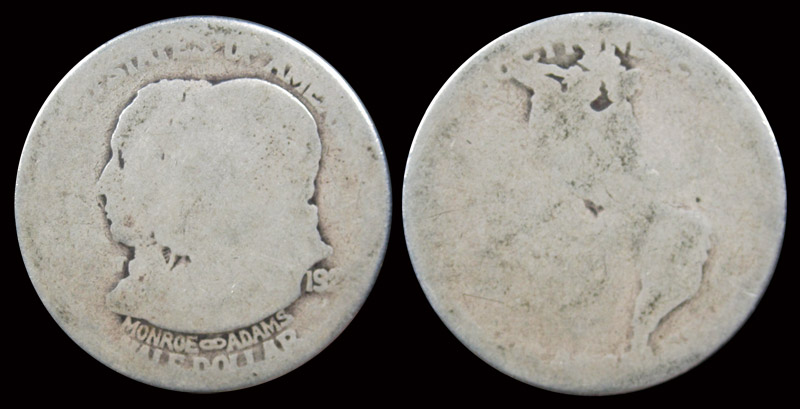 I still claim this is overgraded and should be PO01. Take a look at my other hobby ... http://www.jk-dk.art |
|
Bedrock of the Community
United States
27514 Posts |
Thank you for another excellent history lesson, commems! Quote:
The Mint, however, was not "excited" about having the coins returned and convinced the sponsors to place their remaining coins into circulation. Was this the only time the Mint did not take back unsold commemoratives? Inordinately fascinated by bits of metal with strange markings and figures
|
|
Pillar of the Community
United States
3863 Posts |
Very interesting, commems, thanks! I find the reverse design of the Monroe Doctrine Centennial commemorative very interesting, as has been discussed in one of your other recent topics. I have had a very hard time trying (unsuccessfully so far) to find an attractive and well-struck upgrade for the one currently in my set. I find the eye appeal on so many examples of this issue to be a bit lacking. As I do like the appearance of the MS64 I currently have, I'm really in no hurry so the hunt will go on... Member of SPMC, FCCB, ANA and ANS. My U.S. Classic Commemorative Complete Set: https://www.NGCcoin.com/registry/co...sets/278741/ |
|
CCF Master Historian of Commemorative Coins
 United States
12640 Posts |
Quote:
I would be interested to know how the sponsors covered the expenses of producing the coins. The Los Angeles Clearing House was the financial backer on the issue and was responsible for paying the Mint the cost of the coins. As a large, high volume financial institution, it had the assets to do so. Quote:
I assume the authorizing legislation allowed them to purchase the 275,000 coins at face value plus reasonable costs for preparing the dies and producing the coins. Correct. The additional dies and preparation fees, however, would have added very little to the overall cost (vs. the face value of the coins) and would have amounted to $0.01 or less per coin (amortized over 300,000 coins). Production costs are covered by the seigniorage built into each coin and would not have been added to the $0.50 per coin paid by the sponsor(s). Quote:
If all they received in return was face value by sending the ~247,000 coins into circulation then they must have lost money on that transaction. Yes, on just the circulation coins the sponsors had a small net loss - likely less than $2,500. However, assuming a per coin cost of $0.51 (which produces a total of ~$140,000 on the 274,000 struck coins purchased from the Mint), a return of ~$123,500 on the ~247,000 circulation dump coins and ~$27,000 on the ~27,000 sold at a premium ($1.00 each), the sponsors netted a profit of about $10,000 by my calculations. Certainly not enough to justify the effort (IMO), but at least not a loss! Collecting history one coin or medal at a time! (c) commems. All rights reserved.
|
|
CCF Master Historian of Commemorative Coins
United States
12640 Posts |
Quote:
Was this the only time the Mint did not take back unsold commemoratives? Though sometimes grudgingly, the Mint did accept all returns from commemorative coin sponsors, excepting the Monroe coins. An interesting twist on this is the case of the 1924 Huguenot-Walloon Half Dollar. Per Mint statements, the Huguenot-Walloon New Netherland Commission, Inc., (the coin's sponsor) returned 55,000 coins to the Mint to be melted. The Mint, however, rather than incur costs involved with melting the coins, chose not to melt them and, instead, released them into circulation. Regardless of outcome of the 55,000 coins (melt or release), the sponsor's account was credited for their return. Collecting history one coin or medal at a time! (c) commems. All rights reserved.
Edited by commems
06/17/2023 7:05 pm
|
|
CCF Master Historian of Commemorative Coins
United States
12640 Posts |
Quote:
I find the eye appeal on so many examples of this issue to be a bit lacking. As I do like the appearance of the MS64 I currently have, I'm really in no hurry so the hunt will go on... I'm there with ya'!  Collecting history one coin or medal at a time! (c) commems. All rights reserved.
|
|
Pillar of the Community
 United States
4624 Posts |
Quote:
An interesting twist on this is the case of the 1924 Huguenot-Walloon Half Dollar. Per Mint statements, the Huguenot-Walloon New Netherland Commission, Inc., (the coin's sponsor) returned 55,000 coins to the Mint to be melted. The Mint, however, rather than incur costs involved with melting the coins, chose not to melt them and, instead, released them into circulation. Regardless of outcome of the 55,000 coins (melt or release), the sponsor's account was credited for their return. Well, sure. The mint had already booked the seignorage on them. If they release them for circulation, nothing changes. They're just 55K to the good on their targets for striking coins for the year. If they melt them, they have to back out the seignorage and only get the silver value back. Bad all around, especially if the transactions happen in different years. -----Burton 50+ year / Life / Emeritus ANA member (joined 12/1/1973) Life member: Numismatics International, CONECA Member: TNA, FtWCC, NETCC, EveryCountry (online) coin club Owned by three cats and a wife of 40+ years (joined 1983) Author: 3rd Edition of the Sample Slabs book, https://www.sampleslabs.info/ |
|
CCF Master Historian of Commemorative Coins
United States
12640 Posts |
@BStrauss3: Thanks for joining the discussion, but I think you need to be more familiar with the unusual nature of the US commemorative coinage series.
Collecting history one coin or medal at a time! (c) commems. All rights reserved.
|
|
Moderator
United States
198363 Posts |
Thank you for sharing this. I am glad these were spared the melting pot.  |
| |
Replies: 10 / Views: 847 |
|
To participate in the forum you must log in or register.
Disclaimer: While a tremendous amount of effort goes into ensuring the accuracy of the information contained in this site, Coin Community assumes no liability for errors. Copyright 2005 - 2026 Coin Community Family- all rights reserved worldwide. Use of any images or content on this website without prior written permission of Coin Community or the original lender is strictly prohibited.
Contact Us | Advertise Here | Privacy Policy / Terms of Use
|
| Coin Community Forum |
© 2005 - 2026 Coin Community Forums |
| It took 0.47 seconds to rattle this change. |
 |
|
| |
| |




 Posted 06/17/2023 11:57 am


