| Author |
 Replies: 17 / Views: 1,363 Replies: 17 / Views: 1,363 |
|
New Member
United States
33 Posts |
|
|
|
|
Valued Member
United States
301 Posts |
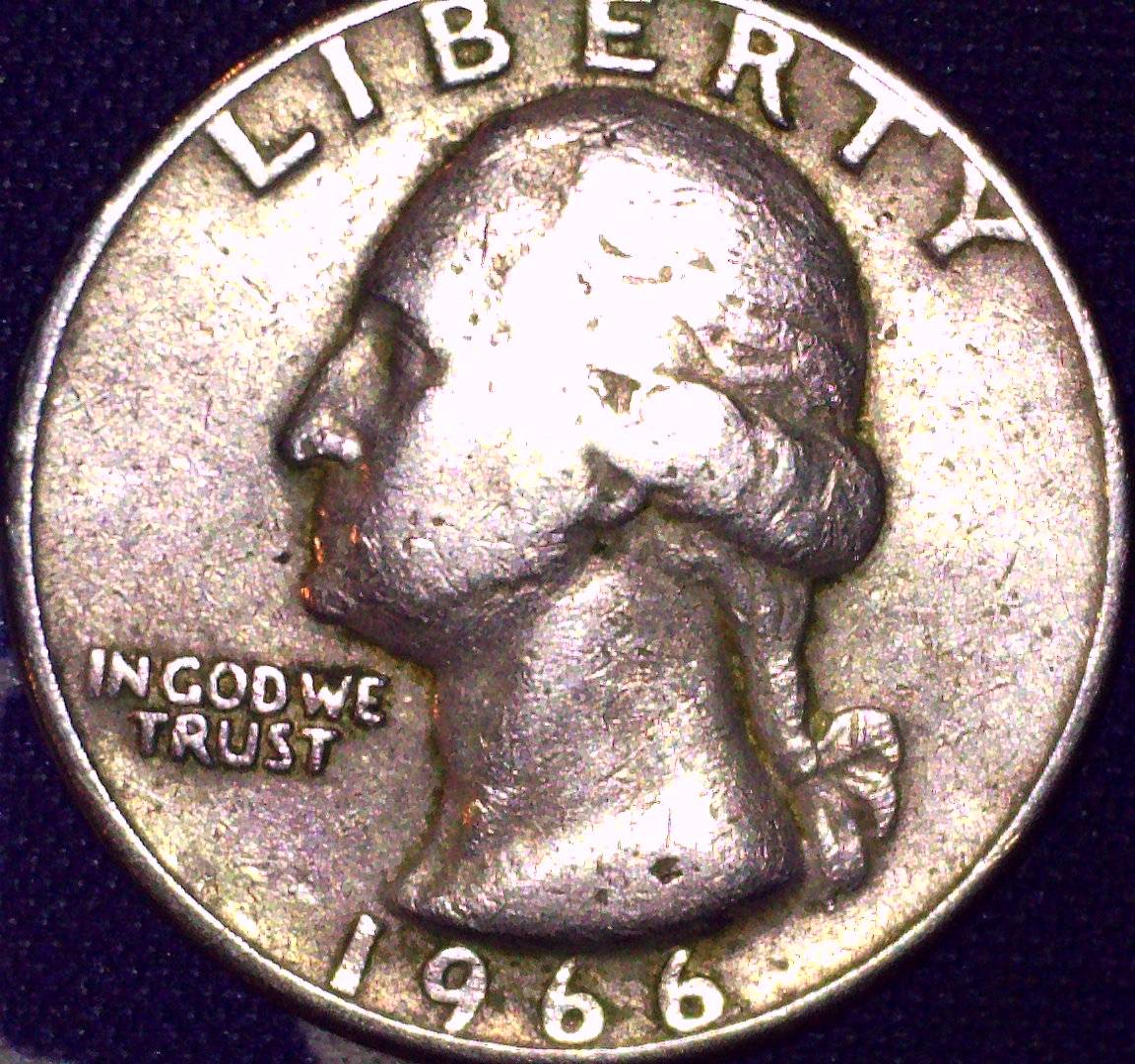
Greetings, will need full pictures of the reverse and close ups of the areas in question.  |
|
New Member
 United States
33 Posts |
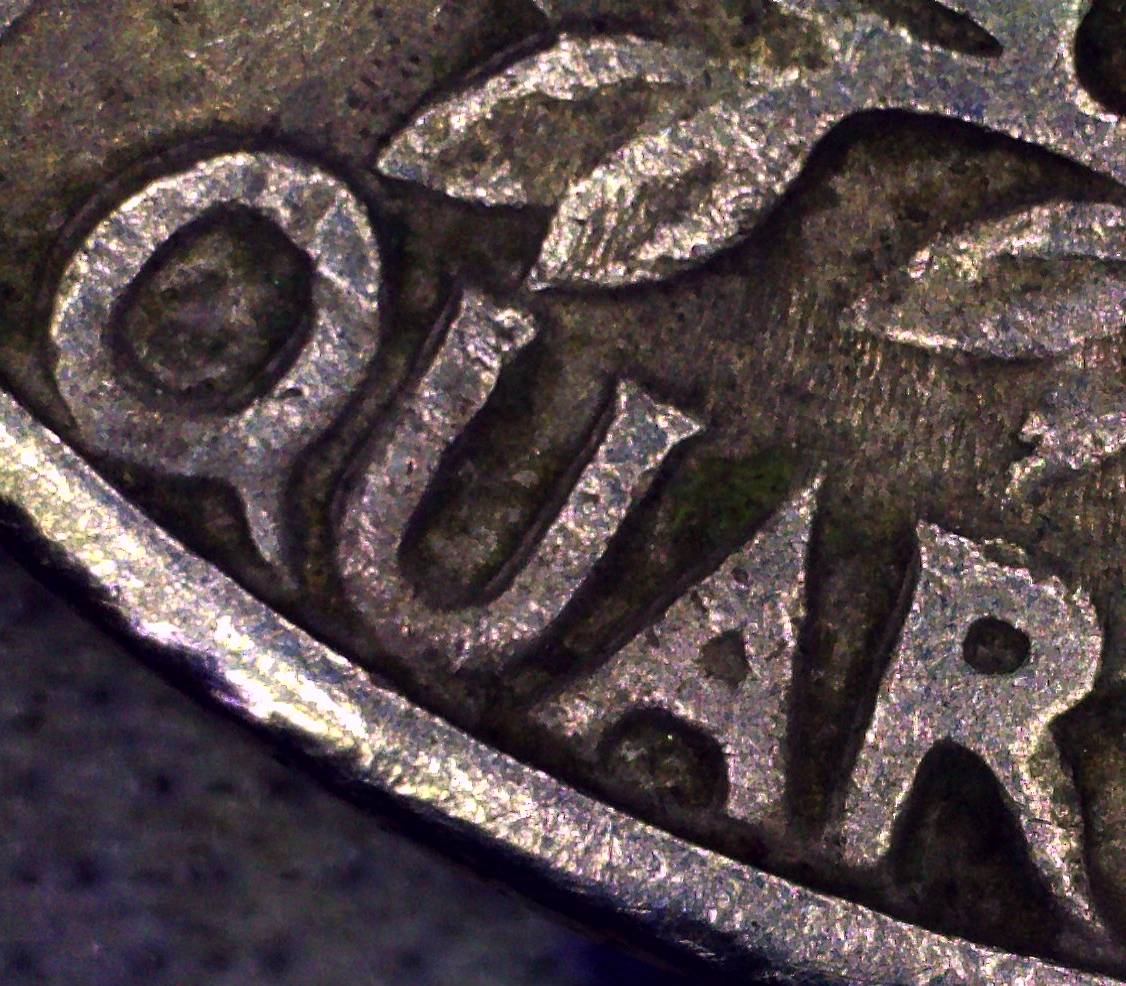
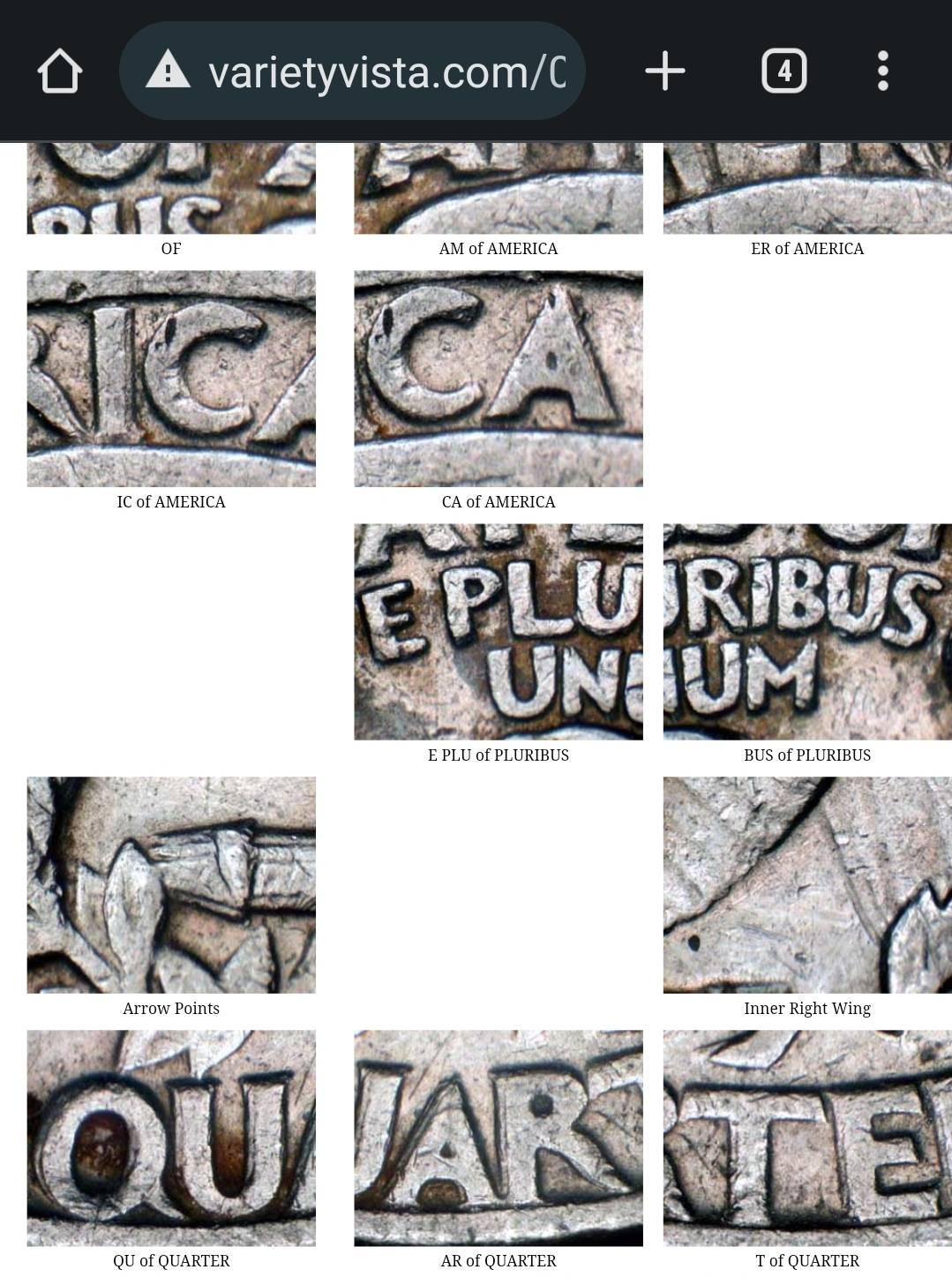
The close up on first pic is from the actual coin just wasn't sure if I should post the rest of the lettering. The bottom 2 examples"QU" AND "AR" in variety look just like my coin.but I can post the rest of the lettering if needed
|
|
Moderator
 United States
105295 Posts |
 If you are going to post images of VV attributions, It would be nice if you can also provide the Designation VV gave the one you posted up above. Also, you should try to match the images that VV provides for ease of comparison. |
|
Pillar of the Community
United States
646 Posts |
Due to the flat appearance, less spread, and lack of split serifs in the "doubling", I believe that what's on the coin is Machine Doubling, not a Doubled Die. |
|
Pillar of the Community
United States
5240 Posts |
It is machined doubled. The two leaf tips above the Q and U are not doubled.
|
|
New Member
United States
33 Posts |
Is the designation not what I have in the title? I'm very confused at this point. Lol now the leaves I can understand becusd there is no split. However the lettering I see no splits nor an obvious doubling from the example vv gave.
|
|
Pillar of the Community
Canada
6244 Posts |
The word Quarter it is an controversy for FS-801. The word AMERICA will tell if it is or not.
You say RDV-005 me I say it is RDV-004 this coin.
Edited by silviosi
07/09/2023 9:24 pm
|
|
New Member
United States
33 Posts |
Thank you silviosi so I would look for the error as a whole with all lettering on the reverse correct?
|
|
Pillar of the Community
United States
3237 Posts |
@Ninetailedsage look more closely at the VV entry. Notice how the letters are thickened by the doubling? That's because the doubling comes from additional negative space on the die. Your example has more narrow devices because the material that's creating the doubling is where the ordinary width devices were pinched after the strike due to Machine Doubling. |
|
New Member
United States
33 Posts |
Appreciate it Sam I can understand that explanation. Geez finding errors is harder than I thought lol
|
|
Pillar of the Community
United States
3237 Posts |
@Ninetailedsage it is very hard to find true doubled dies, but don't be discouraged. It WILL happen if you keep at it, and you start to develop the eye for what is and what isn't doubling after you see the real thing in person. Remember that some of these coins are minted in the billions and each die only strikes several hundred thousand to a million coins. That means that literally thousands of dies will be used for each denomination in a given year for most modern coins, and each doubled die represents exactly ONE of those dies. When you realize that, you see why they're so uncommon.
|
|
Pillar of the Community
United States
3237 Posts |
Also, to answer you question in the post, to be a doubled die, ALL the doubling needs to match. To understand why, let's take a step back and talk about how doubled dies are produced. For simplicity, I'll restrict to coins minted before the introduction of single squeeze hubbing, which became the standard for US coins in 1997. For coins minted before 1997, dies were produced in multiple stages, using a positive engraving of the design called the "hub" and a hard metal cylinder called the die blank. The image on the hub was transferred to the die blank by impressing the hub into the surface of the blank under immense pressure. However, because the die needs to be quite hard in order to strike coins without immediately deforming and losing detail, it wasn't easy to impress the image from the hub all the way into the die in a single go. The Mint's solution to this problem was to perform a series of hubbings (impressions of the hub into the die blank) and annealings (softening of the die blank between hubbings to make the die blank receive the hubbing more readily). A doubled die would be created when, between subsequent hubbings, the hub was aligned slightly out of position with the previous hubbing. This would double the image imprinted on the die (hence the name "doubled die"). There are many ways this could happen from rotational misalignments (Class I doubled dies), to pivoted misalignments (class 5), to more complicated examples where a different hub was used that caused a distended second hubbing (Class II/Class VI). In total, there are 9 generally-accepted classes of doubling, and I encourage you to read up on all of them in depth, as it will help you to better understand what doubled dies look like. The important thing to understand, is that the doubling on a doubled die is a property of the die itself. Thus, every coin struck over the course of that die's lifetime will exhibit exactly the same doubling as every other (give or take whatever detail is lost to polishing/die wear). This is why we can catalogue dies in the first place, since every coin struck by the same doubled die is, in essence, exactly the same. Edited by SamCoin
07/09/2023 10:29 pm
|
|
Bedrock of the Community
United States
94367 Posts |
|
|
New Member
United States
33 Posts |
I appreciate your time and reply sam, I will definitely look further into these classes so I can truly understand. Is there an existing thread here on CC? If not there should be because this was really informative. Thanks again!!
|
|
Pillar of the Community
United States
3237 Posts |
|
| |
Replies: 17 / Views: 1,363 |












 Posted 07/09/2023 7:22 pm


