The effort to mark the 100th anniversary of Theodore Roosevelt receiving the Nobel Peace Prize in 1906 with commemorative coins began in October 2002 with the introduction of a bill in the House of Representatives by Peter Thomas King (R-NY). The bill called for the striking of coins "in commemoration of the centenary of the bestowal of the Nobel Peace Prize on President Theodore Roosevelt."
Theodore Roosevelt (Image Credit: Library of Congress, Prints and Photographs Division. Public Domain.)
The coins proposed were a Gold Half Eagle and a Silver Dollar, respective maximum mintage figures were 50,000 and 500,000. The coin designs were to "be emblematic of the life and legacy of President Theodore Roosevelt" with both coins featuring a "Rough Rider" design on their obverse, based on a 1920 medal designed/sculpted by
James Earle Fraser. (You can check it out here:
What If? 1958 Theodore Roosevelt Centennial Medal.) The reverse design for the coins was to be based on the flying eagle seen on Augustus St. Gaudens ' Gold Double Eagle of 1907 to 1933.
King's bill included an informative and impressive "Findings" section:
The Congress finds that --
(1) Theodore Roosevelt, one of America's greatest presidents, was born on October 27, 1858, in New York City, New York;
(2) At the young age of 23, Theodore Roosevelt was elected to the first of 3 terms as a representative in the New York State Assembly (1882-1884);
(3) From 1895 to 1897, Theodore Roosevelt served as Commissioner of the New York City Police Department;
(4) While serving as Assistant Secretary of the Navy under President William McKinley (1897-1898), Theodore Roosevelt organized the First United States Volunteer Cavalry Regiment, popularly known as the ``Rough Riders'', and then served as Colonel of this regiment during the Spanish-American War;
(5) From 1898 to 1900, Theodore Roosevelt served as Governor of New York;
(6) In 1900, with the election of President McKinley, Theodore Roosevelt was elected as the 25th Vice-President of the United States;
(7) Becoming the 26th President of the United States the following year, Theodore Roosevelt took a very active role in foreign affairs, establishing the United States as a new world power, and instituted broad reforms, at home, particularly with respect to labor, monopolies, and conservation, until the end of his presidency in 1909;
(8) On January 16, 2001, Theodore Roosevelt was posthumously awarded the Congressional Medal of Honor for leading a charge up the San Juan Heights in Cuba during the Spanish-American War, shortly before the war ended, thereby becoming the first President of the United States to be awarded the Congressional Medal of Honor.
(9) 2006 will mark the 100th anniversary of Theodore Roosevelt receiving the Nobel Peace Prize, the first citizen of the United States to receive such prize, for drawing up the 1905 peace treaty ending the Russo-Japanese War.The bill specified a surcharge of $35 for the Gold Half Eagle and $10 for the Silver Dollar with all surcharge funds collected to be paid to the Theodore Roosevelt Association "to be used exclusively for educational programs at Sagamore Hill National Historic Site, operated by the National Park Service, including for the construction and maintenance of a visitor's center."
Upon its introduction, the bill was referred to the House Committee on Financial Services which then further referred it to the Subcommittee on Domestic Monetary Policy, Technology and Economic Growth. The bill was not reported out and died for lack of action with the adjournment of the 107th Congress on November 22, 2002.
In May 2003, during the 108th Congress, Kent Conrad (D-ND) introduced a bill in the Senate that was based on King's previous coin bill, but altered the coins requested. Conrad's bill called for two commemorative Silver Dollars for the same purposes as the King bill, namely, "in commemoration of the centenary of the bestowal of the Nobel Peace Prize on President Theodore Roosevelt." Representative King joined Conrad with introduction of a companion bill for himself and 54 House colleagues in June.
The new bills repeated the "Findings" of the previous bill, with one addition:
Theodore Roosevelt's commitment to conservation stemmed from his experiences as a rancher in the badlands of North Dakota from 1883 to 1886 and earned him the title of the "Conservationist President" for his efforts in establishing 51 Bird Reserves, 4 Game Preserves, 150 National Forests, 5 National Parks, and 18 National Monuments, totaling nearly 230 million acres of land placed under public protection during his presidency;The coin bills proposed a similar approach to the commemorative coin program for the 300th anniversary of the birth of Benjamin Franklin (2006) that program included two Silver Dollars: one "Scientist" design and one "Founding Father" design.
The bills proposed a "Rough Rider" Silver Dollar and an "Adventurer" Silver Dollar. As with the previous bill, the designs for each were to be "emblematic of the life and legacy of President Theodore Roosevelt" and were to be based on designs by
James Earle Fraser and Augustus St. Gaudens, two "sculptors most closely associated with the revitalization of the
United States coinage, commonly referred to as the ``Golden Age of American Coin Design'', that was initiated by President Theodore Roosevelt." Each of the Silver Dollars was to have a maximum mintage of 500,000.
The Rough Rider silver dollar was to feature, on its obverse, "the image of Theodore Roosevelt as a Rough Rider that was used on the
James Earle Fraser medal of 1920." On the coin's reverse, the eagle seen on Augustus St. Gaudens' $20 gold double eagle was to be used.
The obverse of the Adventurer silver dollar was to depict "the image of Theodore Roosevelt on horseback, based on
James Earle Fraser's monumental 16-foot high bronze equestrian figure of Roosevelt that...stands at the east front of the American Museum of Natural History in New York." The coin's reverse design was to be based on another
James Earle Fraser piece - the Roosevelt Memorial Association Medal of Honor and the Association's Founders Medal. (You can get a sense of the proposed reverse design here:
What If? 1958 Theodore Roosevelt Centennial Medal.
Theodore Roosevelt Equestrian Statue - American Museum of Natural History, NYC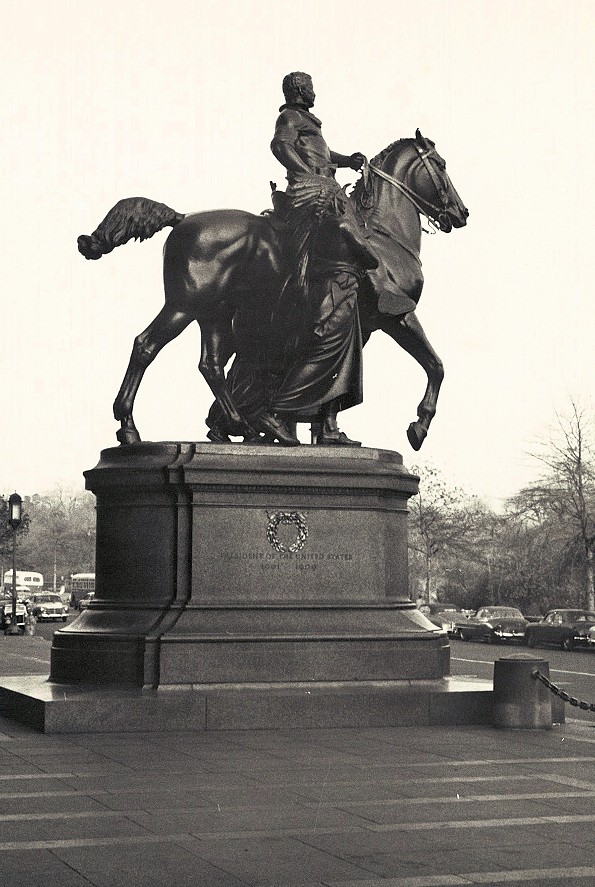 (Image Credit: Library of Congress, Prints and Photographs Division. Public Domain.)
The issue price of each dollar was to include a surcharge of $10, with the first $2.25 million of collected surcharges to be paid to the Theodore Roosevelt Association for its educational programs and construction of a Visitor's Center at Sagamore Hill National Historic Site (the home of Roosevelt from 1885 until his death in 1919). Collected surcharges in excess of $2,25 million were to be split 60/40 between the Theodore Roosevelt Association and the Theodore Roosevelt Medora Foundation ("Foundation"). The Foundation was to use the funds it received for educational programs at the Theodore Roosevelt National Park in North Dakota.
Neither bill was reported by its Committee and so neither gained consideration or approval in its respective chamber.
Senator Conrad and Representative King tried again early in the 109th Congress. The bills were largely the same as those introduced in the 108th Congress, with a few minor changes:
A new "Finding" was added:
President William Harrison appointed Theodore Roosevelt as the United States Civil Service Commissioner in 1889, a post he held until 1895, serving 2 successive Presidents;and a few "Findings" included small edits.
Also, the surcharge distribution was changed to a 70/30 split vs. the 60/40 split described above.
The Senate bill was approved, but neither it nor the House version of the bill gained approval in the House of Representatives. As a result, Theodore Roosevelt was not to be honored with a commemorative Silver Dollar! IMO, this was an unfortunate fail - IMO, "Teddy" was an effective executive and did much to support numismatists - I would have supported these Silver Dollars.
For a discussion of a proposed Theodore Roosevelt coin during the Classic Era, see:
-
What If? 1956 Theodore Roosevelt Birth CentennialFor other of my posts about commemorative coins and medals, including other Modern Commemorative stories, see:
Commems Collection.










 Posted 08/10/2023 12:17 pm