|
This page may contain links that result in small commissions to keep this free site up and running.

Welcome Guest! Registering and/or logging in will remove the anchor (bottom) ads and the security checks. It's Free!
To participate in the forum you must log in or register. | Author |
 Replies: 49 / Views: 7,110 Replies: 49 / Views: 7,110 |
|
|
|
Pillar of the Community
United States
3207 Posts |
Of those desired five characteristics, only number 3, ease of production, supports clad vs the then-existing solid alloy. The alloy of the nickel is harder than clad composition, and thus more difficult to strike into coins. However, that difference also means clad wears faster than the nickel's alloy, which runs counter to desired characteristic number 2. So, Sap's question remains.
|
|
Pillar of the Community
United States
2284 Posts |
Quote:
Do the clad coins actually have the same electrical signal as silver coins? I know that current coin sorting machines can separate them easily. It seems more plausible that they have an electrical signature similar to a standard nickel, which vending machines would have already registered as a pass in 1964. I believe with the technology in place in 1965 the silver and clad were indistinguishable. No doubt there was simple technology that could separate them but it did not exist in the machines. Time don't fly, it bounds and leaps.
|
|
Pillar of the Community
United States
2284 Posts |
Quote:
That's just above a 10% difference in weight. Surely a mass-based coin discriminator that allowed for a 10% weight difference would allow quite a large number of counterfeits and foreign coins through as well. Vending machine technology was better than that in the 1960s.
Nor can clad coins have the same electromagnetic signature as silver. Silver has quite unique properties - it's highly conductive, and thus has a high eddy current effect. No alloy or admixture of copper and nickel can hope to match it. Try it and see: grab one of those supermagnet coin testing slides, put a silver quarter on it, then put a clad. The silver shows significant eddy current braking, the clad... barely any at all.
I'm having trouble idealizing any technology that would look at a clad quarter, and look at a silver quarter, and they both land in the "pass" bucket. There is a reason why silver quarters and dimes end up in the reject bin at Coinstars: they simply don't match the parameters for clad quarters and dimes, so get rejected. Yet, they must have worked back in the 1960s, otherwise there'd have been all kinds of furore and havoc as vending machines suddenly became "unreliable" when using the new coins, in the eyes of the public. "If Coca-Cola won't accept the new coins, then I won't either". But if the vending machines of the 1960s were so poor at discriminating between a 6.25 gram silver coin and a 5.67 gram non-silver coin, then the government could have used pretty much any non-magnetic alloy (such as solid cupronickel) instead. When Britain, Australia, New Zealand etc replaced their silver coins with solid cupronickel coins, the new coins all weighed exactly the same as the old ones (to the nearest 0.01 gram; silver is denser than cupronickel, so the new coins had to be slightly thicker in order to attain the same mass), and all their vending machines were 100% "fooled" into accepting the new coins.
Which leads me back to the original question, if slightly rephrased now: if solid cupronickel worked just fine in vending machines of the 1960s, why did the US use cupronickel-clad-copper, and not solid cupronickel? I believe that the technology of the 60's used induced electrical eddy currents to determine authenticity. For some reason the thin cladding mimicked the same effect in 90% silver. Time don't fly, it bounds and leaps.
|
|
Pillar of the Community
United States
2284 Posts |
Quote:
I haven't yet read the official report. My theory has always been that it had something to do with strike quality and/or die life. They were pumping out tons of these coins and needed to preserve the dies as long as possible. Perhaps the nickel alloy used for the five cent pieces would have quickly worn or damaged the quarter dies. This might not have affected the dimes a seriously, but they may have wanted continuity in all the reeded edge coins. Cu/ ni clad copper was one of the hardest things to coin. With a softer center and harder outside it didn't want to take a strike and wore out dies quickly. The mint was trying to make a quality product anyway so 80% of 1965 quarters passed straight from UNC to AG. The strike on the obverse, reverse, or both was so poor that the tops of slime lettering already merged into the rims. With even a hint of wear the coin was technically in only About Good condition. '66 quarters were even worse but they were able to start fixing the defects by 1967. They still looked awful until 1970 and even up until 1999 many were struck by worn dies and very weakly. Time don't fly, it bounds and leaps.
|
|
Pillar of the Community
United States
2284 Posts |
The mint blamed everyone but the real culprits for the coin shortage.
It was really caused by millions of the general public hoarding silver. in the process they kept more than normal amount of cents and nickels. This rectified itself quickly as the hoarders released the small change so production of cents and nickels dropped sharply after 1964. It was the mint news releases starting in 1962 that warned silver prices were soaring and silver stocks were plummeting that caused the hoarding. Collectors were punished and the coin market was severely damaged as a response. Modern coins have never recovered from mint, FED, and congressional actions in '64 and '65.
Time don't fly, it bounds and leaps.
Edited by cladking
08/29/2023 2:29 pm
|
|
Moderator
 United States
107466 Posts |
I really don't care what they are made of really. As long as it costs less to make than the declared value of the coin.
It is all just representative of imagined value or worth.
I see it this way, why does a paper note with a ONE on it is worth only 1 dollar, and an identical paper note but has 100 on it worth 1 hundred dollars.
When I play poker we use identical plastic colored chips (Red, Blue, and White) but the reds are worth 100, the blue 50, and the white only 10. what gives them any value?
|
|
Pillar of the Community
United States
6903 Posts |
Quote:
what gives them any value? That's a very different discussion than "How did we specifically pick clad for coins in 1965 instead of solid or plated coins?" Fiat exists by declared consensus. While the paper may seem arbitrary, that medium of exchange is reinforced by the fact that if you make your own paper with 100 on it, government law enforcement officers with automatic weapons will kick in your door and drag you off to jail. There are lots and lots and lots of other features of civilized society that are exactly the same way. Arbitrary, but collectively agreed upon, and therefore enforced by steel and lead. |
|
Pillar of the Community
United States
2284 Posts |
Quote:
I really don't care what they are made of really. As long as it costs less to make than the declared value of the coin.
It is all just representative of imagined value or worth.
I see it this way, why does a paper note with a ONE on it is worth only 1 dollar, and an identical paper note but has 100 on it worth 1 hundred dollars.
When I play poker we use identical plastic colored chips (Red, Blue, and White) but the reds are worth 100, the blue 50, and the white only 10. what gives them any value? Ultimately all monetary "value" is psychological. Gold's value, the dollar's value, and even the value of wheat is determined by what people believe. This is the primary reason for clad coins; they look enough like silver to not affect most peoples' perceptions. Of course the government was saying at the time that silver and clad would circulatye side by side "forever" but by June of 1968 the FED was removing silver faster than anyone else. Time don't fly, it bounds and leaps.
|
|
Pillar of the Community
United States
2284 Posts |
There are other factors that affected the decision to produce clads. Incredibly enough even though this is a government operation "efficiency" was one of those reasons. In those days it wasn't nearly as uncommon! The outer clad layer is 75 cu 25 ni so retired nickels could be used to make clads and the clads could be melted and mixed with nickel to make nickels. In those days Olin Brass made a lot of the clad planchets.
Time don't fly, it bounds and leaps.
|
|
Pillar of the Community
United States
681 Posts |
Could be because copper is cheaper than nickel, and the use of more copper allowed there to be at least some cost savings.
|
|
Moderator
 Australia
17005 Posts |
Okay, I think I've figured it out. Here's a picture of a typical eddy-current discriminator, as used in 1960s vending machines (taken from the appendices in the BMI report): 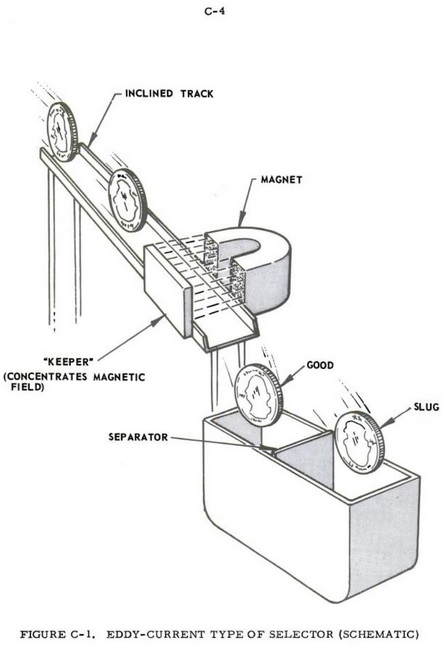 Coins roll down the ramp and past a permanent magnet (another magnet earlier in the mechanism has already filtered out steel slugs and other ferromagnetic things that would actually stick to a magnet). The permanent magnet induces eddy current braking, slowing the coin down. Silver coins, with high conductivity, slow down a lot, and drop straight down after passing the magnet into the "good" bucket. Coins made of low conductivity materials barely slow down at all, carry on by inertia, and overshoot the "good" bucket; they land in the "slug" bucket instead. The core of clad coinage is 100% pure copper. This is important, because pure copper is a much better conductor than pretty much any copper alloy, or anything else except silver. For example, cupronickel is 20 times worse at conducting than silver, while pure copper is only 3% lower than silver. So a pure copper coin - or a coin with a pure copper core - isn't "as good as" silver in this test, since that would be against the laws of physics - but it doesn't need to be "as good as" - it only needs to be "good enough" to fall into the correct bucket. The lighter weight of the clad coins confused me (and the Report indicated the new coins would have to be be lighter in weight, without really explaining why), but the lighter weight is actually necessary for the deception to work: a lighter coin has less inertia, so is slowed down more by the magnet and won't travel as far. You need the combination of pure copper core and lighter weight to trick the mechanism into accepting a clad coin. There were three manufacturers of eddy current vending machines in America at the time. BMI presumably tested all three machines, and found all three were reliably fooled by clad coin blanks. So it seems "vending machine compatibility" is indeed the answer to the problem. The vending machine industry in other countries that got rid of silver at the same time (eg. Australia) was smaller, and most of the machines there apparently didn't use eddy current discriminators, only diameter/weight detectors, so cupronickel coins that were the same size and weighed the same worked just fine as a substitute. The few vending machine operators who used US-made vending machines that did use eddy current discriminators, and needed to adjust their machines to work with the new coins, were monetarily compensated by the Australian government - something the US government couldn't possibly have afforded to do, given the size of the vending industry there. Don't say "infinitely" when you mean "very"; otherwise, you'll have no word left when you want to talk about something really infinite. - C. S. Lewis
|
|
Pillar of the Community
United States
6903 Posts |
Ok, well now that makes sense. Thanks for the explanation, Sap! So it's not measuring the EM response, per se. Just using inertia and eddy current interaction to hit an approximate bucket.
The part about the copper core also makes a lot of sense. The cladding is probably irrelevant, except for the additional mass. I will attest that impurities in copper will severely affect its conductive properties. So the pure copper core would be necessary.
I wonder if there is a similar reason behind the Sacagawea clad dollar? Ever since I learned that the golden metal is manganese brass, I wondered why they didn't just make a solid coin.
|
|
Moderator
Australia
17005 Posts |
Quote:
The part about the copper core also makes a lot of sense. The cladding is probably irrelevant, except for the additional mass. Cupronickel is essentially transparent to the eddy tester, so the cladding is irrelevant, in terms of what it contributes to the overall eddy current response of the coin. But it does add two important things to the coin beyond passing the eddy current tester: size, and colour. Size: prior to the eddy current tester, the coins are filtered by size as well as weight. The cladding is essentially "padding" for this test, bulking the coin out to make the coin a passable size and thickness without making the eddy response either better or worse. They could probably have used a plastic coating with much the same effect. Colour: cladding makes the coins "look silvery", which was believed to be of paramount importance. A 100% pure copper solid coin (no cladding) would have been preferable to a clad coin, for the eddy tester, but pure copper is (a) too soft for heavy circulation, and (b) "too cheap-looking". Likewise, a thin plating of silvery metal over a copper core was rejected because the copper would still be soft and quickly wear down, and the thin layer would wear away too quickly, exposing the copper core. Cladding applies a thick enough layer to prevent this, even after heavy circulation - as everyone experienced with heavily circulated clad coins can attest. Don't say "infinitely" when you mean "very"; otherwise, you'll have no word left when you want to talk about something really infinite. - C. S. Lewis
|
|
Pillar of the Community
United States
3207 Posts |
Sap, any word in your reference about nickels? If nickels also land in the correct bucket, with silver and clad, the mint could have used the nickel's alloy for higher denominations.
|
|
Pillar of the Community
United States
855 Posts |
Yes, brandmeister, the alloy of the Sac dollar is specifically tailored to give the same response as the clad composition of the Anthony dollar. That's the reason it contains manganese, which causes it to turn black in circulation, just the way the Cu-Ag-Mn " War Nickels" turned black. The SBA dollar, in turn, is NOT made of the same clad composition as other US clad coins! The materials are the same, but the layer thicknesses are different. That was so that one couldn't chuck up a half-dollar in a lathe and turn it down to dollar-size, and have it pass a vending machine discriminator. Frankly I regard this as stupidity. They could have used aluminium-bronze or something like that for the outer layers (and made it actually polygonal to boot), and it would have been accepted by people much better. And nick10, that answers your question too. For each individual denomination, there's a bucket. The balance of weight and retardation (that means slowing-down) is unique for each coin. Nickels go in the nickel bucket. Other coins made of the same alloy, at the same diameter and weight, will go in the nickel bucket. Coins made of the same alloy, of different weight and diameter, will not. The key with roll-clad material is that you can make the electromagnetic properties effectively arbitrary. One of the few countries other than the USA to use Cu-Ni/Cu clad is Thailand. If you look at the Thai clad coins, they have a much thicker copper centre, so the balance of properties is different. As BStrauss3 mentioned (hi!), I have a German payphone made circa 1990, which has a very sophisticated coin mechanism. It has to accept 10 pf coins which are made of plated steel, and therefore strongly ferromagnetic (remember that US coin mechanisms normally just reject or trap any ferromagnetic object) ; 50 pf and 1 DM coins which are cupronickel, non-ferromagnetic ; and 2 DM and 5 DM coins which are made of "Magnimat", a clad material with a pure nickel core (ferromagnetic) and cupronickel outer laminations, giving it a unique signature. The Swedes (1 and 5 kr) and apparently the Portuguese (10$00) also used this material in the '70s. The thing is, even this very sophisticated, computer-controlled mechanism can be fooled into accepting much less valuable coins in place of the 1 DM. They're about the right weight and size, and made of the right material. Some off-spec coins work too, because they are wrong one way in a way that offsets being wrong in another way. You can read about my experiments with that, here.Edited by publius
08/29/2023 11:51 pm
|
| |
Replies: 49 / Views: 7,110 |
To participate in the forum you must log in or register.
Disclaimer: While a tremendous amount of effort goes into ensuring the accuracy of the information contained in this site, Coin Community assumes no liability for errors. Copyright 2005 - 2026 Coin Community Family- all rights reserved worldwide. Use of any images or content on this website without prior written permission of Coin Community or the original lender is strictly prohibited.
Contact Us | Advertise Here | Privacy Policy / Terms of Use
|
| Coin Community Forum |
© 2005 - 2026 Coin Community Forums |
| It took 0.41 seconds to rattle this change. |
 |
|
| |
| |







 First Page


 Posted 08/29/2023 2:10 pm


