Connecticut's red brick State House housed Connecticut government, either at the State level (1796-1878) or City of Hartford level (1878-1915). It was designed by Charles Bulfinch, and was built/outfitted between 1792 and 1796; it officially opened in May 1796.
Old Connecticut State House - Circa 1937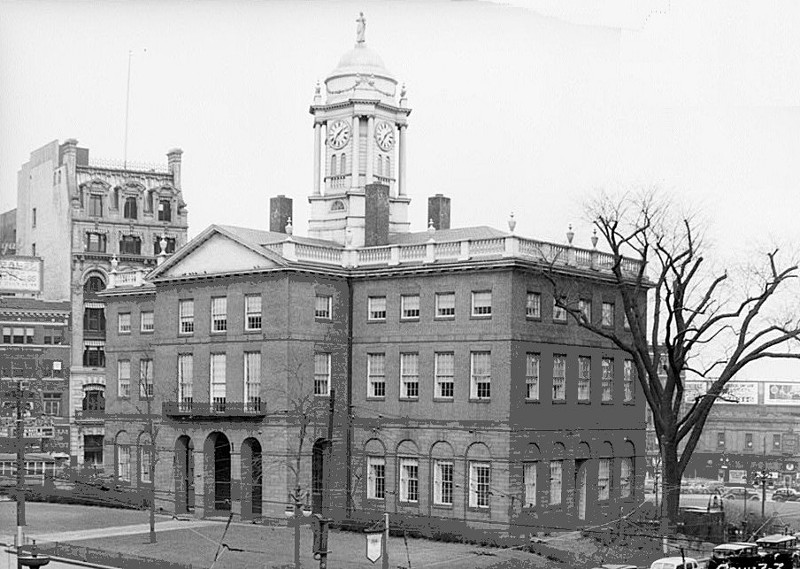 (Image Credit: Library of Congress, Prints and Photographs Division. Public Domain.)
Companion bills were introduced in the House of Representatives and Senate in June and July 1995, respectively, to authorize the striking of Silver Dollars in support of the bicentennial of the Old Connecticut State House; during the 104th Congress. The House bill was introduced by Barbara Kennelly (D-CT) and was referred to the House Committee on Banking and Financial Services; it was subsequently referred to that Committee's Subcommittee on Domestic and International Monetary Policy. The Senate bill was introduced by Christopher Dodd (D-CT) and referred to the Senate Committee on Banking, Housing, and Urban Affairs.
The bill included reference to the State House's place in history:
"The Congress finds that--
(1) the history of the Old State House in Hartford, Connecticut, is intrinsically linked to the history of the city of Hartford, the State of Connecticut, and the United States;
(2) the site of the Old State House is where the Colony of Connecticut was founded and where General George Washington first met Comte de Rochambeau in America to begin plotting the Yorktown strategy to win the Revolutionary War;
(3) the Old State House, designed by Charles Bulfinch, is a prime example of 18th century architecture and was designated a Registered National Landmark by the Secretary of the Interior;
(4) since 1979, the Old State House Association has operated the Old State House as a museum, public meeting house, and focal point for downtown Hartford;
(5) the Old State House Association initiated an extensive renovation in 1992 to revitalize the building and its surroundings and to expand its educational, recreational, and cultural services;
(6) the new Old State House will feature a Museum of Connecticut History, a market on Main Street on the building's west side, and a Peace Park on its east side; and
(7) the new Old State House will be rededicated on its 200th birthday in May 1996, when it will once again become a focal point and meeting place for Hartford, Connecticut, and the entire New England region."The bills called for up to 700,000 Silver Dollars of standard specification, dual-dated "1796-1996," with designs "emblematic of the Old State House and the role of the Old State House in the history of the city of Hartford, the State of Connecticut, and the United States." I can envision designs similar to the 1946 Iowa Statehood Centennial Half Dollar.
The silver for the coins was to come from the Strategic and Critical Materials Stockpile.
The issue price of each coin was to include a surcharge of $10. The surcharge funds collected were to be distributed to the Old State House Association for its use in:
"(1) the construction, renovation, and preservation involving the Old State House, including the Museum of Connecticut History, the Main Street Market, and the Peace Park;
(2) the education of the general public about the central role of the Old State House in the history of Connecticut and the United States through exhibits, programs, and other educational activities; and
(3) the maintenance of the Old State House as a central hub for recreational, cultural, and commercial activities in the city of Hartford."Neither Committee reported its chamber's bill and so neither version progressed in Congress. Though the coin was not authorized by Congress, the restoration of Connecticut's Old State House was completed and it is open today as a history museum and civic space. You can explore it more here:
https://wp.cga.ct.gov/osh/ I have mixed feelings on this one. On one hand, I believe in preserving the history of the United States through sites of importance, and the Connecticut State House certainly has a noteworthy history. On the other hand, it does seem to be somewhat local in nature and approval of the coin would have likely led to proposals for similar structures across the country. In the end, it's probably best that it was addressed by a public-private initiative at the local level.
If it had passed, the coin would have entered a US commemorative coin market that was suffering from collector fatigue (refer to the lackluster sales of the huge 1995-96 Atlanta Olympics program in its second year) and about to undergo significant interventions by Congress.
For other of my posts about commemorative coins and medals, including other What If? stories from the classic and modern eras, see:
Commems Collection.








 Posted 10/29/2023 1:03 pm


