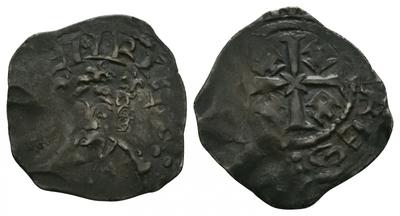
Good night everybody! I would share with you all a doubt...
I saw a number of images of Tealby pennies and I noticed that several ones have a square flan and notwithstanding a good or very good weight (some of mire than 1.40 grams) and quite well centred struck, as if they were in a good condition compared to mint state, without significant clipping... so suggesting original use of square flan just at the moment of minting.
Pennies from Lucca (one of the main imperial mints in Italy) had a vastly wide circulation especially from the beginning of the twelfth century (up to the Holy Land and Germany) and series struck from the beginning of the twelfth century show in most case scarce flan of square form: it is acknowledged that it was due to the minting process, as the flans were cut in a square form by scissors and then bent by the angles and hammered to give them a some-circular form, but in periods of very huge production the flans were left of square form to spare time and hasten minting process.
So, I had an idea: could the square flan of some Tealby pennies prove an occurrence similar to what happened in Lucca and maybe elsewhere in the need of producing huge number of coins in limited time, such as in the case of a recoinage? have you ever heard such an hypothesis, and if so, have you some references? maybe the square-flan Tealby pennies are mainly of "A" type, showing the need to speed up coinage at the time of the initial recoinage?
Thanks to all could share their thoughts!
Ulpianensis








 Posted 11/05/2023 02:21 am


