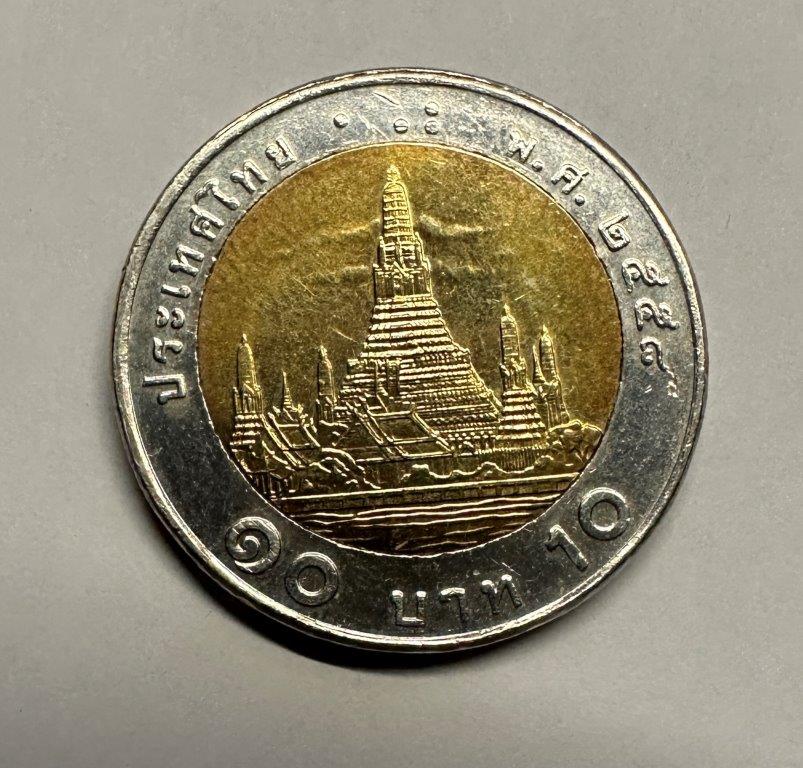
Correct; Thailand 10 baht, dated year 2558 in the Buddhist calendar, or AD 2015.
Some trivia: when the euro coinage was first introduced in 2002, the 2 euro coin was created with almost exactly the same specifications (weight, size, etc) as this Thailand 10 baht coin. And at the time, 10 baht was worth somewhere around 25 eurocents. It didn't take people very long to work out they could use 10 baht coins in European vending machines, for a handy profit. The entire Eurozone was forced to reprogram vending machines with much more rigorous discrimination, to discern the subtle differences between the two coins. This was of course entirely the Europeans fault; the Thais had been using the same composition in the 10 baht coin since 1988.
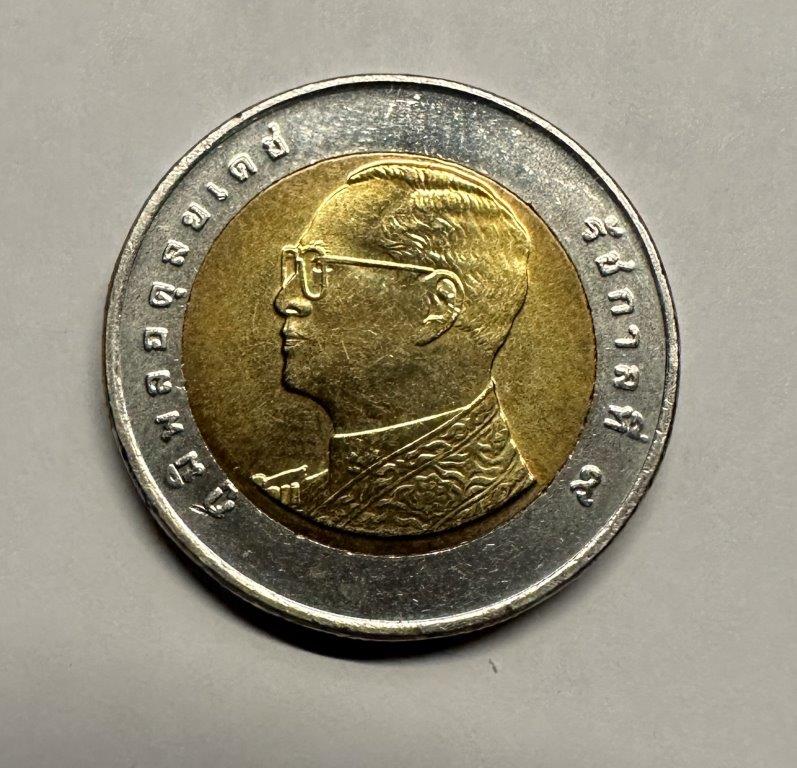
Some more trivia: the Thai king depicted on this coin (the "guy with the glasses") is Bumiphol Adulyadej, also known as Rama IX, who died the year after this coin was struck. At the time he was the world's longest reigning monarch, and the second-longest in recorded history after French king Louis XIV. Queen Elizabeth II overtook him not long before she passed away, so he now sits at number 3 in the record books. As one might surmise, after having such a long reign, his portrait appears on virtually all Thai coinage that you're likely to encounter. Note to Spence: his son and successor, Vajiralongkorn (also known as Rama X) doesn't wear glasses, not in public anyway, so that general rule (glasses = Thailand) will increasingly no longer apply.
Don't say "infinitely" when you mean "very"; otherwise, you'll have no word left when you want to talk about something really infinite. - C. S. Lewis












 Posted 11/10/2023 4:09 pm


