in September 1998, during the 105th Congress, Thad Cochran (R-MS) introduced a bill in the Senate that called for a three-coin commemorative program to "honor the founding of Biloxi, Mississippi." The bill was immediately referred to the Senate Committee on Banking, Housing, and Urban Affairs.
The bill called for the minting of up to 100,000 Gold Eagles ($10), up to 500,000 Silver Dollars and up to 750,000 Copper-Nickel Clad Half Dollar.
Biloxi is a relatively small city (2020 Population: ~49,500) in southeastern Mississippi located on the Gulf of Mexico - it's a "Gulf Coast" city! It traces its European roots to French colonists who arrived in the area on February 10, 1699, first going ashore at the location of present-day Biloxi on February 13, 1699. The French expedition was under the command of Pierre Le Moyne, Sieur d'Iberville; Le Moyne was operating under orders to locate the mouth of the Mississippi River.
Pierre Le Moyne, Sieur d'Iberville - Louisiana State Capitol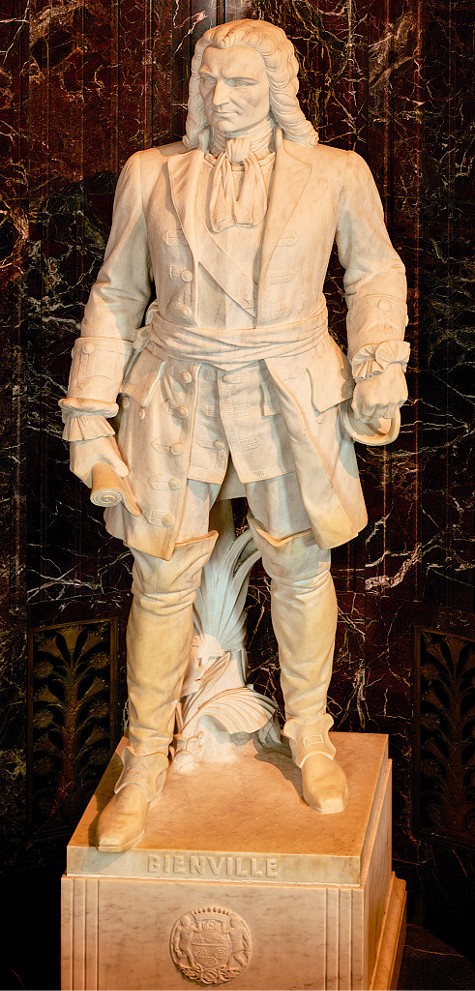 (Image Credit: Library of Congress, Prints and Photographs Division. Public Domain.)
During its history, Biloxi has been governed by the French, the English, the Spanish, the Republic of West Florida, the United States of America, the Confederate States of America and, again, the United States. In 1999, the city celebrated the tricentennial of the arrival of the French and the establishment of its initial settlement (Fort Maurepas - "Old Biloxi").
The Biloxi coins were to be dated "1999" and feature designs "emblematic of the landing of Pierre LeMoyne Sieur D'Iberville on the shores of present day Biloxi, Mississippi, on February 13, 1699." The sponsor of the coins, the Biloxi Tricentennial Commission, was to work with the Commission of Fine Arts and the Secretary of the Treasury to finalize the designs. The coins were only to be struck/issued in calendar year 1999.
The sales prices of the coins were to include surcharges of $35.00 for the Gold Eagle, $10.00 for the Silver Dollar and $1.00 for the Clad Half Dollar. The collected surcharges were to be paid to the Bilox Tricentennial Commission "for the purpose of planning and implementing the 1999 Tricentennial Celebration in Biloxi, Mississippi." Somewhat unusually - but with good forethought - the bill also made allowances for surcharge distribution post-Commission, specifying that "upon dissolution of the Biloxi Tricentennial Commission, Inc." surcharge funds were to go to Biloxi First, Inc., "for the purpose of funding educational projects directly related to local history instruction for students in the public school system in Biloxi, Mississippi." I can't help but wonder what level of surcharge funds would have made it to Biloxi First, Inc.
The bill stalled in Committee and was not reported out. It died when the 105th Congress adjourned in Decmber 1998.
Senator Cochran tried again with a duplicate bill in the 106th Congress, in February 1999, but as with his first attempt, the coin bill was not reported out of Committee.
The Tricentennial Commission was short on funds to fully execute the plans it had created for the 300th anniversary. The Commission forecasted that it would need ~$4 million to stage the celebration it had planned, but was forced to make do with ~$2 million. Had the coin bill passed and achieved modest success - sales of 30% of authorized maximums: 30,000 Gold Eagles, 150,000 Silver Dollars and 225,000 Clad Half Dollars (reasonable estimates for the time) - it would have received ~$2.7 million in surcharge funds - this would have given the Commission the full budget it needed, though it is likely that the collected surcharges would not have been paid to them until well into 2000 (i.e., after the 300th anniversary year).
The Commission spent much of the money it did receive on promotion and advertising, which included print, TV and billboard advertisements to generate interest, as well as on fireworks and a few other anniversary events.
Nothing against Biloxi, MI, but I'm not sure it passes the "national significance" test for commemorative coin worthiness.
For other of my posts about commemorative coins and medals, and more What If? stories from the classic and modern eras of US commemorative coins, see:
Commems Collection.Post Script: For a comical look at Biloxi, circa WWII, I would suggest checking out Neil Simon's "Biloxi Blues" starring Matthew Broderick and Christopher Walken (among others). It's an innocent, coiming-of-age movie that I have found to be an enjoyable viewing experience.






 Posted 11/16/2023 10:38 am


 but an interesting story


