| Author |
 Replies: 15 / Views: 1,701 Replies: 15 / Views: 1,701 |
|
|
Forum Dad
 United States
24225 Posts |
A new friend of mine on a metal detectiing forum has come across this coin... 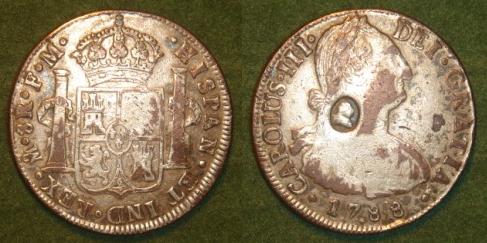 We are trying to determine if it's authentic or not, and if not where and when it might be from. Can you (or anyone) help please? Pretty please?  |
|
|
|
Pillar of the Community
United States
5362 Posts |
The coin is a counterfeit - some sort of plated base metal (my guess is a copper or bronze based on the color). The plate in this case does NOT appear to be Sheffield so it is not likely to be one of the counterfeits made in the 1790s that was marked with the oval C/S years later. It uses the portrait of Charles IV but calls it Charles III. That is a known forgery type illustrated in Riddell (made in the 1820-1840 era) but the dies are NOT the same. So it is possible that this is a modern counterfeit, but I prefer a theory of an earlier origin. Has the coin been accurately weighed and has anyone stated an opinion about the character (composition) of the silver plate? I would be very interested in either examining this particular coin. I am NOT familiar with the die pair.
|
|
New Member
United Kingdom
4 Posts |
Hi everyone. Its my coin that you're looking at in this thread.
I met your main man Bobby on a great Metal Detecting forum that we both use here in the UK. It was Bobby that alerted me to Swamperbobs interest in these coins. I realise its most likely to be a counterfeit but never the less I'm still very interested to hear any further views any of you may have. Thanks for your interest & input so far Swampy.
|
|
Forum Dad
 United States
24225 Posts |
Bob, he did weigh the coin, it's 27 grams.
Welcome marconorth!
|
|
Pillar of the Community
United States
5362 Posts |
The weight of 27 grams in a circulated condition points in the direction of a more modern forgery. It would be helpful to have the weight to the nearest 10th gram as a minimum. The typical counterfeit of the period before the hard times (1837) was about 97% of the correct weight. That translates to about 26.2 grams. Of the 282 coins documented by Dr. J.L. Riddell in 1844 only 8 weighed as much as 27.5 grams. Only about 10% of the 282 were overweight AT ALL with many in the 27.0 to 27.1 range. Later counterfeits, especially those made to be sent to China in the 1880s and 1890s, were NORMALLY overweight. Those were often made with countermarks so that they were readily accepable. Fake chop marks and fake Bank of England stamps abound. Of the roughly 100 of these late Chinese fakes that I have examined at least 60% weigh between 27.0 and 27.2 grams. They are often silver (quite often sterling silver 0.925 fine) and they were largely made in the US for merchants who dealt with China. They were made when silver prices in the US started to fall.
|
|
Pillar of the Community
Australia
1262 Posts |
Goodaye marconorth and welcome to this forum.
I hope you enjoy your stay here and look forward to reading your posts.
Feel free to ask any numismatic question that you need answered and our members will respond.
Good to have you with us.
|
|
New Member
United Kingdom
4 Posts |
Update.....27 gramms was the weight I obtained using my digital kitchen scales. I have since taken this coin to my local jewelers & it weighs in at exactly 26.02 grammes.
|
|
Pillar of the Community
United States
5362 Posts |
The weight of 26.02 grams is far more correct for a period counterfeit than 27 grams. An original 8R weighs 27.03 grams in MS and very rarely will an original be overweight. So it is obvious to everyone that a worn coin weighs less - but the key issue really is how much less is correct. The period counterfeiters knew the correct weight BUT they also knew that the average person had no idea how much silver really wears off a coin. So they would make the "counterfeits" look worn - but they would often make them full size (or just slightly larger) in copper or white metal. The worn looking coin was accepted by the "mark" usually because they overestimated how much metal wears off in normal circulation. A 26.02 gram coin in this condition looks like it would be "about right" but that is actually underweight. This is 96.26% of the original weight. If the plating was still intact I would bet that it would weigh about 26.2 grams. That is the lower limit a Merchant would be looking for on a scale - about 97% of the original weight. Remember that a counterfeit only has to pass once for it to be a success.
|
|
New Member
United Kingdom
4 Posts |
Great Forum,& what a top bunch of people you all are on here. Many thanks to Bobby for putting me onto Swamperbob. What that guy doesn't know about these coins, isn't worth knowing!. He is an absolute fountain of information.
|
|
Forum Dad
United States
24225 Posts |
Told ya!  Tell your friends. |
|
Pillar of the Community
United States
4589 Posts |
Hey swamperbob I am speechless rock on Brother
|
|
Pillar of the Community
United States
4589 Posts |
welcome marconorth yea these guys and gals are real good
|
|
Pillar of the Community
United States
5362 Posts |
scoutjim99 - my wife loves your new avitar - the combat infantry badge. Her Dad was very proud of his from WWII - he was in the Texas 36th and landed in the first waves at Salerno.
|
|
Pillar of the Community
United States
4589 Posts |
well thank you swamperbob I like it better than the one I had before that was proably scaring people and I always wanted a CIB now that I have one I would give back the experience just to live in piece. but thank you I am very proud just to wear just a device that my forefathers have so respectfully earned .
|
|
Pillar of the Community
United States
5362 Posts |
The coin that started this string - the 1788 Mo FM counterfeit 8R with the oval George III counterstamp, has arrived safely in North Carolina from its former home in the UK. It is definitely a "Sheffield Plate". The original scan/picture was not sharp enough to make that determination. However, in person there is no doubt whatsoever. There are sharp breaks in the plating at some points where the plating delaminated. However, because these areas are apparently "silvered" (and tarnished), I also believe that this one was resilvered somewhat later in life to make it pass a second time. A second proof of this second forgery is the fact that the silvering on the edge of some of the highest wear points appears to be a different form of plating over the original one. This coin will clearly require an XRF test to be positive.
This second attempt at passing a dollar forgery happened quite often. I own 10 or 12 similar coins silvered twice. In each case, an earlier plating layer had worn off exposing the core and then an electroplate or wash was applied over the whole coin. This second plate wears off exposing the core a second time. Making the forgery obvious. I guess it is simple greed that motivates the second silvering. In this case there are NO cancellation marks so it was an obvious candidate.
The coin was made overly thick to compensate for the fact that it is 90% copper or more. This accounts for the weight of just over 26 grams while having a Specific Gravity just below 9 which is perfect for this particular composition.
The edge design is a circle and square style which would perhaps fool a novice but the forger used an incorrect spacing and the edge was not applied on a two die edging mill.
I did get an exact match with a 1794 coin when I compared this coin with known Sheffield Plate counterfeits. That one also has the oval George III c/s. Unfortunately the 1794 is not tied to the 1796 issue of Birmingham, UK. It is thus far classified as of "Unknown Origin". In fact the 1794 mated with this Mo FM die has only been recently discovered and is known to me from a single exemplar. The 1794 portrait die is also paired in a rather common mating with an So DA die (Chile) and a few other shield dies including at least one OTHER Mo FM die with different letter spacings. That other Mo FM pairing is known from many examples and is listed in earlier sources. So this 1788 is a new member of a rather large "old" family of related forgeries. It definitely gives me hope that it will ultimately get tied back to the Birmingham area even if it can not be tied to one of the 15 documented die pairs from the original issue of 1796.
This one will require a lot of study and analysis before I can be absolutely sure of its age, but for right now I am leaning to a date of about 1820 at the latest. The resilvering would likely date to the 1840s or later.
Many thanks to Mark for bringing it to my attention and to Bobby for making the original post.
One other final thing about this coin. Did everyone know it was part of a limerick? It went something like - "The bank (Bank of England), In oder to make its money pass, stamped the Head of a Fool on the Neck of a butt."
|
|
New Member
United Kingdom
4 Posts |
Great post as always Swamperbob. I'm going to do a little reasearch myself on this coin. Hopefully I might be able to gather a little more info to enable you pinpoint the origin of this Counterfeit more accurately.
|
| |
Replies: 15 / Views: 1,701 |
|








 Posted 03/29/2006 4:10 pm


