|
This page may contain links that result in small commissions to keep this free site up and running.

Welcome Guest! Registering and/or logging in will remove the anchor (bottom) ads. It's Free!
To participate in the forum you must log in or register. | Author |
 Replies: 5 / Views: 894 Replies: 5 / Views: 894 |
|
|
Valued Member
United Kingdom
435 Posts |
Thought I'd share a little adventure I had identifying the subtype of Apollonia Pontica diobol. These types are notoriously faked often (see Black Sea fakes) and deserve to be treated with caution. So when I struggled to find another with the magistrate letters ΠΑ, themselves on the opposite side of the anchor to the usual types, as well as the crayfish and A in their reverse position to what is most often seen on the diobol denomination, I was more than nervous. But I did trust my instinct that the style looked good, the surfaces not worrying and the weight and dimensions as expected. I also compared it to every known fake I could find. Eventually, I found its type, exactly described, in a fairly obscure Polish publication. It's the rarest of the known magistrate types, only being known as about 1.7% of a single hoard, but had orinally been listed by Imhoof Blumer in 1908. The Polish article can be found at https://www.academia.edu/43524959/A..._at_ConstantApollonia Diobol. 400-360 BCE. Obv. Facing head of Apollo. Rev.Anchor, ΠΑ magistrate in right field, crayfish under left arm, A under right 1.47g, 10mm. Ref. Imhoof Blumer 1908, 142. CNT 7503 (Romanian Academy). Unlisted in SNG BM Black Sea and SNG Stancomb 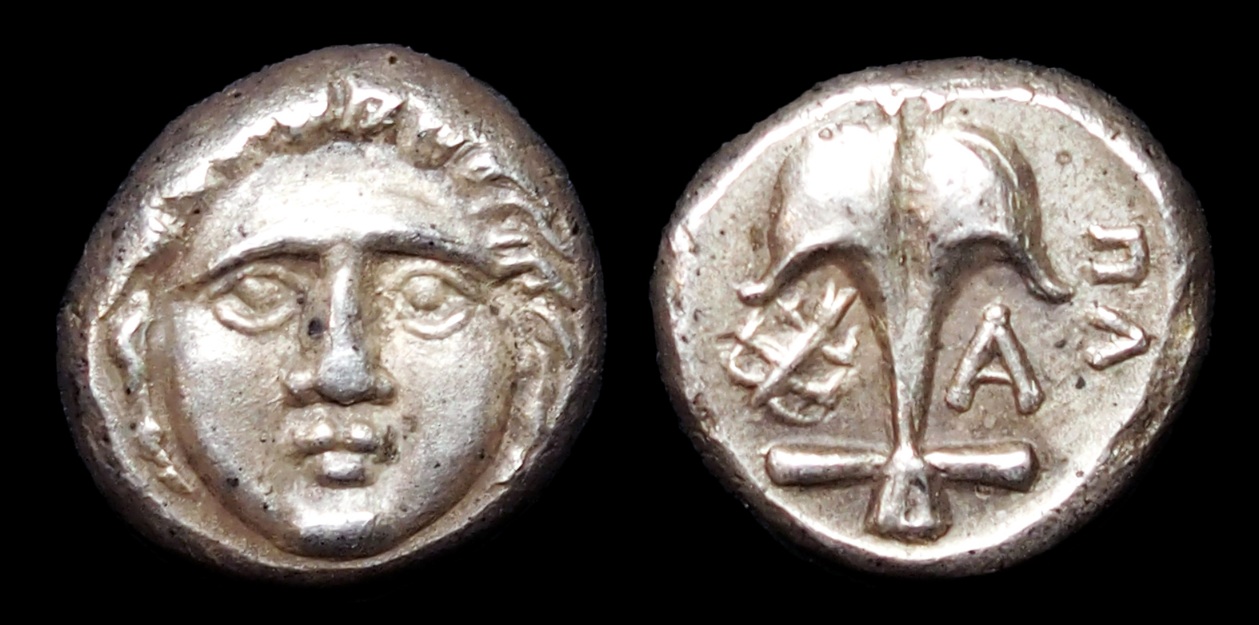 Edited by Valecrucis
11/20/2023 12:56 pm
|
|
|
|
Pillar of the Community
United States
5003 Posts |
Apollo looks great, not a bit of wear on that face...or anywhere! Great looking coin Valecrusis!
|
|
Valued Member
 United Kingdom
435 Posts |
Thanks chrsmat71. It's a lovely little coin, isn't it!. Such sensitivity in the facial expression, packed into a tiny coin. Tell me they didn't have great magnifying tools! I was really glad to find a reference for the precise type. That it was such a rare subtype, barely mentioned in the literature, gave me the reassurance I needed that it was genuine. Very happy with it!
|
|
Moderator
 United States
194816 Posts |
Happy to see a successful adventure. A very nice example!  |
|
Valued Member
France
332 Posts |
I have to tell you that something worries me a little bit with this coin. The surface show no trace of wear at all, they look too perfect to my eye. But what strikes me the more is the style : there is something clumsy, especially the eyes and the crayfish. I have really doubts about its authenticity. I hope of course to be wrong...
|
|
Valued Member
United Kingdom
435 Posts |
Hello ancient67,
I have to say I disagree with your conclusion. Of course, it's impossible to be absolutely certain, but to the degree that it's possible with these types I am confident now. That is not to say your observations are flawed. The surfaces are indeed very good and there is little wear. However that is not in itself a reason for concern, the surfaces look crystallised to the limited degree expected for its age and state and there are many other examples in a similar state of preservation. As for the crayfish, I agree with you about its style. That concerned me too (though of course the depiction is cruder on this denomination than the drachm).I did trawl through hundreds of these tho' and saw a number sold in good auctions that were equally 'odd'. My confidence grew when I saw the plate coins in that Polish article. Number 14, to which this type corresponds, looks similar (tho' the image is poor, so that in itself is inconclusive). What really gave me confidence is the logic of such a rare subtype. While it certainly does not exclude the possibility that someone created it as a fake, the fact that the exact magistrate type and arrangement of reverse symbols corresponds with a type known, but virtually unlisted in the literature, makes it unlikely candidate for either a cast copy or modern dies. Whilst of interest to me, the fact adds little to its overall value, so it would seem natural for a forger to copy one of the commoner types (usually a non-magistrate types, or a common magistrate type) to attract less attention. That is indeed the case for all the usual Apollonia fakes identified. Moreover, the style of Apollo does not have that clumsiness seen almost universally in other pressed or struck fakes, using modern dies. Again, there can be no certainty. I wouldn't even trust one of these Apollonia Pontica types 100% if a great expert vouched for them. However, within the limits of reason I feel satisfied
Edited by Valecrucis
11/21/2023 5:14 pm
|
| |
Replies: 5 / Views: 894 |
|
To participate in the forum you must log in or register.
Disclaimer: While a tremendous amount of effort goes into ensuring the accuracy of the information contained in this site, Coin Community assumes no liability for errors. Copyright 2005 - 2026 Coin Community Family- all rights reserved worldwide. Use of any images or content on this website without prior written permission of Coin Community or the original lender is strictly prohibited.
Contact Us | Advertise Here | Privacy Policy / Terms of Use
|
| Coin Community Forum |
© 2005 - 2026 Coin Community Forums |
| It took 0.25 seconds to rattle this change. |
 |
|
| |
| |






 Posted 11/21/2023 04:50 am


