| Author |
 Replies: 6 / Views: 854 Replies: 6 / Views: 854 |
|
|
Pillar of the Community
United States
1080 Posts |
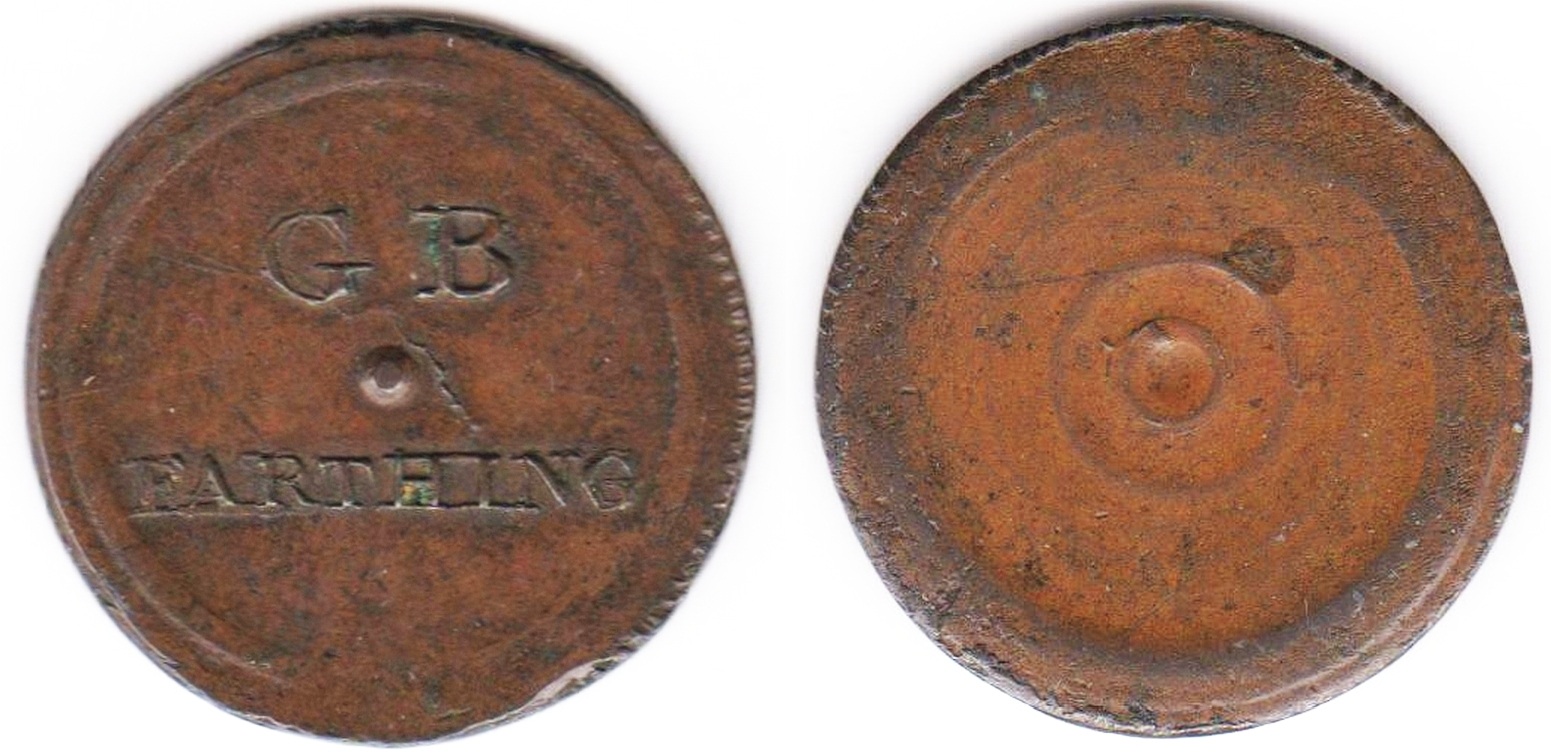 This unattributed British farthing token, presumed 1811-1820, is one of my handful of mystery pieces. Diameter 21mm, weight 2.5g. Withers 1735, Davis Not Local 119. Crude issue, not at all pretty, but quite sought after for its RRR rarity. My theory is that it was struck in haste by a button manufacturer. This unattributed British farthing token, presumed 1811-1820, is one of my handful of mystery pieces. Diameter 21mm, weight 2.5g. Withers 1735, Davis Not Local 119. Crude issue, not at all pretty, but quite sought after for its RRR rarity. My theory is that it was struck in haste by a button manufacturer.
Five years ago one of these -- an ex-Cokayne specimen and the Withers plate coin -- appeared in a Dix Noonan Webb auction with the phrase "almost certainly the only known specimen" in the lot description. I'd picked one up for a song in an ebay auction maybe five years earlier than that, so I contacted DNW and we basically established that "one of only two known" would be the best way to tag them going forward, until and unless more examples surfaced.
Some months later in some side correspondence, Andrew Wager, the Henry Morgan chronicler and Withers BCT contributor, pointed out that the "GB" might not signify "Great Britain." That's certainly possible, maybe even likely, but not a slam-dunk, as no one's published any hints one way or another as to issuer. Alternatively, the "GB" could represent a person or company, as is presumed to be the case with the many "GB" countermarks recorded as far back as Batty (1877) as appearing on 1806 Regal halfpennies. But as to whether this one is British at all...well, B.A. Seaby had it added to their 1979 reissue of Davis's 1904 catalogue, "The Nineteenth Century Token Coinage" and no one's questioned that pedigree yet.
If I can trip over a rare maverick like this on ebay, anyone can, so please check in if you've seen one of these or -- even better -- if you own one!
Any thoughts on issuer or similar pieces will be greatly appreciated as well.
My thanks to all!

"If everything seems to be under control, you're just not going fast enough."
--- Mario Andretti
|
|
|
|
Moderator
 United States
198004 Posts |
Very interesting!  |
|
Bedrock of the Community
United States
27514 Posts |
What an excellent scoop and score, daltonista! Hopefully you'll be able to work out an attribution for it.
Inordinately fascinated by bits of metal with strange markings and figures
|
|
Bedrock of the Community
United States
12057 Posts |
Looks as though you've already done a lot of the heavy lifting in regards to the provenance and attribution. Quite fascinating.
I wonder why it was struck, though. 21mm and 2.5 grams is certainly correct for a contemporary farthing. Are there any known examples in similar style for a halfpenny or penny?
Perhaps it was intended to test the viability of striking coins using button-making machinery and tooling, which would be in line with the origin of many of the trade tokens of the late 18th and early 19th c. It's plausible that at some point one of the enterprising button-makers in Birmingham or elsewhere may have decided to see if their equipment could be used to successfully carry out the production of tokens and struck this piece up as a trial strike or 'proof of concept.'
The thought that the use of the initials G B is a monogram or maker's mark is certainly not without precedent and is in line with how contemporary button-makers would have labelled their work.
Member ANA - EAC - TNA - SSDC - CCT #890 "Most of the things worth doing in the world had been declared impossible before they were done." -- Louis D. Brandeis |
|
Pillar of the Community
 United States
1080 Posts |
Great minds think alike, paralyse! See my opening paragraph in the original post.
To expand a bit on our shared theory, just last night another CCF member suggested in an otherwise off-topic email to me: "If it was made by a button manufacturer, I wonder if the B could stand for "buttons"?"
That would narrow the field down considerably...
 "If everything seems to be under control, you're just not going fast enough."
--- Mario Andretti
|
|
Bedrock of the Community
United States
12057 Posts |
Yes, I apologize for restating what you had already stated. I was working through my mind and just typing what I was thinking. Interestingly, your example is clearly better than CNG's coin (e-Auction 546, lot #861) which as you noted above has provenance to DN&W (2019), Cokayne (1945), Spink's (1913) - the Withers plate coin Entry #3519 from Spink's: 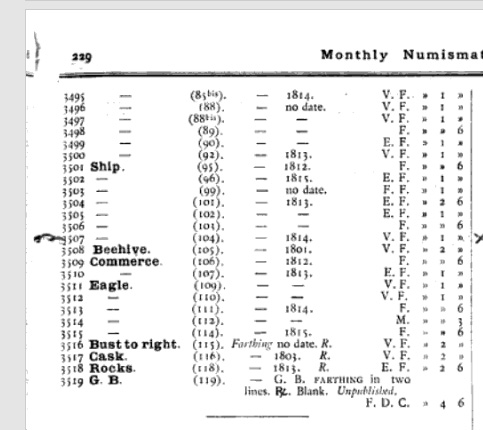 Too bad we can't take a journey back to 1913 and ask them where they got it from! They didn't seem to know much about it either but clearly seemed to think it FDC - odd, given its apparent condition, unless they fancied it a trial strike or pattern as well. Also, it brought $325.00 (£255.50) at CNG, quite a step up from Spink's listed price of 4/6... Member ANA - EAC - TNA - SSDC - CCT #890 "Most of the things worth doing in the world had been declared impossible before they were done." -- Louis D. Brandeis Edited by paralyse
12/19/2023 10:09 pm
|
|
Pillar of the Community
United States
1080 Posts |
Thank you, paralyse, for bringing that 1913 Spink listing into the discussion. It reminded me that I'd saved the DNW photo from 2019 and can therefore illustrate your point about condition.
How often do we get the chance to study the ONLY TWO of any coin or token in the same place?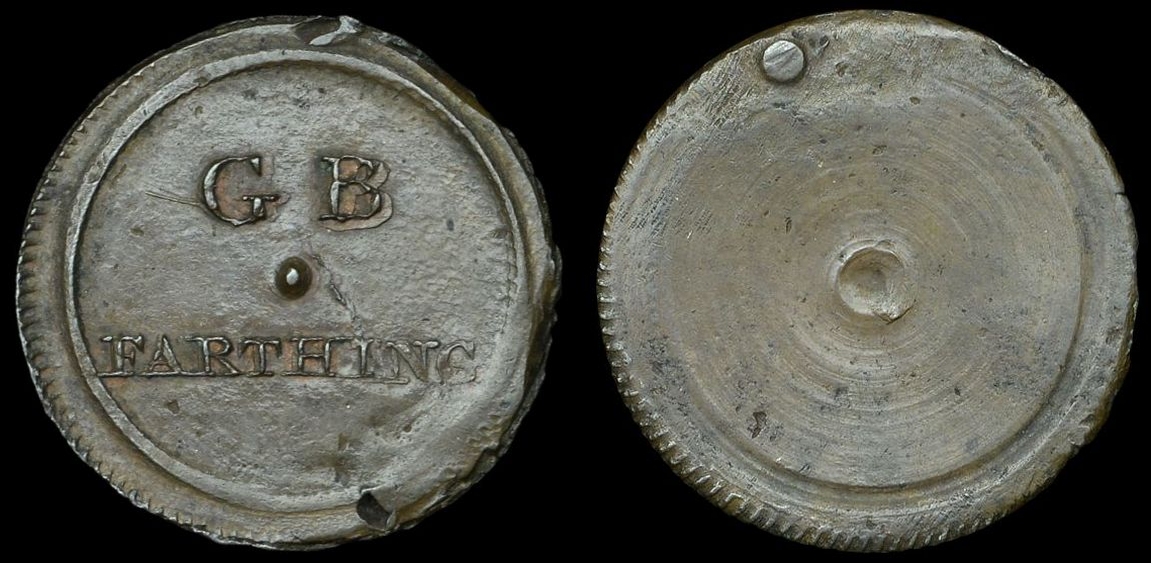 As for condition, I suppose FDC could have been a possibility if wear were the only factor under consideration, as the legends or lettering on both of these suggest they haven't seen much circulation, if any. Only the miserably beat-up planchet is holding this token back from its MS-65 aspirations! As for condition, I suppose FDC could have been a possibility if wear were the only factor under consideration, as the legends or lettering on both of these suggest they haven't seen much circulation, if any. Only the miserably beat-up planchet is holding this token back from its MS-65 aspirations! 
Studying these images closely, and factoring in all we can ascertain about the differences between them -- none of which is explainable by wear -- I've developed a few further thoughts on their production. In keeping with paralyse's conjecture, and on the premise that it would be irresponsible not to speculate, my best guess is that not only were these struck onto button blanks, but that the blanks were snatched randomly out of the button factory's reject bin, and that the final product that we're looking at today were cast aside as unacceptable, not to be seen again until one showed up in that 1913 Spink's fixed-price list. That my specimen would show up in an ebay listing a century later is almost a lightning-strike sort of event. (I was the only bidder...we British Regency Period token collectors are a special breed, few and far between!)
Interesting to see that in 1913 the G.B. Farthing token, though listed at the bottom of Spink's price list, bore the highest price, evidently due to its previously unpublished status. But also of interest is the item right above it, "3518 -- Rocks -- 1813, R," which would have to be the Anglo-Canadian Trade & Navigation farthing with the botched dies that was covered extensively in the CCF Canadian Tokens forum, starting 09/12/21 here: http://goccf.com/t/163981&whichpage=50.
Happy Holidaze to all!
"If everything seems to be under control, you're just not going fast enough."
--- Mario Andretti
|
| |
Replies: 6 / Views: 854 |
|
To participate in the forum you must log in or register.
Disclaimer: While a tremendous amount of effort goes into ensuring the accuracy of the information contained in this site, Coin Community assumes no liability for errors. Copyright 2005 - 2026 Coin Community Family- all rights reserved worldwide. Use of any images or content on this website without prior written permission of Coin Community or the original lender is strictly prohibited.
Contact Us | Advertise Here | Privacy Policy / Terms of Use
|
| Coin Community Forum |
© 2005 - 2026 Coin Community Forums |
| It took 0.33 seconds to rattle this change. |
 |
|




 Posted 12/19/2023 12:01 am





