










 Posted 12/25/2023 5:59 pm


Unfortunately, this item is neither Byzantine, nor a coin.
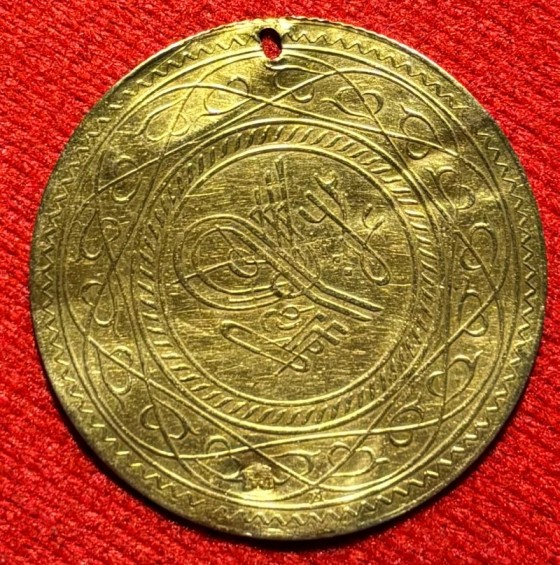
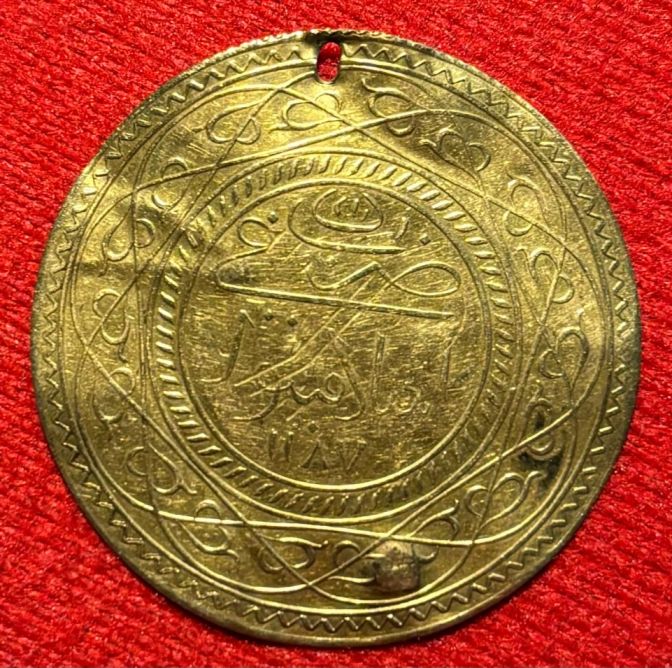
This is a jewellery imitation of an Ottoman Empire gold coin. The design is based on the gold altin of Sultan Abdulhamid I, who ruled 1774-1789, minted in "Islambul" (which we now call Istanbul); here's a genuine example. Your coin has somewhat garbled Arabic inscriptions, and the regnal date numerals are just random scribbles. These imitations are designed to "look good at first glance", but not stand up to close-up scrutiny. Your item is most likely much more modern than thhe 1789 date implies, mid 20th century at the earliest.
These "jewellery imitations" were worn in Turkey and elsewhere in the Middle East by women (hence the punched hole). Genuine coins were also punched and worn by women, which is why the genuine example I linked to above is also holed. These imitations are often called "belly dancer coins", though this is an oversimplification - holed coins were part of every woman's formal and festival outfit. Poorer women who could not afford genuine gold coins would have cheap gilt or brass imitations instead.
So, the big question: is your coin gold? You would need to get it tested - but my assumption would be no, it is not. Most of these replicas are not made of gold - if the woman could afford a genuine gold coin, she would have bought one, and not bought an imitation.
This is a jewellery imitation of an Ottoman Empire gold coin. The design is based on the gold altin of Sultan Abdulhamid I, who ruled 1774-1789, minted in "Islambul" (which we now call Istanbul); here's a genuine example. Your coin has somewhat garbled Arabic inscriptions, and the regnal date numerals are just random scribbles. These imitations are designed to "look good at first glance", but not stand up to close-up scrutiny. Your item is most likely much more modern than thhe 1789 date implies, mid 20th century at the earliest.
These "jewellery imitations" were worn in Turkey and elsewhere in the Middle East by women (hence the punched hole). Genuine coins were also punched and worn by women, which is why the genuine example I linked to above is also holed. These imitations are often called "belly dancer coins", though this is an oversimplification - holed coins were part of every woman's formal and festival outfit. Poorer women who could not afford genuine gold coins would have cheap gilt or brass imitations instead.
So, the big question: is your coin gold? You would need to get it tested - but my assumption would be no, it is not. Most of these replicas are not made of gold - if the woman could afford a genuine gold coin, she would have bought one, and not bought an imitation.
Don't say "infinitely" when you mean "very"; otherwise, you'll have no word left when you want to talk about something really infinite. - C. S. Lewis


