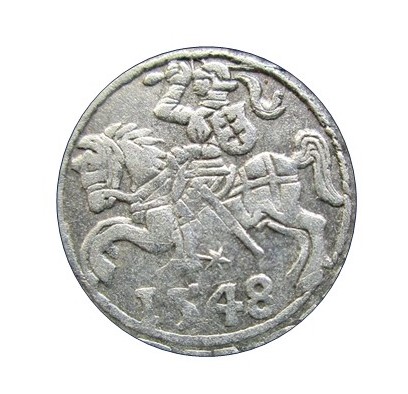
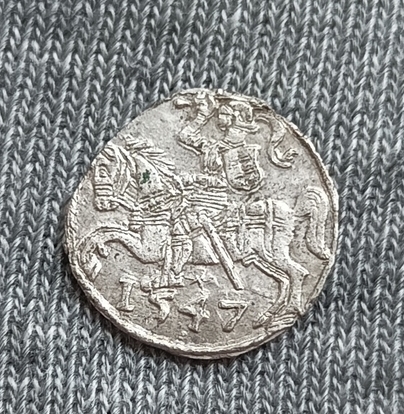
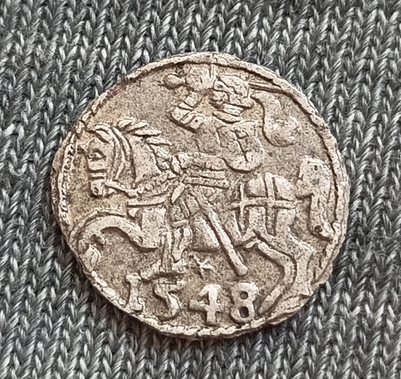
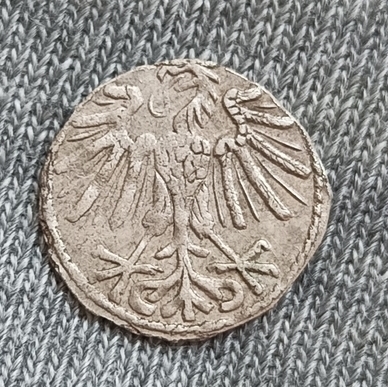
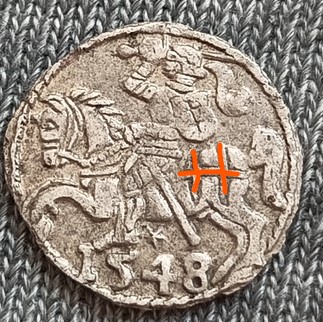
OK, so both are denars of Sigismund August, king of Poland and grand duke of Lithuania. Years 1547 and 1548 are pretty rare so I'm suspicious about these coins. They are too heavy (0.53 grams per coin) when compared to a catalogue (0.32 grams), diameter is fine tough (13 mm).
The second doubt is this below part - back of the horse armament. There are two vertical elements however all coins found in internet have just one... These two vertical elements are found on 1/2 grossus coins from this period...
Could somebody share some knowledge regarding this please?
I hope @giedrius will comment on your question, because he is certainly our foremost expert on Lithuanian coins at CCF.
I agree that your observations suggest these are fakes. If I compare them to the small number of examples in the WCN archive, I also see the difference you mention. And Gumowski says the weight was specified at 0.32 gr.
You could also send the photos to Mr. Kondrat at WCN for his opinion.
Quote: The second doubt is this below part - back of the horse armament. There are two vertical elements however all coins found in internet have just one... These two vertical elements are found on 1/2 grossus coins from this period...
Between that and the large weight with normal diameter, I wonder if someone had cut out the middle circle from a (presumably much less rare) 1/2 grossus; it would be about the right size, I think, but it's hard to estimate from pictures.
I don't think I can rule out those being real denars, though.
Quote: I wonder if someone had cut out the middle circle from a (presumably much less rare) 1/2 grossus; it would be about the right size
YES!!! Of course this is the answer. My half groats measure 20 mm. So, cutting the coin down to 13 mm would remove about 58% of the weight, and yield a fake denar of about 0.5 gr. And both dates are common for the half groat. So the trickster takes a $20 coin and makes it a $200 fake.
Here is what I get if I trim my 1548 half groat to 13 mm with photo editing:
Haha, I've just wanted to suggest this. I bought them in a lot with several 1/2 grossus coins and it fits. I'm happy as I bought them for little money and having this kind of 'counterfeit' is a interesting example.
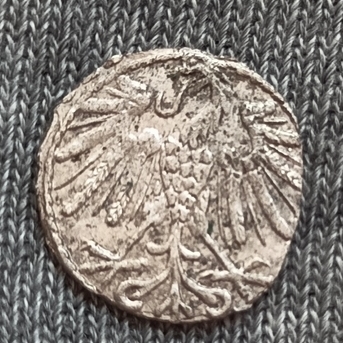
On the eagle side of the 1547 coin, there appear to be some traces of a legend just outside the circle at top left (10-11h). Looks like it would have said DVX on the polgrosz and I think the traces are consistent with that.
Interesting coins! I also suspect (sadly) that the clipping is modern, but it's definitely intriguing to speculate.
Yes, all these denars are intended to deceive collectors. These are the middle parts of halfgroats, they are larger in diameter and have two straps on the side of the horse. There is one belt on the side on the original denar.
Disclaimer: While a tremendous amount of effort goes into ensuring the accuracy of the information contained in this site, Coin Community assumes no liability for errors. Copyright 2005 - 2026 Coin Community Family- all rights reserved worldwide. Use of any images or content on this website without prior written permission of Coin Community or the original lender is strictly prohibited. Contact Us | Advertise Here | Privacy Policy / Terms of Use









 Posted 06/27/2024 04:27 am