I had not heard of Attaea where this latest and uncommon coin was struck, so was keen to find out more of the background to the city. It quickly became apparent that there was some confusion as to where it was actually located. Attaea, Attea, Attaia, Attia and Attalia all appeared to be the same place, but this is another city that seems to only be known by it's coins with no known history. Two possible locations are shown in the Barrington Atlas, but no history of the city was found.
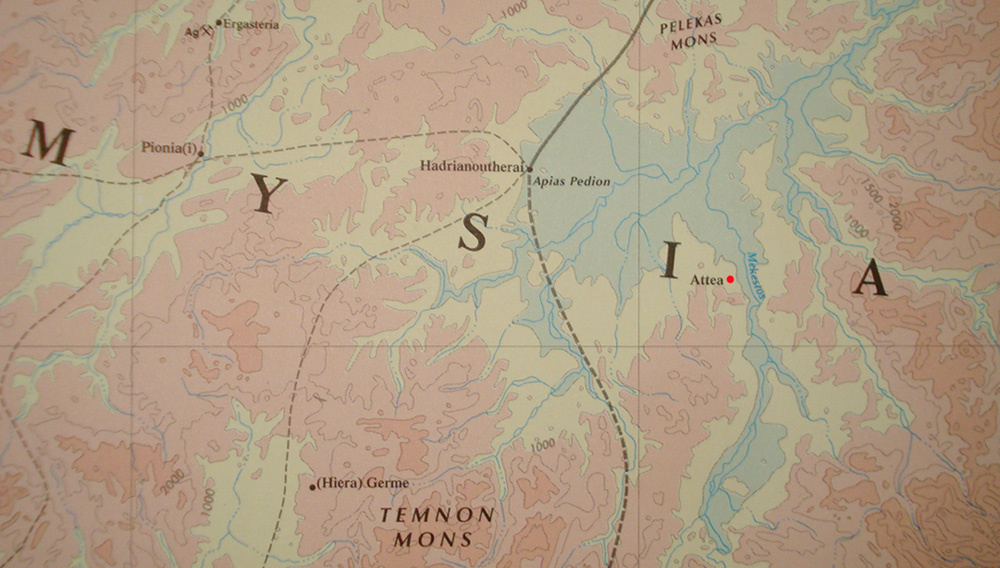
From the RPC site: City: Attaea. Other names: Attea. Region: Mysia. Latitude: 39.515977. Longitude: 28.115927. Ethnic: ΑΤΤΑΙΤΩΝ.
From Wikipedia:
Attaea or Attaia was a city of Classical Anatolia in the region of the Caicus River or Lycus River. It minted coins inscribed "ΑΤΤΕΑΤΩΝ" from Caracalla's time simultaneously with those who have the legend "ΑΤΤΑΙΤΩΝ." It was also the site of a bishopric and was an important site for early Christianity. Attaea is today a titular see of the Roman Catholic Church in the ecclesiastical province of Ephesus. Its site seems to be at Ajasmat Koi on the right bank of Ajasmat Chai, 3 kilometres (1.9 mi) east of the Sunabai shore.
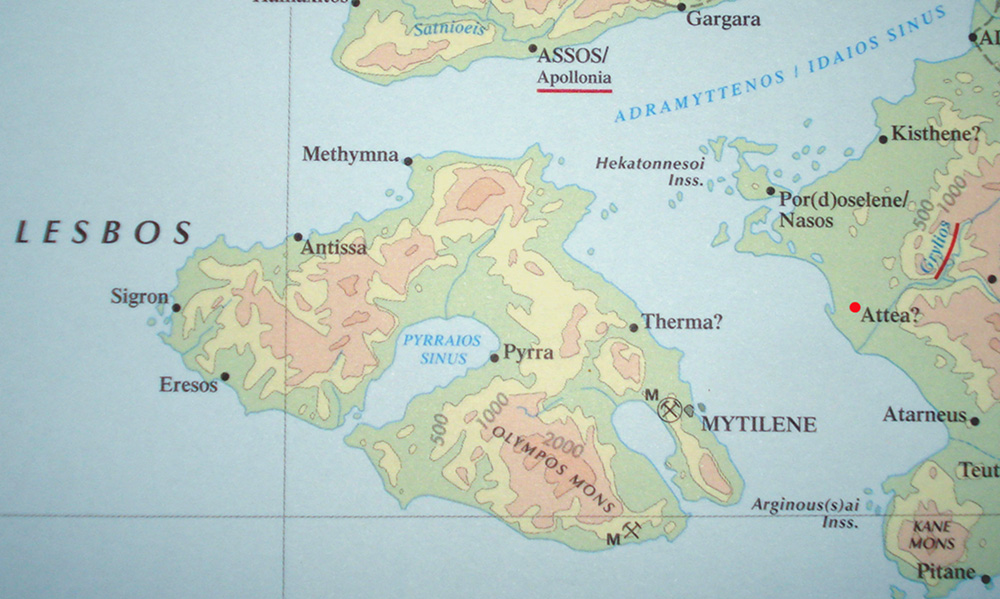
The Dbpedia org page, About: Attea, reads:
Attea was a coastal town of ancient Mysia or of Aeolis. If we follow the order of Strabo's enumeration, it lay between Heracleia and Atarneus. It has been conjectured that it is the same place which is named Attalia in the Peutinger Table. Pliny the Elder mentions an Attalia in Mysia, but he places it in the interior; and he also mentions the Attalenses as belonging to the conventus of Pergamum. It seems, then, there is some confusion in the authorities about this Attalia; and the Lydian Attalia of Stephanus of Byzantium and this Attalia of Pliny may be the same place. Also, attempts to equate the town with Attaea, a later bishopric near Ephesus, have likewise proved unsatisfactory. Its site is located near Maltepe, Ayazment, Asiatic Turkey.
The paper; "Trojan War Locale Numismatic Evidence Attea (Attia)", on Academia edu says: Near seacoast west of Pergamon. May have hosted Trojan War battles.
Extract from: The Madra Cay Delta Archaeological Project, First Preliminary Report: Geomorphological Survey and Borehole Sampling of the Altinova Coastal Plain on the Aegean Coast of Northwest Turkey. (January 1996)
Schuchhardt stated that antiquities had been marked on the hill of "Assar- Kaya" (c. 1 km. north-northwest from modern Salihler) by Kiepert, but in 1899 the former scholar could find no trace of remains there, only on a foothill to the west known as "Taschagyl" (Schuchhardt 1899: 144, 146). Today one of the peaks north of Salihler is still called "Asarkaya", but the only nearby toponym of Tasagil is that associated with a low knoll 1 km south-southeast from the modern Salihler village. Whether, therefore, the remains marked by Schuchhardt on his "Taschagyl" hill to the west of Salihler (as on the early map of Berlet in Conze et al. 1912: pl. I) are to be equated with the modern toponym still requires clarification. (see note 4)
Note 4: Schuchhardt twice mentions Kiepert as the source of the claim that remains existed on a hill named "Assar-Kaya" in this area (1899: 144, 146), stating that Kiepert equated these remains with ancient Attea (ibid.: 146). Unfortunately, Schuchhardt fails to indicate to which of (H.) Kiepert's maps (or R. Kiepert's geographical commentaries) he is referring, and on all of the H. Kiepert's maps we have been able to locate it is Karene which seems to be marked at TaSagil/Assar-Kaya, not Attea (see Appendix). However, in (R.) Kiepert's commentary on his father's Formae Orbis Antiqui (1909: 3), the author support's Schuchhardt's claim, reaffirming that his father once placed Attea at Assar-Kaya, although on which of H. Kiepert's maps or topographical discussions this association is published is not stated.
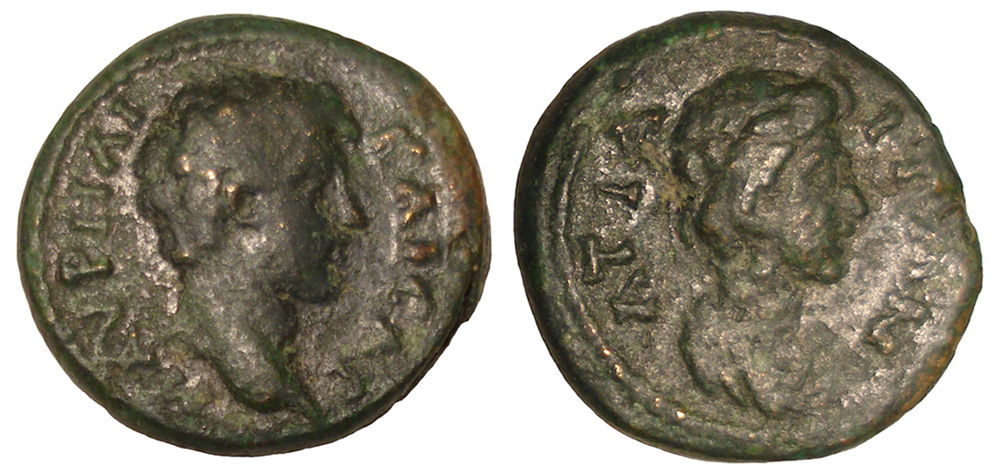
Attaea in Mysia. Antoninus Pius (138-161) with Marcus Aurelius (Caesar).
Obverse: Draped laureate bust of Marcus Aurelius right. Obverse inscription: M AVPHΛI KAICAP. Reverse: Draped youthful bust of the Roman Senate. Reverse Inscription: ATTAITΩN. Bronze. Diameter: 16 mm. Weight: 3.52 gr.
Reference: RPC IV.2, 461




 Posted 07/26/2024 07:18 am





