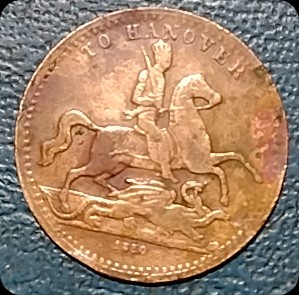
This is a class of brass token called a "Cumberland Jack" - so named because the figure on the horse is the
Duke of Cumberland, Ernest August. What he's doing on that token is a brief bit of history trivia.
William IV of Great Britain was not just king of Great Britain, he was also king of his ancestral homeland of Hanover, in Germany, as his predecessors had been ever since the time of George I. Ernest was the younger brother of, and nearest living male heir to, king William IV when William died in 1837. Under Germanic traditional law, women were ineligible to inherit the throne and become monarchs in their own right. So while Victoria was recognized as rightful queen in Britain, Ernest was recognized as king in Hanover.
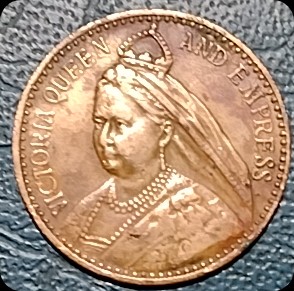
Now, the Duke had made himself quite unpopular in Britain, thanks to numerous scandalous reports of his infidelity and the allegations of a couple of murders of his servants. William IV had openly hated him. Thus this token mocks the old Duke: off he goes to Hanover, leaping over the dead body of the two-headed dragon (representing the formerly dual kingdoms of Britain and Hanover) in his haste. The political message was obvious, especially when combined with the obverse portrait of Victoria: "good riddance to the Duke of Cumberland, the Germans can keep him. We'll keep our Queen Victoria, thank you very much".
Now, this token is indeed not as old as the usual "young head" type, which were mostly made in the 1840s and 1850s; the portrait of Victoria is much older, and shows the ceremonial veil of mourning Victoria wore after the death of her husband in 1861. She also wears the miniature crown made for her for the 1887 Jubilee, and includes in her titles the title "Empress", which was not formally given to her until 1876. The token thus must have been made after 1887. Which makes the reverse depiction of Ernest rather anachronistic, given he had died in 1851.
The reverse design also superficially resembles the British gold coin known as a sovereign, which depicts Saint George slaying a dragon. This is intentional, but also the intent was not to have the design resemble a sovereign too closely, lest the manufacturer be charged with counterfeiting.
For the purpose of these tokens was not to fool anyone into thinking it was gold, or a sovereign, but much more mundane: they were made and sold by the token factories of Birmingham, and sold with packs of cards, to be used as counters or gambling chits. in that sense they are related to the "in memory of the good old days" false guineas, which were also made as card game counters.
Don't say "infinitely" when you mean "very"; otherwise, you'll have no word left when you want to talk about something really infinite. - C. S. Lewis












 Posted 08/15/2024 09:11 am


 to CCF.
 Uncirculated American Silver Eagles


