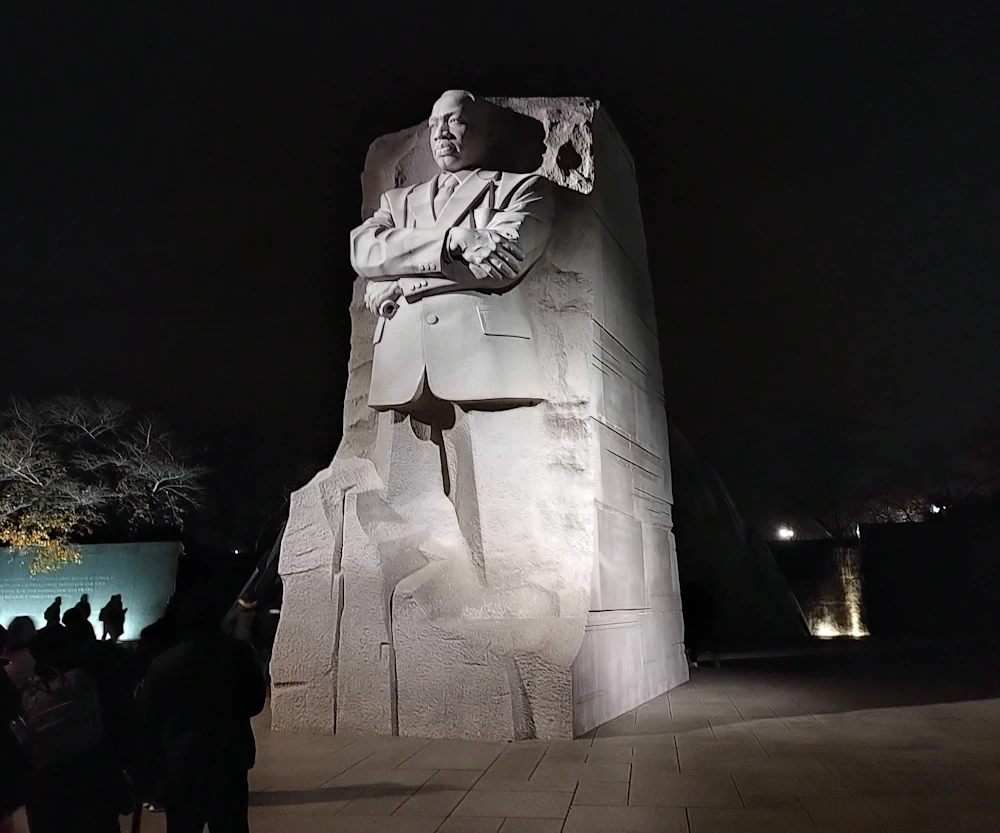
Between March 2000 and February 2004, no less than seven bills were introduced between the House of Representatives and the Senate that called for a commemorative coin program in honor of a fallen civil rights leader - Dr. Martin Luther King, Jr.
The four Senate bills were each introduced by Mary L. Landrieu (D-LA); the three House bills by James A. Leach (R-IA); all of the bills were introduced between the 106th and 108th Congresses.
The "Findings" section of the original legislation was repeated in future versions of the bill and provides a brief history of Dr. King (Items 1 through 5) and the driver behind the coin proposals (Item 6).
"Congress finds that--
"(1) Dr. Martin Luther King, Jr. dedicated his life to securing the Nation's fundamental principles of liberty and justice for all its citizens;
"(2) Dr. Martin Luther King, Jr. was the leading civil rights advocate of his time, spearheading the civil rights movement in the United States during the 1950's and 1960's;
"(3) Dr. Martin Luther King, Jr. was the keynote speaker at the August 28, 1963, March on Washington, the largest rally of the civil rights movement, during which, from the steps of the Lincoln Memorial and before a crowd of more than 200,000 people, he delivered his famous "I Have A Dream" speech, one of the classic orations in American history;
"(4) Dr. Martin Luther King, Jr. was a champion of nonviolence, fervently advocated nonviolent resistance as the strategy to end segregation and racial discrimination in America, and was awarded the 1964 Nobel Peace Prize in recognition of his efforts;
"(5) all Americans should commemorate the legacy of Dr. Martin Luther King, Jr. so "that one day this Nation will rise up and live out the true meaning of its creed: We hold these truths to be self-evident; that all men are created equal."; and
"(6) efforts are underway to secure the personal papers of Dr. Martin Luther King, Jr., for the Library of Congress so that they may be preserved and studied for generations to come."The four Senate bills each called for the striking of 500,000 Silver Dollars. Each of the House bills called for a three-coin program consisting of a Gold Half Eagle, Silver Dollar and Copper-Nickel (CuNi) Clad Half Dollar. The House bills consistently requested 50,000 Gold Half Eagles and 350,000 Silver Dollars, but varied in the number proposed for the Clad Half Dollars with request ranging from an initial one (1) million to five (5) million in follow-up bills.
The bills, whether for a single silver dollar or a three-coin set specified designs that were "emblematic of the inspirational life and works of Dr. Martin Luther King, Jr." Six of the bills specified a coin date of 2003, the seventh (proposed in 2004 in the Senate) specified a date of 2009.
Surcharges for the Gold/Silver/Clad coins was $35/$10/$3, respectively. Collected surcharge funds were to be paid to the Dr. Martin Luther King, Jr., Legacy Fund of the Library of Congress "for the purpose of securing the personal papers of Dr. Martin Luther King, Jr., for the Library of Congress."
The Committee structure changed a bit in the House over the Sessions of Congress in which the MLK bills were introduced:
First House Bill: 2000
Initial Referral: House Committee on Banking and Financial Services
Sub-Referral: Subcommittee on Domestic and International Monetary Policy
Second House Bill: 2001
Initial Referral: House Committee on Financial Services
Sub-Referral: Subcommittee on Domestic Monetary Policy, Technology and Economic Growth
Third House Bill: 2003
Initial Referral: House Committee on Financial Services
Sub-Referral: Subcommittee on Domestic and International Monetary Policy, Trade, and Technology
Matters were more consistent in the Senate, with all four of its bills referred to the Senate Committee on Banking, Housing, and Urban Affairs.
In all cases, however, the bills were held in Committee and never reported out for full consideration. Congress did, however, in 2004, authorize a Congressional Gold Medal for Dr. King and his wife Coretta Scott King.
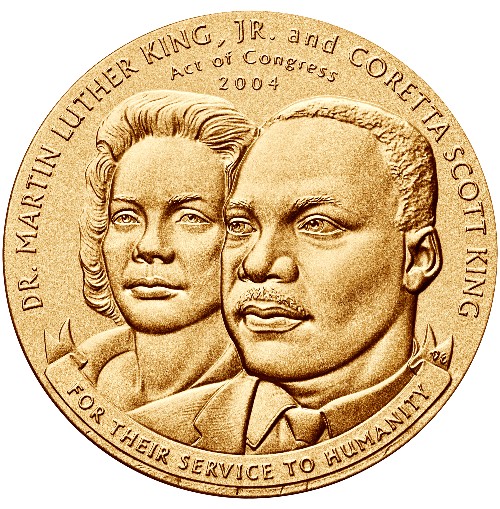
 (Image Credit: US Mint.)
For more details on the medal, see:
-
Remembering Martin Luther King, Jr.The centennial of Dr. King's birth takes place in 2029. It seems a fair bet that one or more coin proposals will be introduced to recognize the milestone.
For more of my topics on commemorative coins and medals, including other Modern US Commemorative Coin stories, see:
Commems Collection.




 Posted 11/01/2024 3:54 pm