| Author |
 Replies: 29 / Views: 2,044 Replies: 29 / Views: 2,044 |
|
|
|
Pillar of the Community
 United States
7174 Posts |
Quote:
It occurs as an oxidation product of zinc ores and as post mine incrustations No zinc in a 75. |
|
Pillar of the Community
 United States
8929 Posts |
Quote:
No zinc in a 75. I thought they were 95% copper and 5% tin and or zinc? The reason for my earlier post with a link to another thread on this site was to show the somewhat straight strip, similar to the OP's coin. Depending on what may be in this strip, could have caused the corrosion. Just a thought. -makecents-
|
|
Pillar of the Community
United States
1501 Posts |
Yes, I put the two concepts together thinking of a damaged coin with zinc exposed, so a mistake on my part... True, a 1975 Lincoln Memorial cent should be composed of bronze? (95% copper and 5% zinc)?... I suppose it would be highly unlikely, although possible that hydrozincite could form on such a bronze cent even if it is exposed to a harsh, moisture-filled environment and heavy weathering... more unlikely for smithsonite which, as I now understand, would require the same type of environment, as well as a source of carbonate ions in the environmental exposure. I wonder what is underneath that encrustation or whatever it is. I also wonder what it actually is, and how one could analyze it to find out. I still think it looks pretty cool. |
|
Pillar of the Community
United States
8929 Posts |
Alright then, I guess my thought process is different than most....
-makecents-
|
|
Pillar of the Community
 United States
985 Posts |
Weight of the coin is 3.13.
I am hesitant to mess with the coin in order to see what is beneath the oxidation.
"We are all flawed, some MD and some PMD." NYI |
|
Pillar of the Community
United States
8929 Posts |
And I'm out....
-makecents-
|
|
Bedrock of the Community
United States
27036 Posts |
Copper sulfate is blue - if sulfuric acid was dripped on the coin, it would form.
Inordinately fascinated by bits of metal with strange markings and figures
|
|
Pillar of the Community
United States
1501 Posts |
Quote:
Copper sulfate is blue - if sulfuric acid was dripped on the coin, it would form. That is plausible. So same as first response and many others... Likely corrosion from environmental conditions, whether purposefully or not. Whatever caused it, reacted with the alloy and below would likely be a pitted or damaged surface. Edited by igwt79
12/03/2024 04:36 am
|
|
Pillar of the Community
United States
985 Posts |
Thank you all for the very interesting and enlightening responses. I've been getting curious to see what's below the blue oxidation strip. If I cave to my curiosity I will share the findings with the community.
"We are all flawed, some MD and some PMD." NYI |
|
Pillar of the Community
United States
985 Posts |
Curiosity got the best of me and I'm surprised to find nothing under the oxidation...... 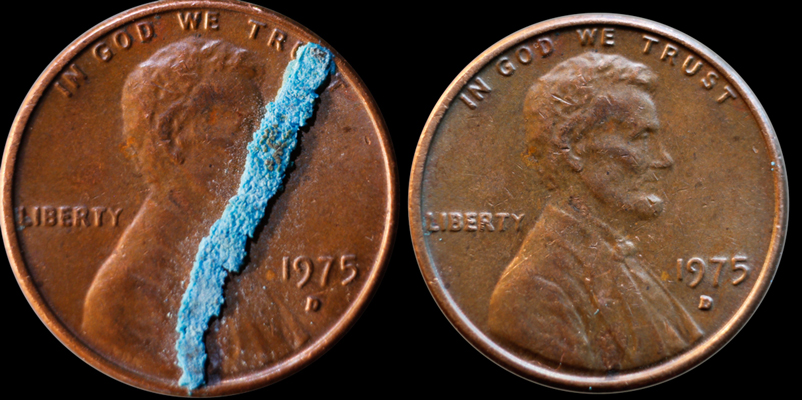 "We are all flawed, some MD and some PMD." NYI |
|
Bedrock of the Community
United States
27036 Posts |
Very curious, NY Islander. As there's no traumatic injury to the coin where the crud was, I'm thinking it was a rubber band.
Inordinately fascinated by bits of metal with strange markings and figures
|
|
Pillar of the Community
United States
3535 Posts |
Could have been someone's Science Experiment.
|
|
Moderator
United States
193736 Posts |
Quote:
Curiosity got the best of me and I'm surprised to find nothing under the oxidation......  |
|
Pillar of the Community
United States
1501 Posts |
Well, I was completely wrong!
Interesting outcome... Thanks for sharing!
|
| |
Replies: 29 / Views: 2,044 |








 First Page


 Posted 12/02/2024 5:41 pm


